Clarification, September 24, 2026: This article originally gave Maryland's statewide enrollment total without saying what the figure counted. It covers kindergarten through grade 12 and excludes prekindergarten. No number has changed.
This is part of The MDEdTribune's series on Maryland's 2025-26 enrollment data.
Five years after COVID emptied Maryland classrooms, the state expected students to come back. They did not. Of the state's 24 school systems, only four have returned to their 2019-20 enrollment levels: Frederick↗ET, Carroll↗ET, Wicomico↗ET, and Charles↗ET. Together, those four districts enroll roughly 13% of the state's public school students. The other 87% attend school systems that remain below where they stood before the pandemic.
The deficit is not closing. It is growing. In 2025-26, Maryland posted its largest single-year enrollment drop since the COVID crash. The state's 849,698 students in kindergarten through 12th grade represent its lowest total since 2016, erasing a decade of growth in five years.
The plateau that wasn't
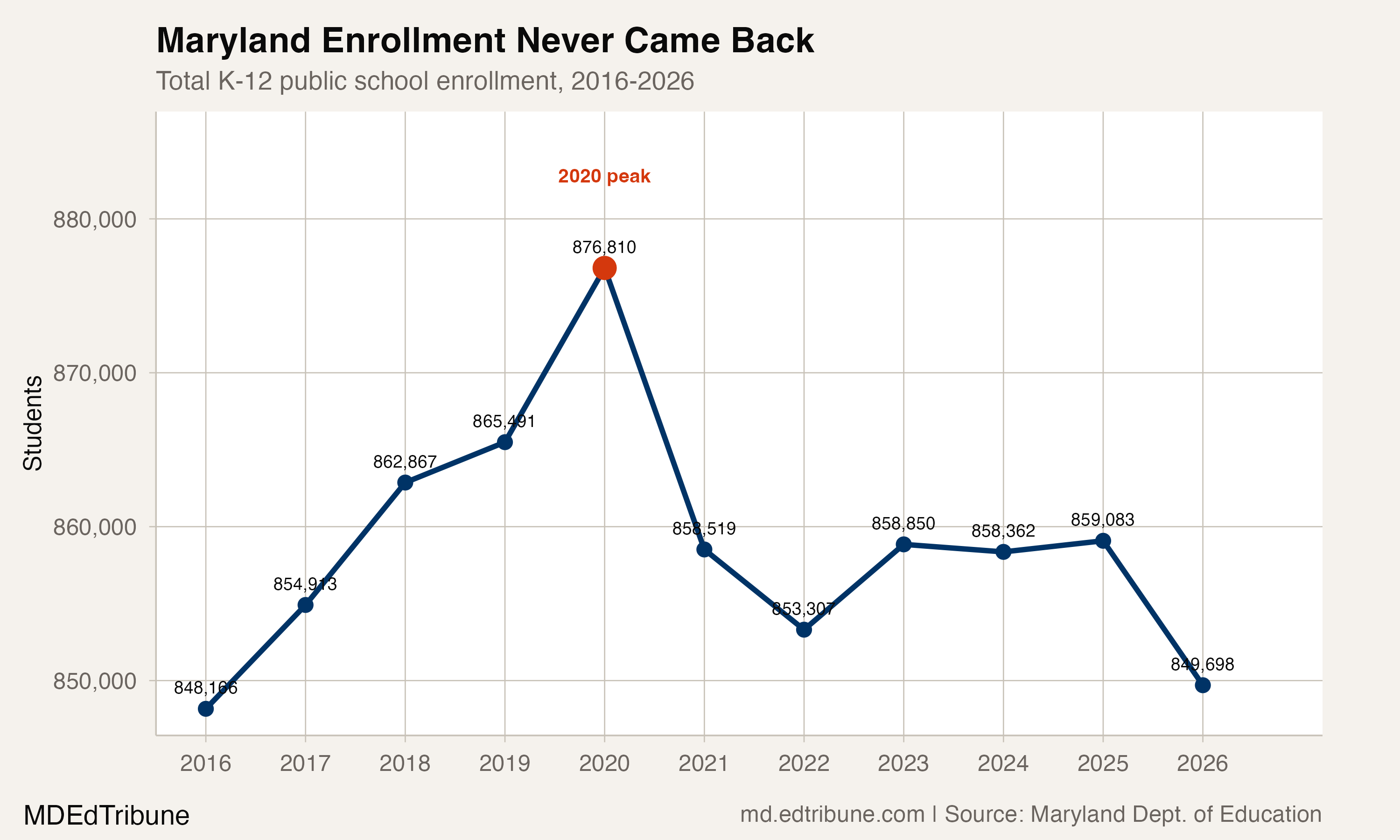
Maryland's enrollment trajectory since 2020 tells a story of false hope. The state lost 18,291 students in the pandemic's first year, then partially recovered. A 5,543-student rebound in 2022-23 suggested the bottom had been found. State officials at the Maryland Department of Planning projected modest growth, anticipating an increase of roughly 2,500 students in 2025-26.
Instead, enrollment fell by 9,385, a swing of nearly 12,000 students from projections. Geoff Sanderson, the state's schools accountability chief, told The Baltimore Banner that the scale of the decline caught the state off guard:
"Admittedly, this fall was a bit of a surprise to us."
The surprise was not that enrollment fell. It was that the decline accelerated after three years of apparent stability. From 2023 to 2025, state enrollment held nearly flat, fluctuating within a range of 800 students. Then the floor dropped.
Where the students aren't
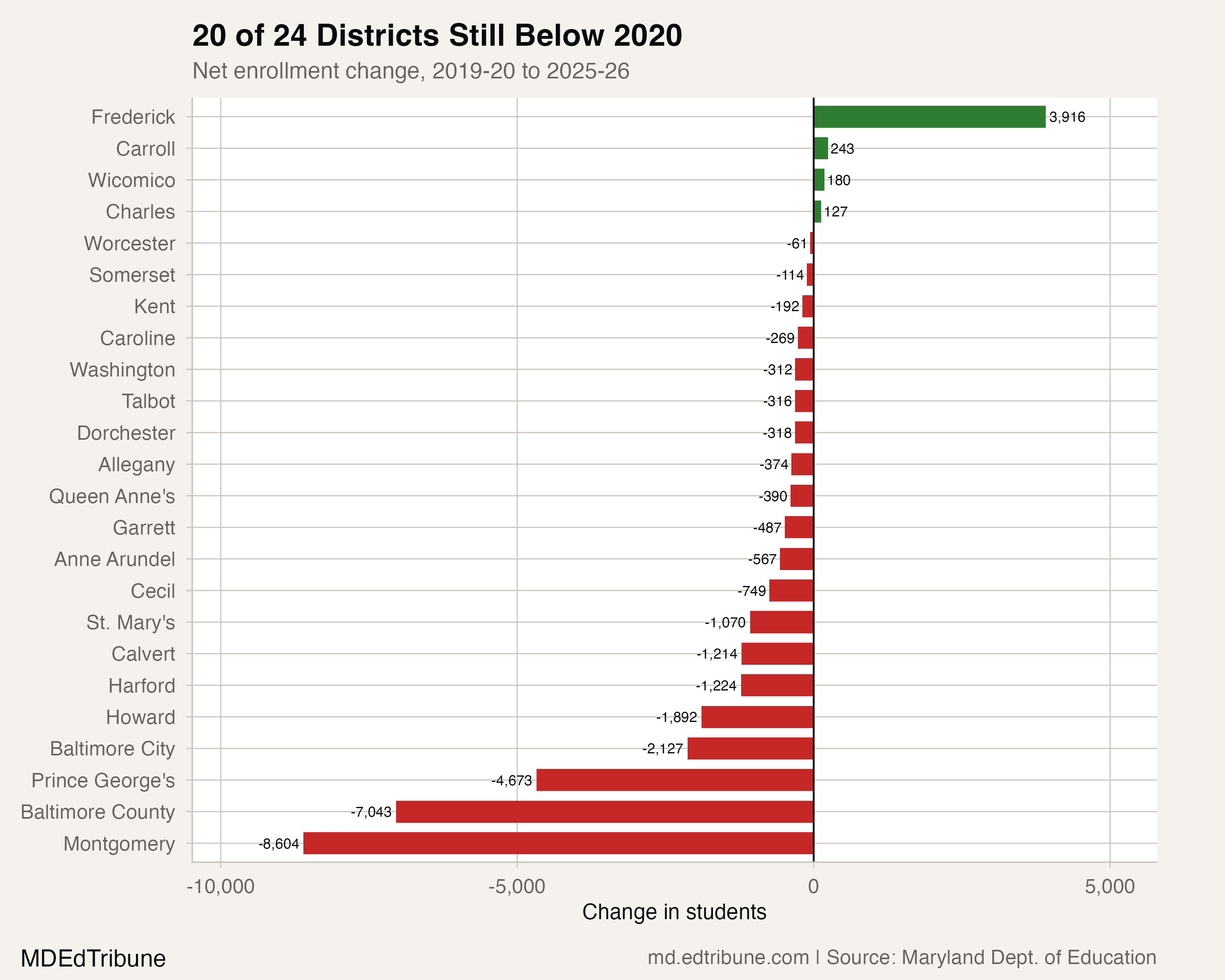
The five largest deficits account for 76.1% of the total gap between Maryland's 2020 peak and its current enrollment. Montgomery↗ET leads the state, sitting 8,604 students below its pre-pandemic level, a 5.4% decline that has accelerated each year since 2023. Baltimore County↗ET is 7,043 below, a 6.3% drop. Prince George's↗ET is 4,673 below. Baltimore City↗ET is 2,127 below. Howard↗ET is 1,892 below.
These are not small, rural districts losing a handful of students. They are the state's population centers, its economic engines, the jurisdictions that receive the largest share of Blueprint for Maryland's Future funding. Montgomery County alone enrolls more students than the 16 smallest districts combined.
Among the smaller systems, the percentage losses are even steeper. Garrett↗ET County, one of the state's smallest districts with 3,142 students, has lost 13.4% of its enrollment since 2020. Calvert↗ET is down 7.8%. Kent↗ET County, which registered the only enrollment gain in 2025-26, still sits 10.7% below its 2020 level.
2026: every district lost students except one
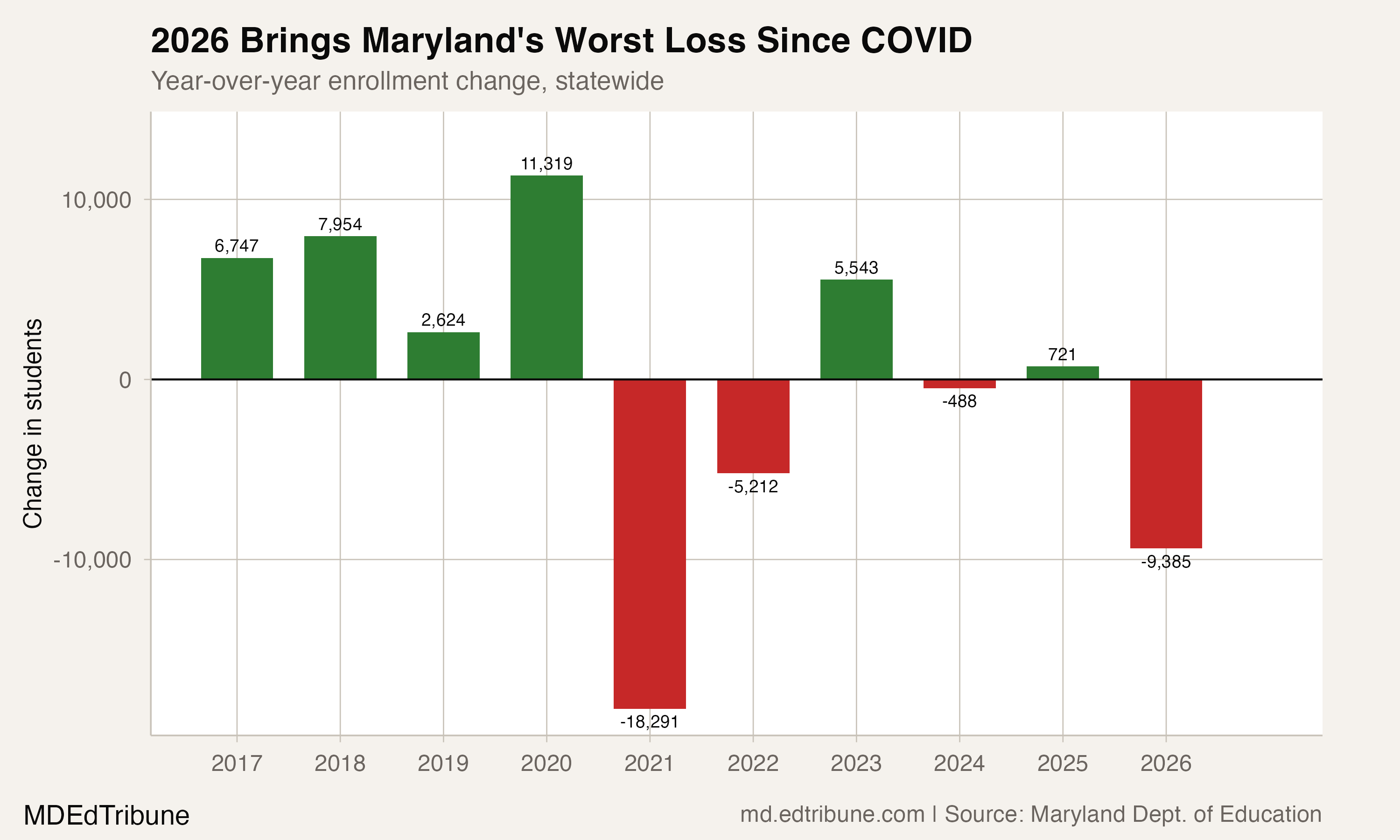
The 2025-26 school year produced something Maryland has not seen in at least a decade: 23 of 24 districts lost students simultaneously. Only Kent County bucked the trend. The three largest suburban systems — Montgomery, Baltimore County, and Prince George's — accounted for nearly two-thirds of the total decline.
The breadth of the decline is what distinguishes 2026 from earlier years. In 2022-23, when the state rebounded by 5,543, the gains were concentrated in a handful of growing suburbs. In 2025-26, the losses reached everywhere, from Frederick (down 123 after years of growth) to Carroll (down 442, losing its recovery status from the prior year) to the Eastern Shore.
Worcester County, which had clawed back above its 2020 level by 2025, fell below again. The recovery count dropped from five districts to four.
Why recovery keeps receding
Three overlapping forces are suppressing enrollment, and none is temporary.
The most direct is a birth rate decline that began in 2016 and deepened during the pandemic. Maryland recorded roughly 70,000 births in 2019 and 2020, compared to more than 77,000 in 2007 and 2008, according to The Baltimore Banner. Those smaller cohorts are now arriving in kindergarten. Statewide, K enrollment is down 5,883 students from 2020, a 9.0% decline, the steepest loss of any grade.
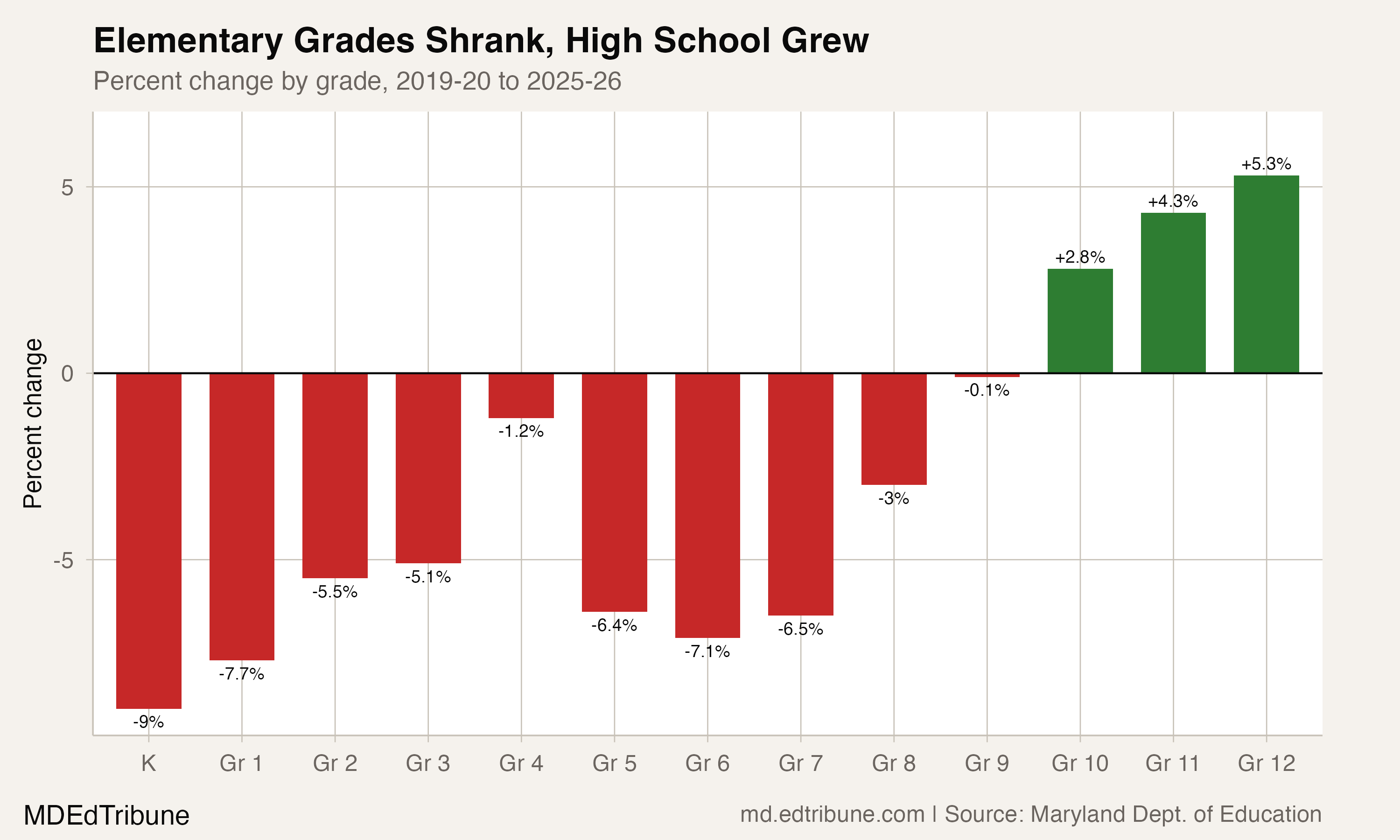
The grade-level pattern is stark: every grade from K through 8 shrank since 2020, while grades 10 through 12 grew as larger pre-pandemic cohorts aged through high school. Grade 12 is up 5.3%. Grade 1 is down 7.7%. When those larger high school classes graduate, they will be replaced by the smaller elementary cohorts working their way up, compounding the decline for years.
Homeschooling accounts for a second channel of loss. Maryland's homeschool population has grown 51% since the pandemic, from 27,754 students in 2020 to more than 42,000. That 14,000-student increase would fill roughly half of the statewide enrollment gap on its own. Private school enrollment, by contrast, has held steady at 12% to 13% of the K-12 population since 2017, suggesting the exits are going to kitchen tables, not competing campuses.
Immigration enforcement has introduced a third, more recent pressure, concentrated in Montgomery County. The district's newcomer enrollment, defined as students brand-new to the country or returning after years abroad, dropped from more than 400 by October 2023 to just 111 by the same point in 2024. Superintendent Thomas Taylor said international enrollments were "sharply down." County Executive Marc Elrich attributed part of the decline to federal deportation actions. Montgomery County school board members attributed part of the decline to federal immigration enforcement, telling The Baltimore Banner that some students had simply vanished from enrollment rolls.
No single factor explains why Montgomery, the state's largest system, has lost 8,604 students in five years. Birth rates, homeschooling, and immigration enforcement all contribute. The data cannot apportion the decline among them, and the state does not track enrollment exits by destination.
Frederick's exception proves nothing
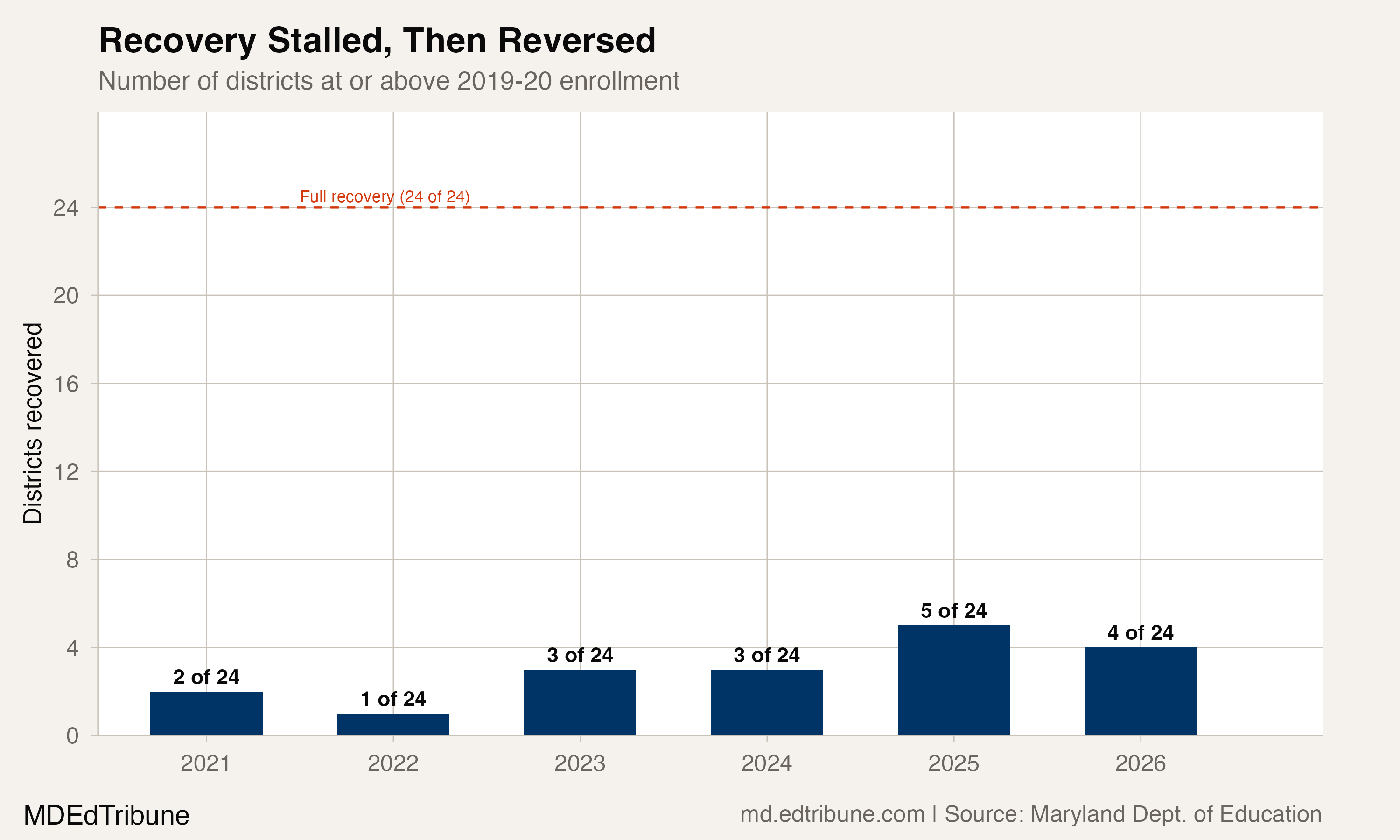
Frederick↗ET County is the only large district to recover, and it is not close. At 46,345 students, it sits 3,916 above its 2020 level, a 9.2% gain that makes it the fastest-growing school system in Maryland. The district is building a new 882-seat elementary school to handle overcrowding. One campus, Oakdale Elementary, is operating at 170% of capacity.
Frederick's growth is real, but it is driven by suburban housing development along the I-270 corridor, a pipeline that does not exist in most of the state. The three other recovered districts, Carroll (+243), Wicomico (+180), and Charles (+127), are barely above their 2020 marks. A single bad year could push any of them back below, as it did to Worcester in 2025-26.
The recovery tracker tells the story in miniature. In 2022, only one district was at or above 2020 levels. That number crept to three, then five. In 2026, it fell back to four. The trend line for recovery is not rising. It is oscillating at the bottom of the chart.
Funding in a shrinking system
Enrollment decline collides with one of the largest education spending increases in state history. The Blueprint for Maryland's Future allocates funding on a per-pupil basis, with a foundation amount that rises from $8,310 in 2022-23 toward $12,365 by 2032-33. When enrollment falls, the total dollars flowing to a district fall with it, even as the per-pupil amount increases.
The timing compounds the pressure. The federal government notified Maryland in early 2026 that $360 million in COVID-era relief funds would not be reimbursed. State Superintendent Carey Wright called the decision "catastrophic," noting the funds had already been spent. The districts hit hardest, Prince George's, Montgomery, and Baltimore City, are the same ones with the deepest enrollment deficits.
Montgomery County is now discussing the possibility of school closures for the first time in 40 years. The district projects enrollment will continue falling to 149,706 by 2031, a loss of 15,561 from the 2019 peak. It maintains 238 school buildings.
What the pipeline signals
Maryland's enrollment problem is not a COVID aftershock that will fade. The grade-level data makes that clear. Kindergarten, the entry point for the system, lost 9.0% of its students since 2020. First grade lost 7.7%. These are not students who left during the pandemic. They are students who were never born or never enrolled.
The 18 of 24 districts whose gap from 2020 widened between 2024 and 2026 are not slowly recovering. They are falling further behind. Even Frederick, the state's growth engine, lost 123 students in 2025-26 after years of unbroken gains.
The question Maryland faces is not when enrollment will recover. The grade-level pipeline answers that: it will not, absent a reversal in birth rates or migration patterns that does not appear in any current projection. The question is what a school system built for 876,000 students does when it has 849,000 and shrinking.
Detailed code that reproduces the analysis and figures in this article is available exclusively to EdTribune subscribers.
Discussion
Sign in to join the discussion.
Loading comments...