Clarification, September 24, 2026: This article originally gave Maryland's statewide enrollment totals without saying what the figures counted. They cover kindergarten through grade 12 and exclude prekindergarten. No number has changed.
This is part of The MDEdTribune's series on Maryland's 2025-26 enrollment data.
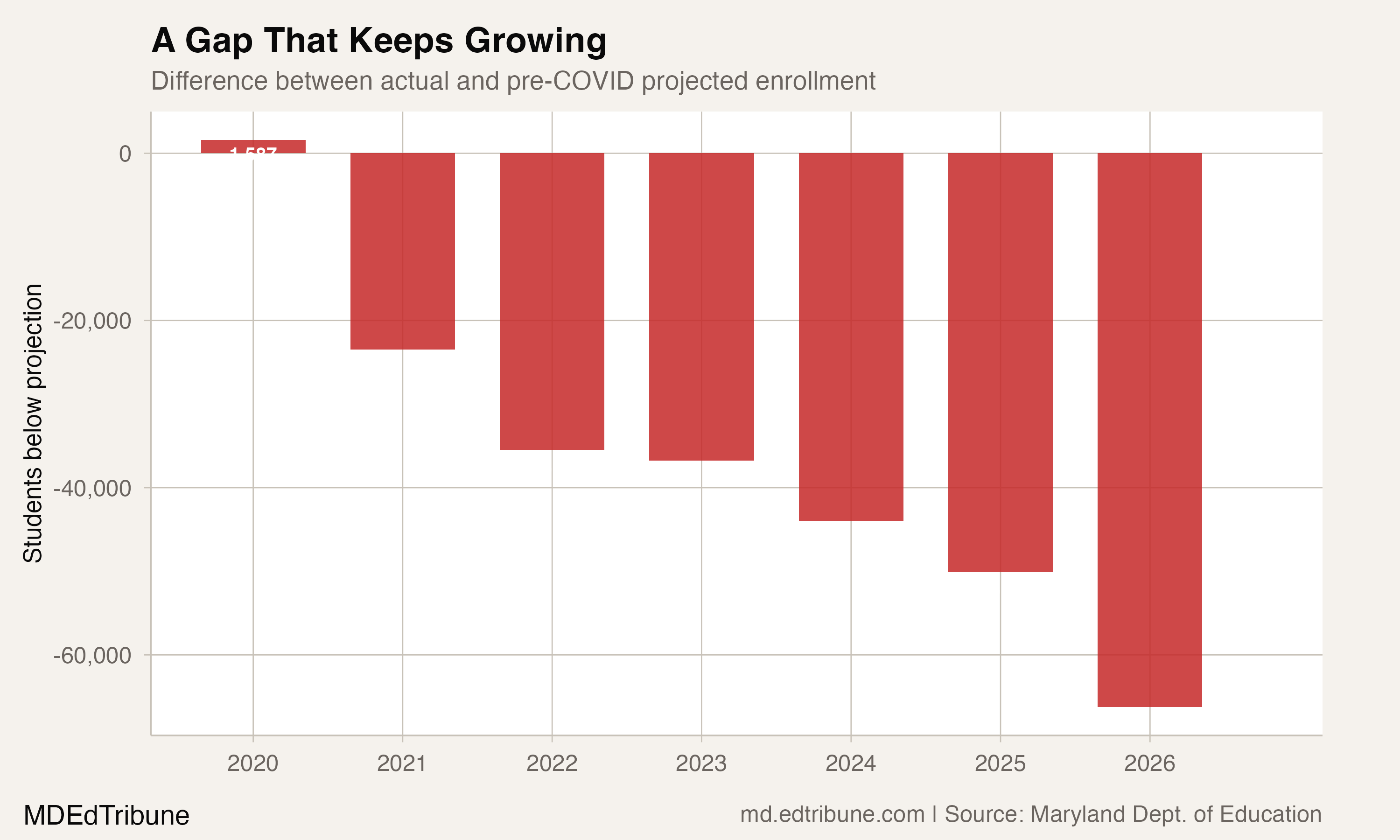
If Maryland's pre-COVID kindergarten-through-12th-grade enrollment growth had continued, the state would have had 915,942 students in fall 2025. It had 849,698. The difference — 66,244 students, or 7.2% of what should have been — is a ghost class larger than every school district in the state except Montgomery County.
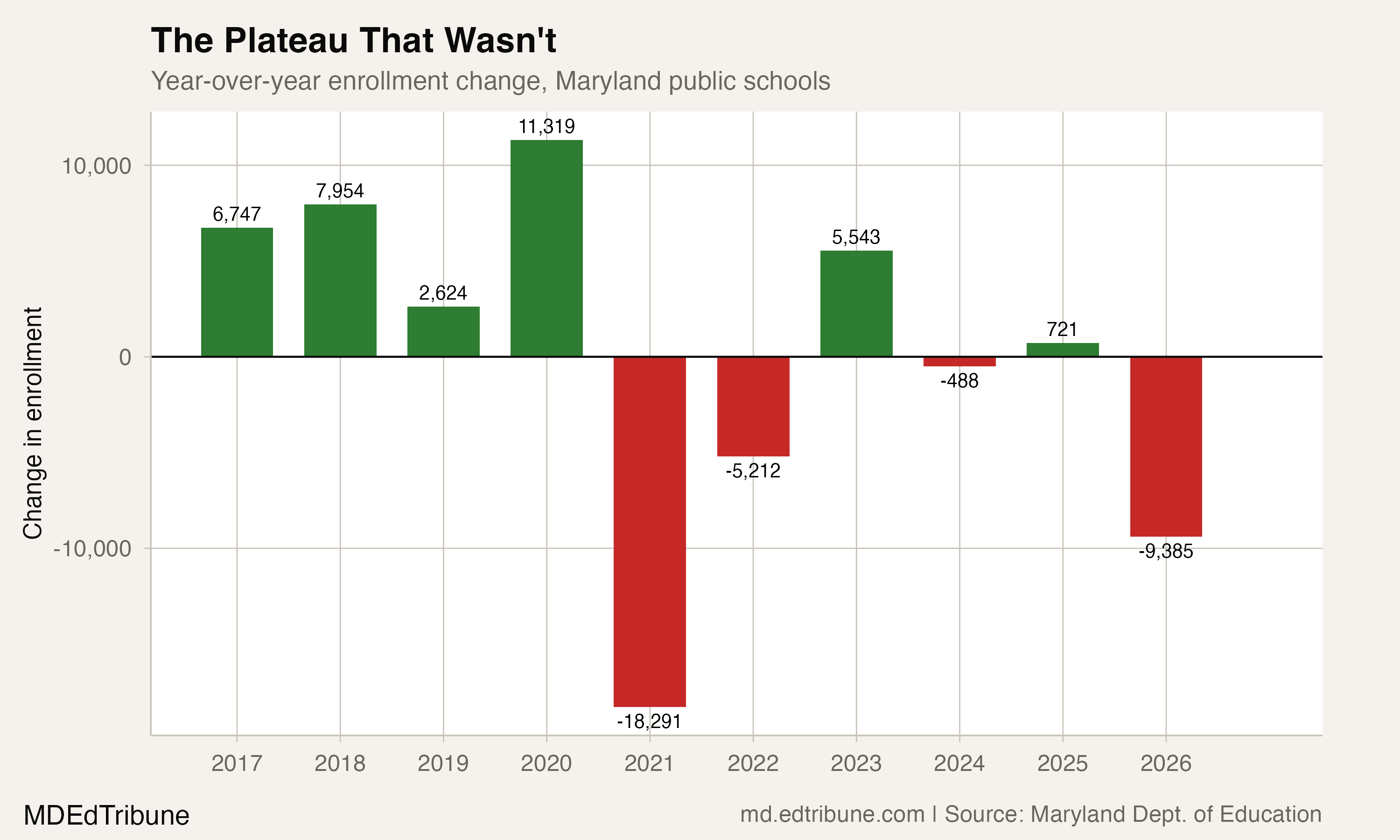
That gap widened by 16,171 students in 2025-26 alone, the biggest single-year increase since the pandemic opened it. Budgets, staffing plans, and the Blueprint for Maryland's Future were all built around a student body that no longer exists.
Where Maryland was supposed to be
Before COVID, Maryland's public schools were growing at a pace of roughly 6,800 students per year. From 2016 to 2020, enrollment climbed from 848,166 to a peak of 876,810. If that trajectory had continued, the state would have enrolled approximately 915,942 students in fall 2025.
Instead, it enrolled 849,698. The gap between projection and reality: 66,244 students, or 7.2% of what should have been.
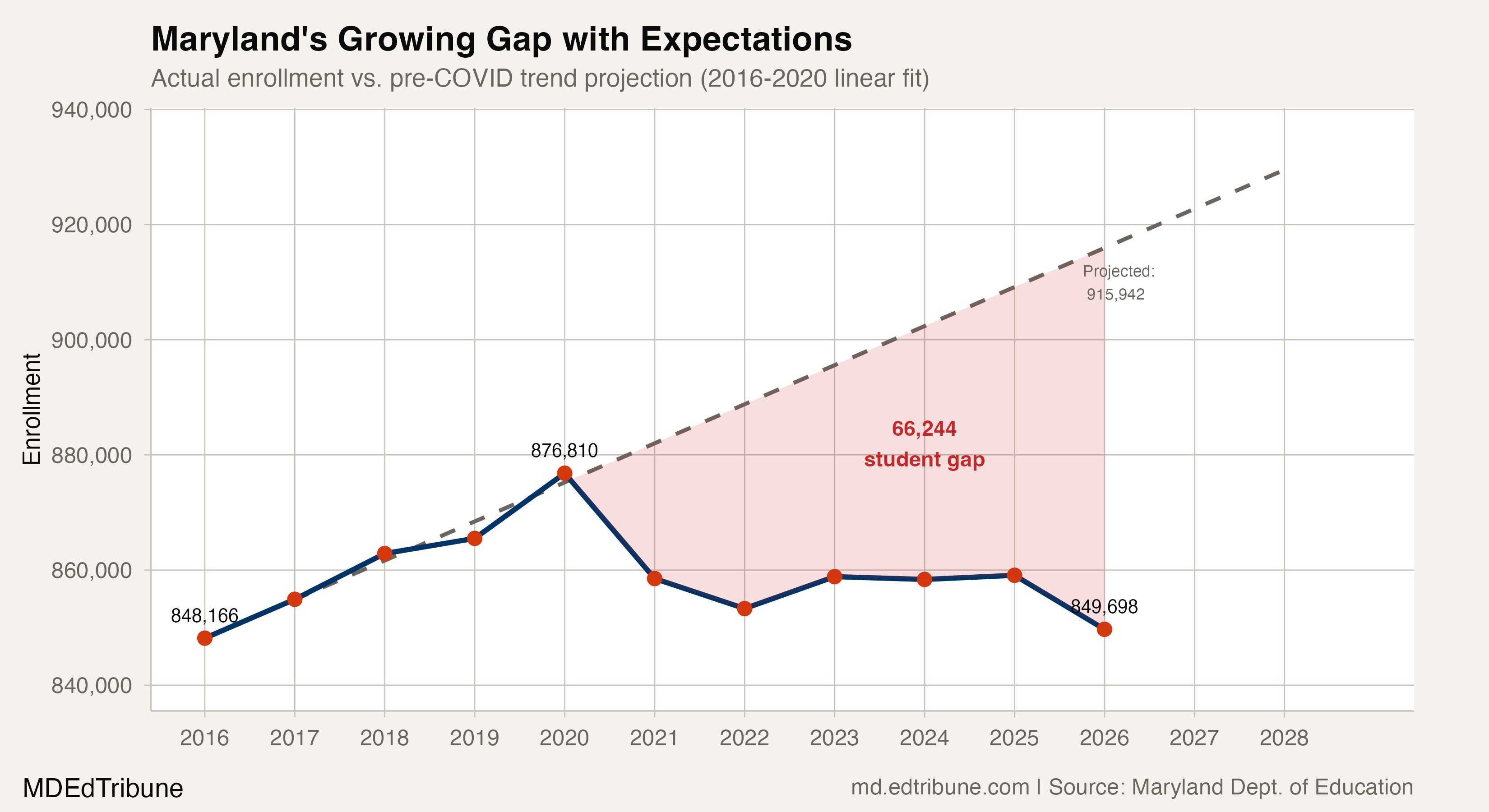
This is not a pandemic story. The pandemic opened the gap. What happened since has been worse. In 2022-23, the gap was 36,732 students. By 2023-24, it was 44,007. In 2024-25, it was 50,073. In 2025-26, the gap widened by 16,171 students, the largest single-year increase since 2021.
The four-year plateau from 2022 to 2025 masked what was really happening. Enrollment appeared stable in absolute terms. But every year of flatness, while the projection line kept climbing at 6,787 students per year, added another 7,000 phantom students to the shortfall. The plateau was not recovery. It was the gap compounding in the background.
The year the floor dropped
The 2025-26 decline stands out not just for its size but for its breadth. Of Maryland's 24 county-based school systems, 23 lost students. Kent↗ET, the smallest district in the state with 1,609 students, was the sole exception, gaining 18.
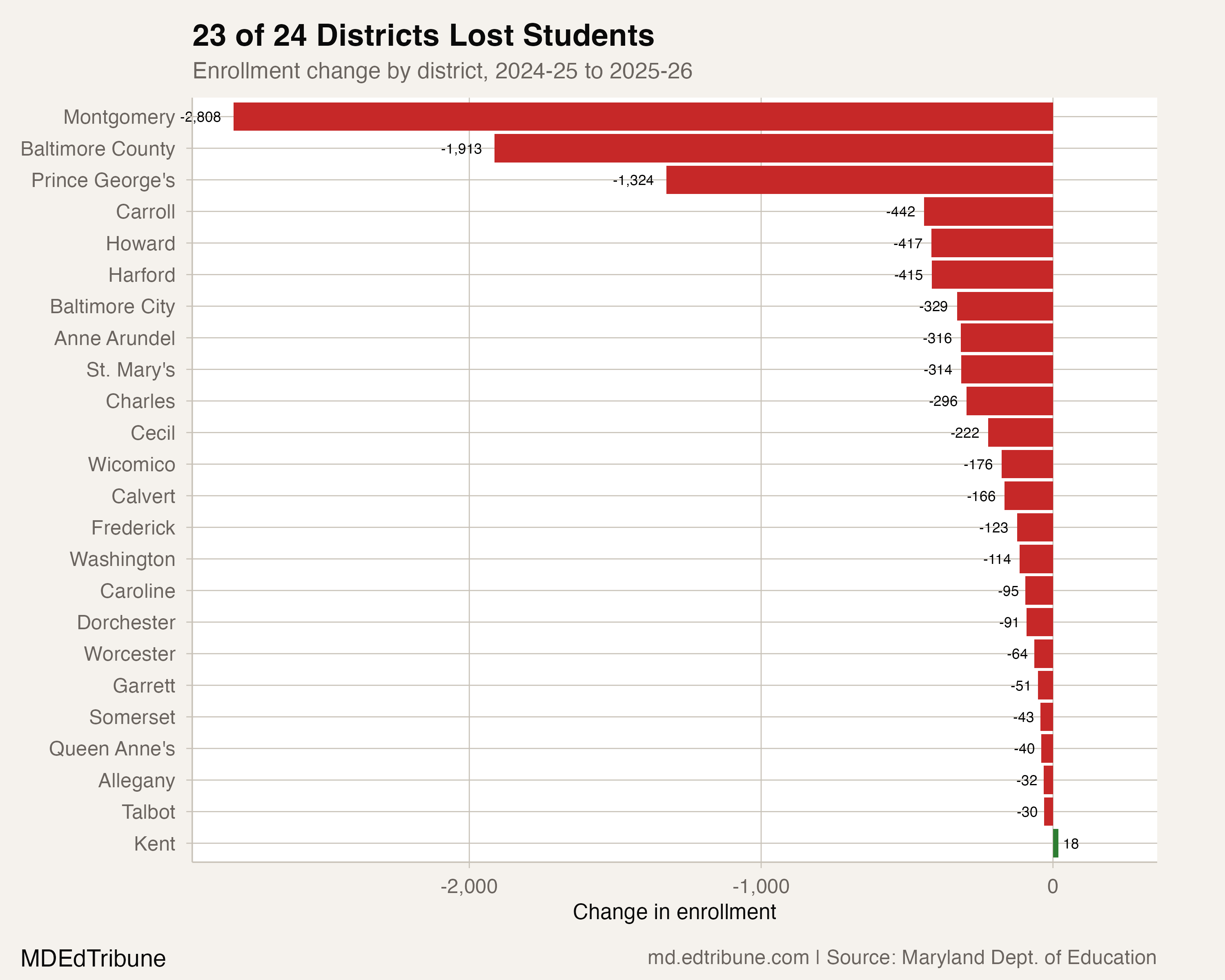
Three districts drove nearly two-thirds of the statewide loss. Montgomery County↗ET lost the most, 1.8% of its enrollment and nearly a third of the state's total decline. Baltimore County↗ET lost 1,913 (20.4% of the total). Prince George's County↗ET lost 1,324 (14.1%).
The pattern extended into mid-sized and small districts alike. Carroll County lost 442 students (1.7%), Howard County↗ET lost 417 (0.7%), and Harford lost 415 (1.1%). Even Dorchester County, with only 4,169 students remaining, lost 91, a 2.1% decline that was the steepest percentage drop in the state.
Where the gap lives
Zoom in with district-level projections and the ghost class is not evenly distributed. If pre-COVID trends had continued, Montgomery County would have 172,915 students. It has 151,983, a gap of 20,932 or 12.1%. Prince George's County is 14,827 below projection (10.5%). Baltimore County is 12,490 short (10.7%).
These are the state's three largest systems, and they were all growing before the pandemic. Montgomery was adding roughly 2,050 students per year. Prince George's was adding 1,769. Baltimore County was adding 912. All three have been losing students since 2020, and the losses accelerated in 2025-26.
The exceptions are telling. Frederick County↗ET, which was growing at 726 students per year pre-pandemic, is only 329 students below its projection, 0.7%. It is the only large system to nearly hold its pre-COVID trajectory. Baltimore City↗ET, which was losing roughly 1,127 students per year before the pandemic, is actually 5,127 students above its projected 2026 level. The pandemic did not cause Baltimore City's decline. It merely continued a pattern that had already been priced in.
A system splitting in two
The statewide numbers conceal a structural divergence that will define Maryland education for the next decade. Elementary and high school enrollment are moving in opposite directions.
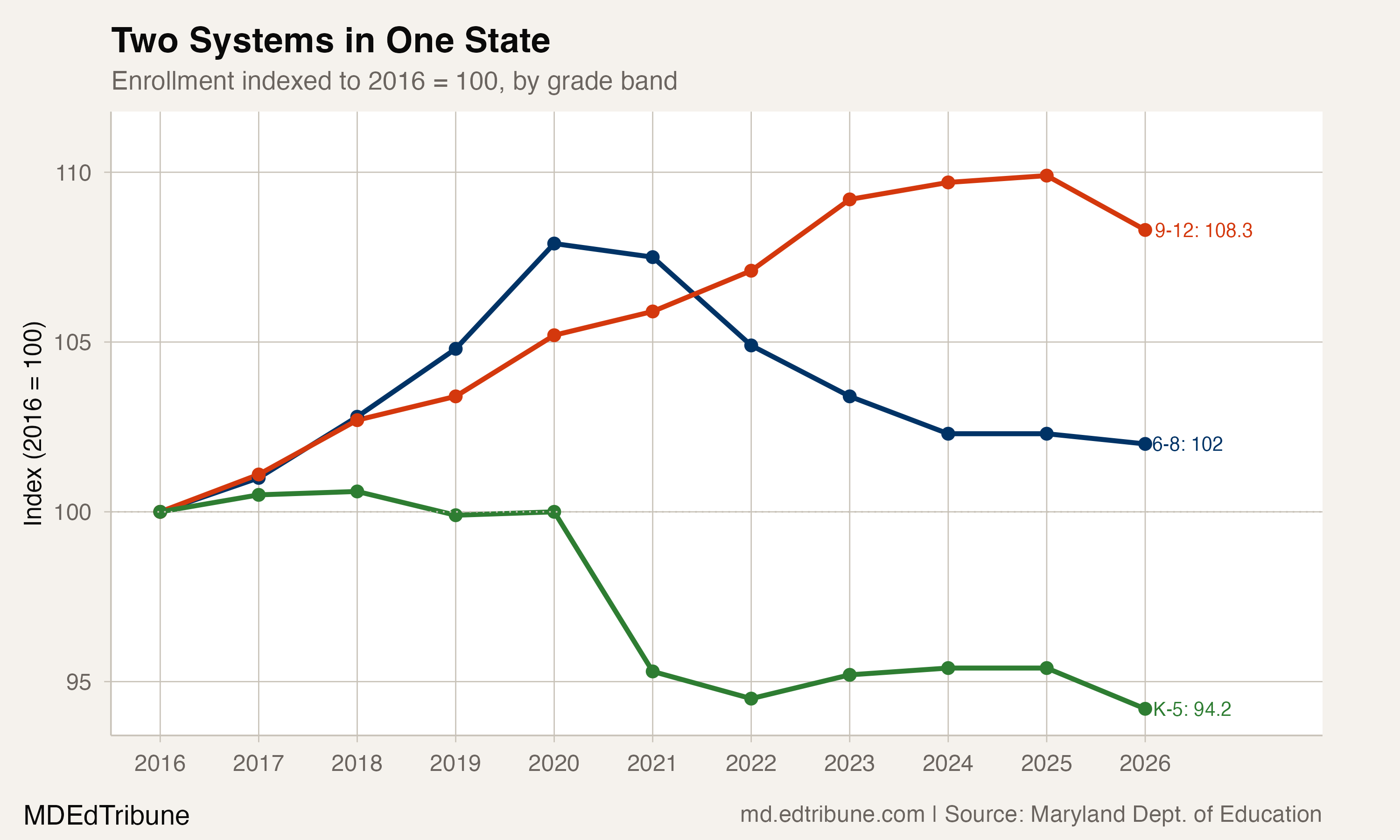
Since 2020, K-5 enrollment has fallen by 23,343 students, a 5.8% decline. Kindergarten alone has dropped from 65,087 to 59,204, down 9.0%. Meanwhile, grades 9-12 have grown by 7,754 students (2.9%), as the larger pre-pandemic cohorts move through high school. Grades 10, 11, and 12 each gained students since 2020, even as every elementary grade lost thousands.
This is a pipeline problem. The smaller kindergarten cohorts entering in 2025-26 will produce smaller middle school classes in five years and smaller high school classes in nine. Montgomery County's birth data illustrates the mechanism directly: the county recorded more than 13,000 births in 2014. By 2023, that number had fallen below 11,000. Those children are just now entering kindergarten.
The high school enrollment bump is temporary. When the smaller K-5 cohorts reach grade nine, high schools will begin to decline too. Montgomery County Public Schools projects losing an additional 7,000 students by 2032.
What is driving the gap
No single factor explains 66,244 missing students. The most direct contributor is declining births. Maryland's birth rate began falling in 2016, and the children not born in 2016-2020 are the students not enrolling in kindergarten in 2025-26. The data is structural and largely irreversible on a five-year horizon.
Homeschooling accounts for a measurable share. Maryland had 27,754 homeschooled students in 2020. That number is now approximately 42,000, an increase of roughly 14,000 students, or about 21% of the ghost class. Not all of those students would have been in public schools absent the pandemic, but the majority were enrolled in public schools before switching.
"The missing children in the public school system are in the homeschooling environment and they have not come back." -- Alfred Sundara, Assistant Secretary, Maryland Department of Planning
A third mechanism emerged in 2025-26: immigration enforcement. Montgomery County welcomed 111 newcomer students as of October 2025, compared to more than 400 in the same period the prior year. Whether families left the state, pulled children from school, or simply did not enroll is not known. Montgomery County school board members told The Baltimore Banner that immigration enforcement had driven families out of the enrollment rolls, though the district could not track where they went.
Housing costs compound the problem in the state's most expensive counties. Montgomery, Howard, and Prince George's counties all border Washington, D.C. The loss of an estimated 15,000 federal jobs in Maryland, reported by The Baltimore Banner, could accelerate outmigration from the D.C. suburbs that anchor the state's enrollment base.
The fiscal arithmetic
The gap between expected and actual enrollment is not abstract. The Blueprint for Maryland's Future allocates state funding based on per-pupil formulas. The Maryland Department of Planning's own projections showed schools running 32,300 students below Blueprint estimates as of fall 2025. The actual shortfall, measured against the pre-COVID trajectory, is twice that.
At the state's base per-pupil foundation amount of roughly $10,000 (scheduled to reach $12,365 by 2033 under the Blueprint), 66,244 missing students represent hundreds of millions of dollars in enrollment-driven funding that will not flow. The state does not simply lose this money; the formula was designed to fund schools that would be teaching these students. Districts are left with the fixed costs of buildings and contracts sized for a population that no longer shows up.
Montgomery County Superintendent Thomas Taylor has proposed repurposing a high school under construction as a holding facility rather than opening it on schedule. Districts across the state face decisions about consolidating programs, reducing sections, and managing a teaching workforce that has grown by 10,202 positions since 2021 even as enrollment shrank.
The enrollment data tracks bodies in seats. It does not say where 66,244 students went — some were never born, some are homeschooled, some left the state. Maryland does not publish a comprehensive accounting, and the available numbers on homeschooling and private enrollment do not sum to 66,244. The gap has components that cannot be separated with the data the state collects.
The next five years
If enrollment stays near 850,000 and the pre-COVID trendline keeps climbing, the ghost class will surpass 80,000 by 2028. If it stays flat through 2030, the gap reaches 93,000.
The more immediate question is whether 2025-26 was a one-time correction after four years of artificial stability, or the beginning of a new trajectory. The kindergarten pipeline suggests the latter. With 59,204 kindergartners in 2025-26, down from 65,087 in 2020, the elementary system is feeding smaller cohorts into every subsequent grade for the next decade. The high school enrollment bump that has partially offset elementary losses will peak within two to three years and then reverse.
Maryland passed the most ambitious education funding law in the country four years ago. The Blueprint for Maryland's Future was designed for a student body that no longer exists — and the gap is growing by 16,000 students a year.
Detailed code that reproduces the analysis and figures in this article is available exclusively to EdTribune subscribers.
Discussion
Sign in to join the discussion.
Loading comments...