Clarification, September 24, 2026: This article originally gave Maryland's statewide enrollment total without saying what the figure counted. It covers kindergarten through grade 12 and excludes prekindergarten. No number has changed.
This is part of The MDEdTribune's series on Maryland's 2025-26 enrollment data.
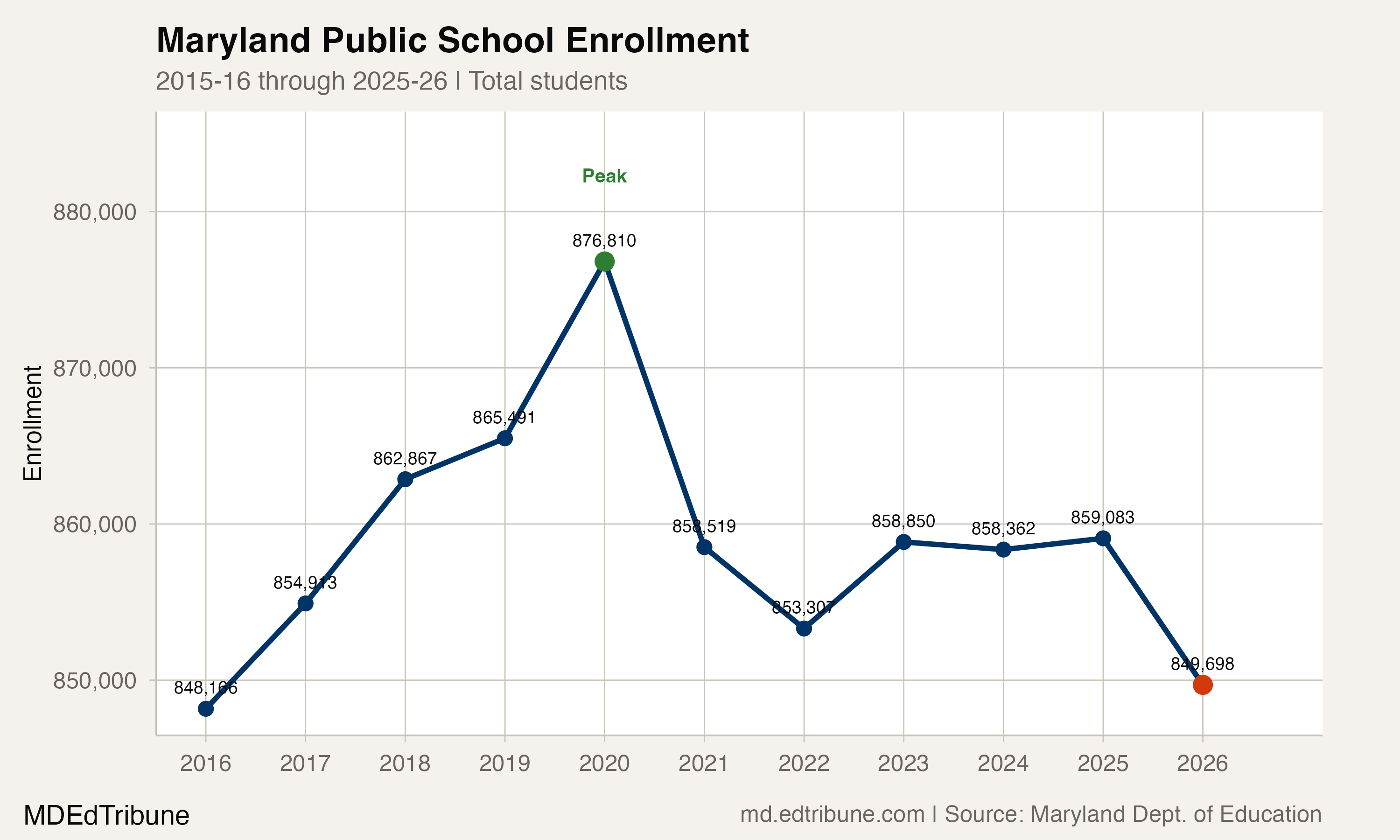
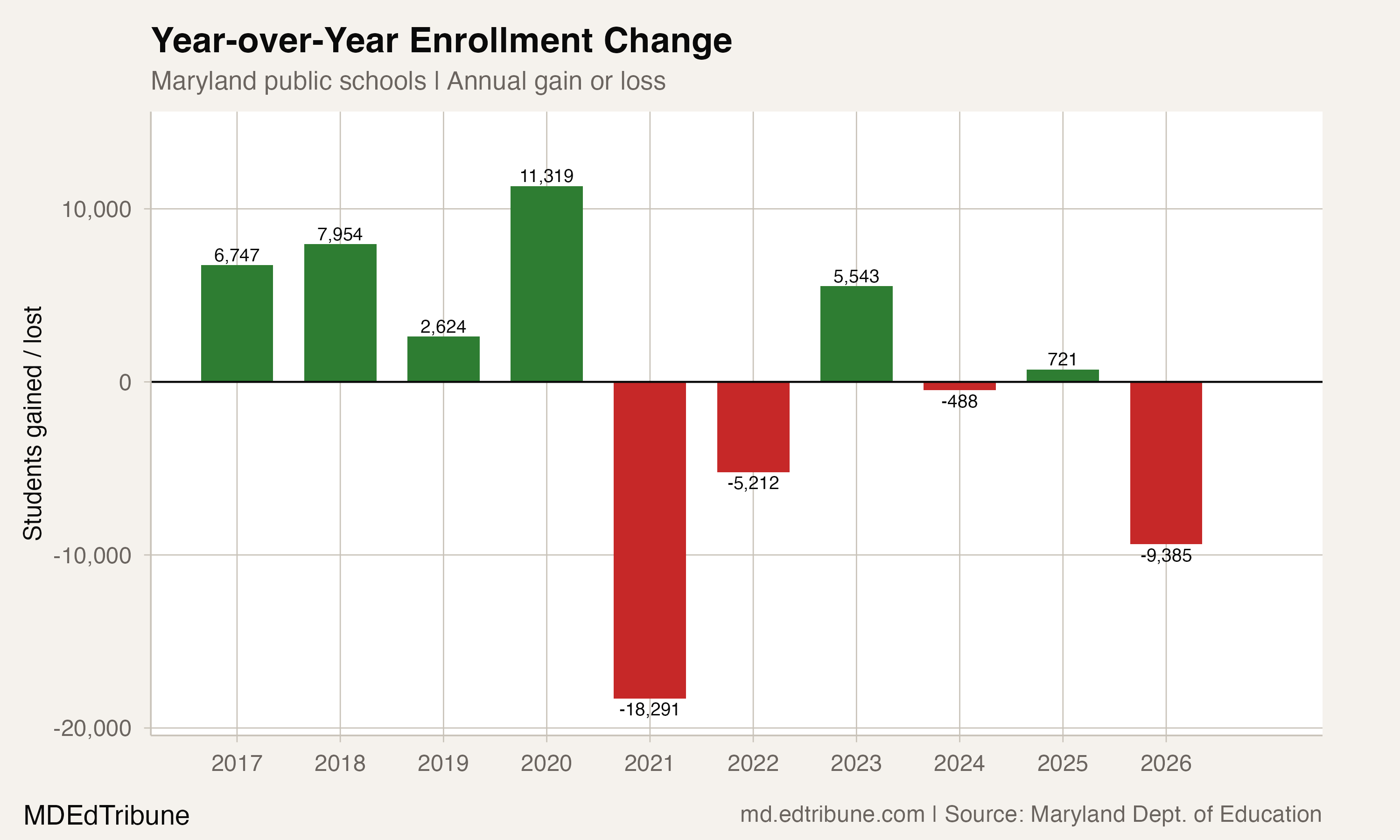
Maryland's public schools lost 9,385 students in a single year. The 2025-26 headcount, kindergarten through 12th grade, landed at 849,698, a 1.1% decline that ranks as the second-largest in at least a decade, behind only the 18,291-student COVID crash. Twenty-three of Maryland's 24 school districts lost students. Eleven hit all-time lows.
The drop landed after three years of near-flat enrollment that looked, briefly, like stability. Between 2022-23 and 2024-25, the statewide count fluctuated within a 700-student band. School leaders had reason to think the post-COVID freefall was over. It was not.
Three years of false stability
The plateau that formed between 2022-23 and 2024-25 now looks less like stabilization and more like a pause before a second contraction. The state averaged 858,765 students across those three years. The 2025-26 figure is 9,067 below that average.
Maryland had been growing before the pandemic. Between 2016-17 and 2019-20, the state added 21,897 students, peaking at 876,810. If that pre-COVID growth rate had continued, Maryland would have enrolled roughly 908,800 students in 2025-26. The actual figure is 59,100 below that projection, representing six years of lost growth plus actual decline.
The state is now 27,112 students, or 3.1%, below its 2019-20 peak.
Where the losses landed
The decline was not distributed evenly. Three districts accounted for 61.6% of all losses: Montgomery (-2,808), Baltimore County (-1,913), and Prince George's (-1,324). These are three of Maryland's four largest school systems, and all three are now at or near all-time lows within the 11-year data window.
Kent County, with 1,609 students, was the only district to grow, adding 18 students. Every other district lost ground. Even Frederick and Anne Arundel, which had largely held steady through the post-COVID period, shed 123 and 316 students respectively.
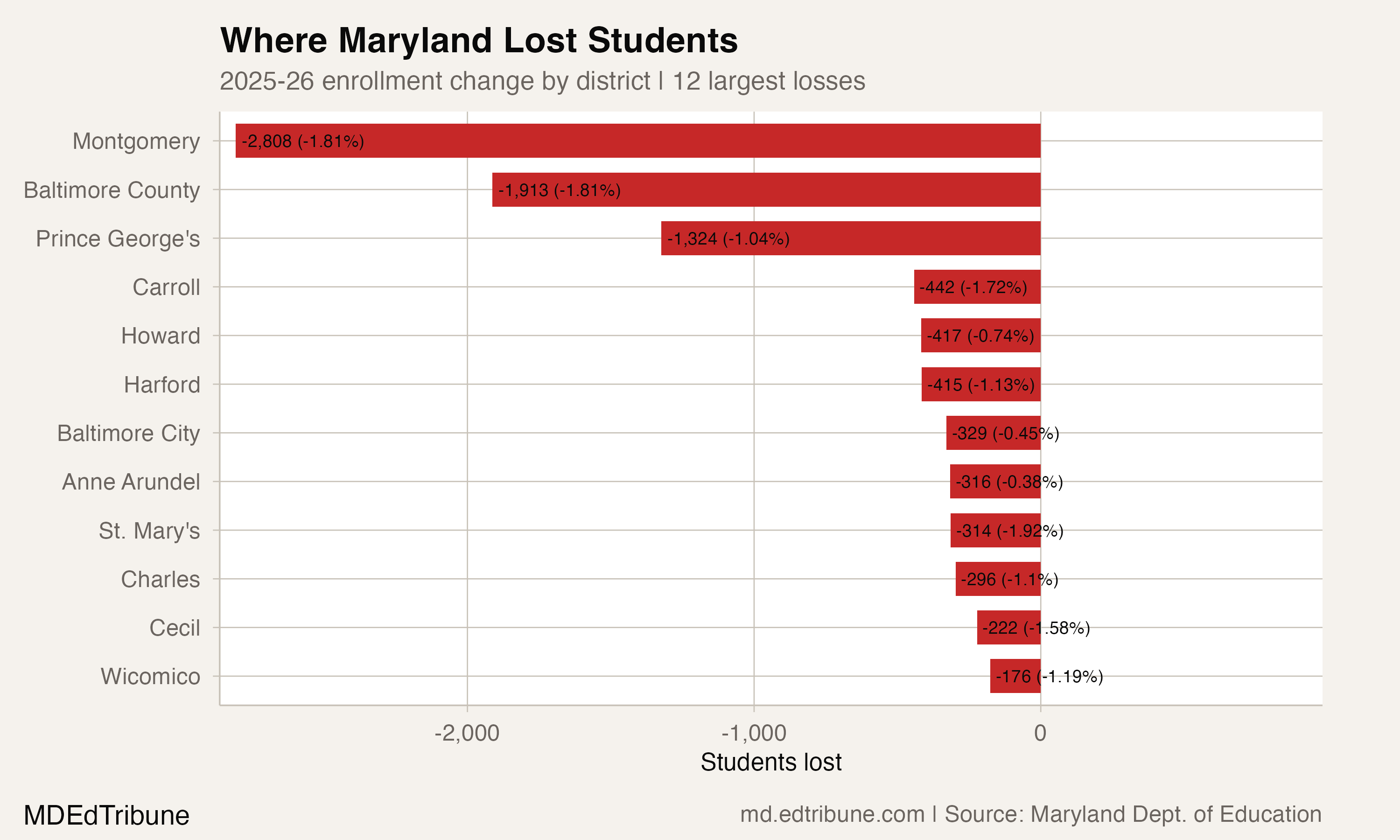
Montgomery County's loss of 2,808 students was its largest non-COVID decline. The system has shed 8,604 students since its 2019-20 peak, a 5.4% drop. Budget manager Donald Connelly told WJLA that the district is "anticipating a loss of over 6,000 students" in the next six years. Bethesda Magazine reported the expected decrease has spurred proposals to close some schools.
Baltimore County has now declined for six consecutive years, losing 7,043 students, or 6.3%, from its 2019-20 peak. The district cut $104 million from its budget and eliminated roughly 494 positions last year, partly in response to enrollment-driven funding reductions.
Eleven districts at record lows
Nearly half of Maryland's 24 school systems are now at the lowest enrollment recorded in the 11-year data window. The list includes both the state's largest suburban system (Montgomery, at 151,983) and its smallest rural districts (Garrett, at 3,142). The gap between their percentage declines from peak is instructive: Garrett has lost 14.2% from its high-water mark, while Harford, also at an all-time low, is down just 3.3%.
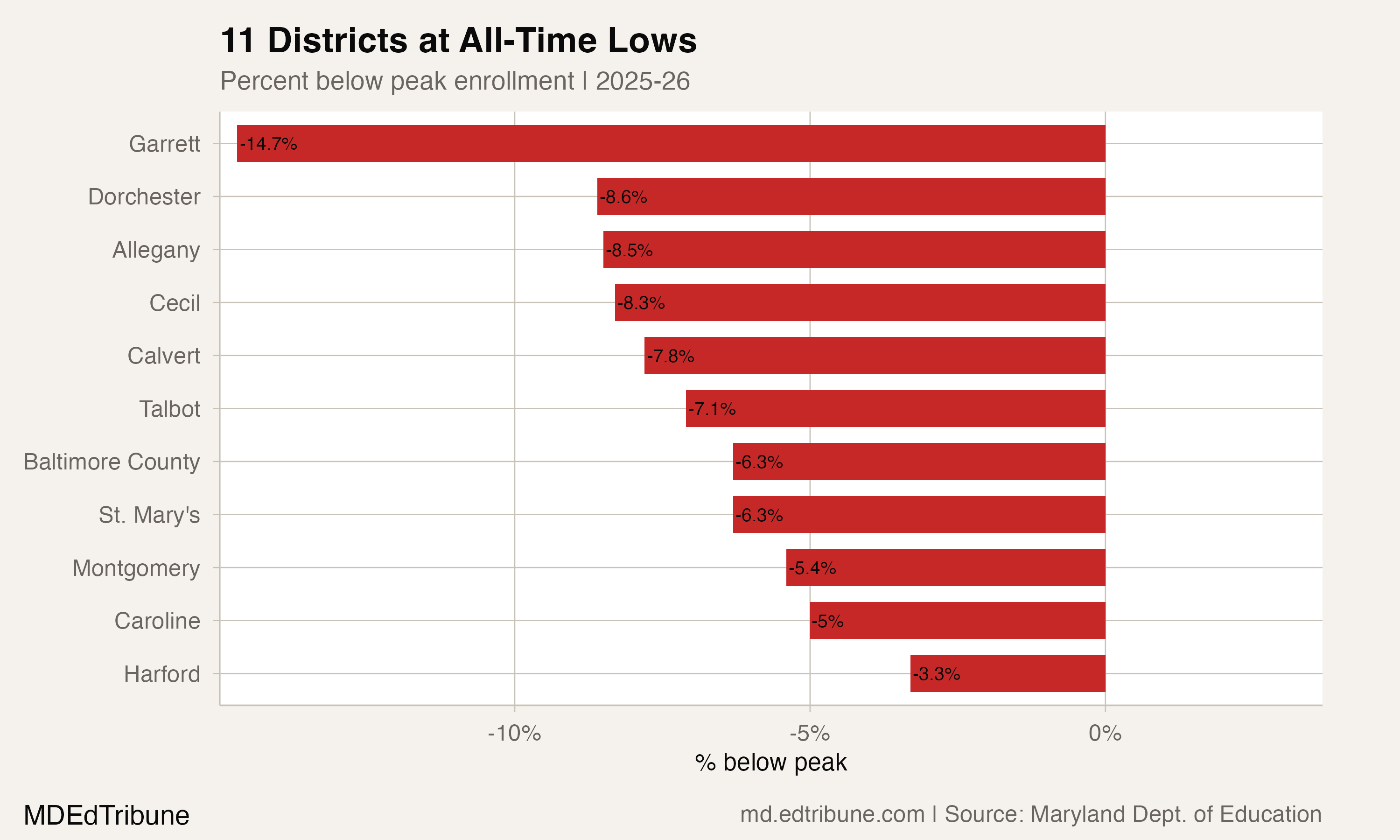
The breadth of this list is the more telling signal. All-time lows at small rural districts like Garrett, Dorchester, or Allegany could be attributed to the long-running population drain from western Maryland and the Eastern Shore. All-time lows at Montgomery and Baltimore County cannot. These are large, economically diverse suburban systems, and their presence on this list reflects structural forces that affect the entire state.
Fewer children entering, more leaving
Maryland is graduating more students than it enrolls in kindergarten, a pipeline inversion that guarantees continued enrollment decline even if every other factor stabilizes.
In 2016-17, kindergarten enrollment exceeded Grade 12 by 6,204 students. In 2025-26, the relationship has flipped: Grade 12 enrollment (64,391) exceeds kindergarten (59,204) by 5,187. The kindergarten class has shrunk 8.2% over nine years while Grade 12 has grown 10.5%, driven by the larger cohorts born in the mid-2000s now aging through high school.
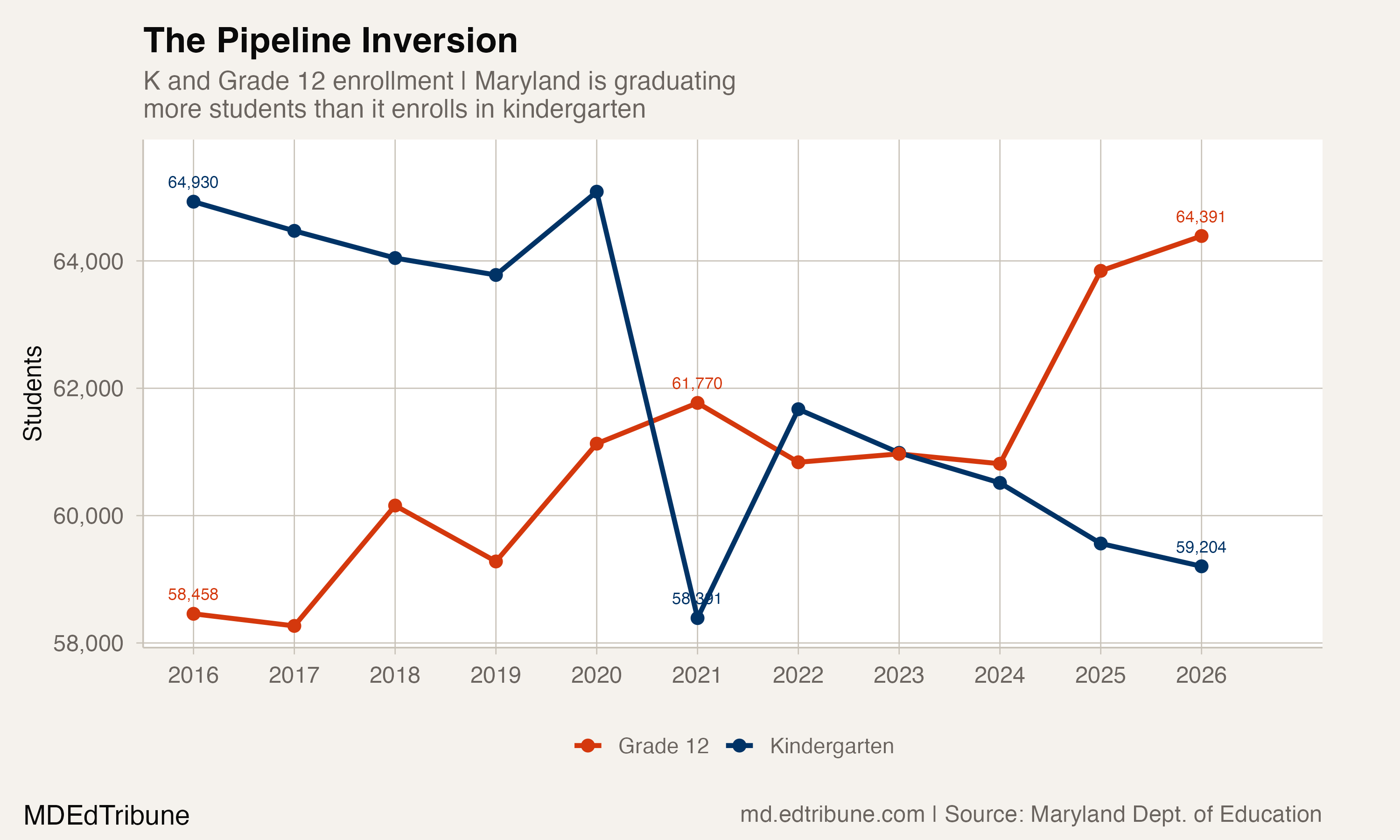
This inversion reflects falling birth rates. Montgomery County births dropped from about 13,200 in 2014 to roughly 10,900 in 2023, a 17% decline. Statewide, roughly 70,000 babies were born in 2019-20, compared to more than 77,000 born in 2007-08, according to The Baltimore Banner. The children not born in 2019 are the kindergarteners not enrolled in 2025.
Multiple forces, compounding
Birth rates alone do not explain a 9,385-student loss in a single year. The size and suddenness of this drop suggest several forces converging at once.
The most visible new factor is immigration enforcement. Montgomery County welcomed just 111 newcomer students by October 2025, compared to more than 400 during the same period in 2023-24. Montgomery County school board officials told The Baltimore Banner that families had disappeared from enrollment rolls amid federal immigration enforcement, with some administrators saying they had no idea where the students went. The state education board attributed a 4.4-point drop in Hispanic graduation rates to the same dynamic, with Board President Josh Michael noting: "I've never seen a drop or a gain that significant, year-over-year, in a relatively large subgroup."
Homeschooling remains elevated. More than 42,000 Maryland students are now learning at home, up from roughly 28,000 before the pandemic, a 50% increase. Enrollment peaked at nearly 45,000 in 2021-22 and has since settled around 42,000, suggesting the shift is sticky rather than temporary.
Federal workforce reductions add another layer. Maryland lost 15,000 federal jobs under the current administration, and many of those positions were concentrated in the suburban Washington counties where enrollment losses are heaviest. Whether affected families have left the state, shifted to private schools, or begun homeschooling is not visible in enrollment data alone.
Housing costs may also be pushing families with young children to lower-cost states. This is a plausible contributing factor, particularly in Montgomery and Howard counties, though no Maryland-specific data isolates its effect on school enrollment.
Funding follows the students out the door
The fiscal consequences are immediate. Maryland's Blueprint for Maryland's Future, a $3.8 billion education reform law, allocates funding on a per-pupil basis. Each lost student reduces state revenue to the district. Baltimore County's $104 million in budget cuts and 494 eliminated positions offer a preview of what other declining districts will face.
The structural problem is that fixed costs do not shrink with enrollment. A school building that served 600 students still needs heating, a principal, and a custodial staff when enrollment drops to 500. Specialized instructional programs, which the Blueprint specifically funds based on student need, are particularly difficult to scale down. A district cannot eliminate half a speech therapist.
Whether 2025-26 was a one-time shock or the start of something worse depends on whom you ask. The kindergarten pipeline does not equivocate: with 5,187 fewer kindergartners than graduating seniors in 2025-26, the underlying demographics guarantee continued contraction. The only open question is how fast.
Detailed code that reproduces the analysis and figures in this article is available exclusively to EdTribune subscribers.
Discussion
Sign in to join the discussion.
Loading comments...