Clarification, September 24, 2026: This article originally gave Montgomery County's enrollment total without saying what the figure counted. It covers kindergarten through grade 12 and excludes prekindergarten. No number has changed.
This is part of The MDEdTribune's series on Maryland's 2025-26 enrollment data.
Montgomery County↗ET enrolled 151,983 students in kindergarten through 12th grade in fall 2025. It is the largest school system in Maryland, the employer of thousands of teachers and support staff, the institution around which suburban families organize their lives. It has never, in at least a decade of records, enrolled so few.
It is not alone. Eleven of Maryland's 24 school systems recorded their lowest enrollment on record in 2025-26. The list runs from the state's biggest district to its smallest, the Baltimore suburbs to the Eastern Shore, the I-95 corridor to the Appalachian foothills.
A decade of growth, erased
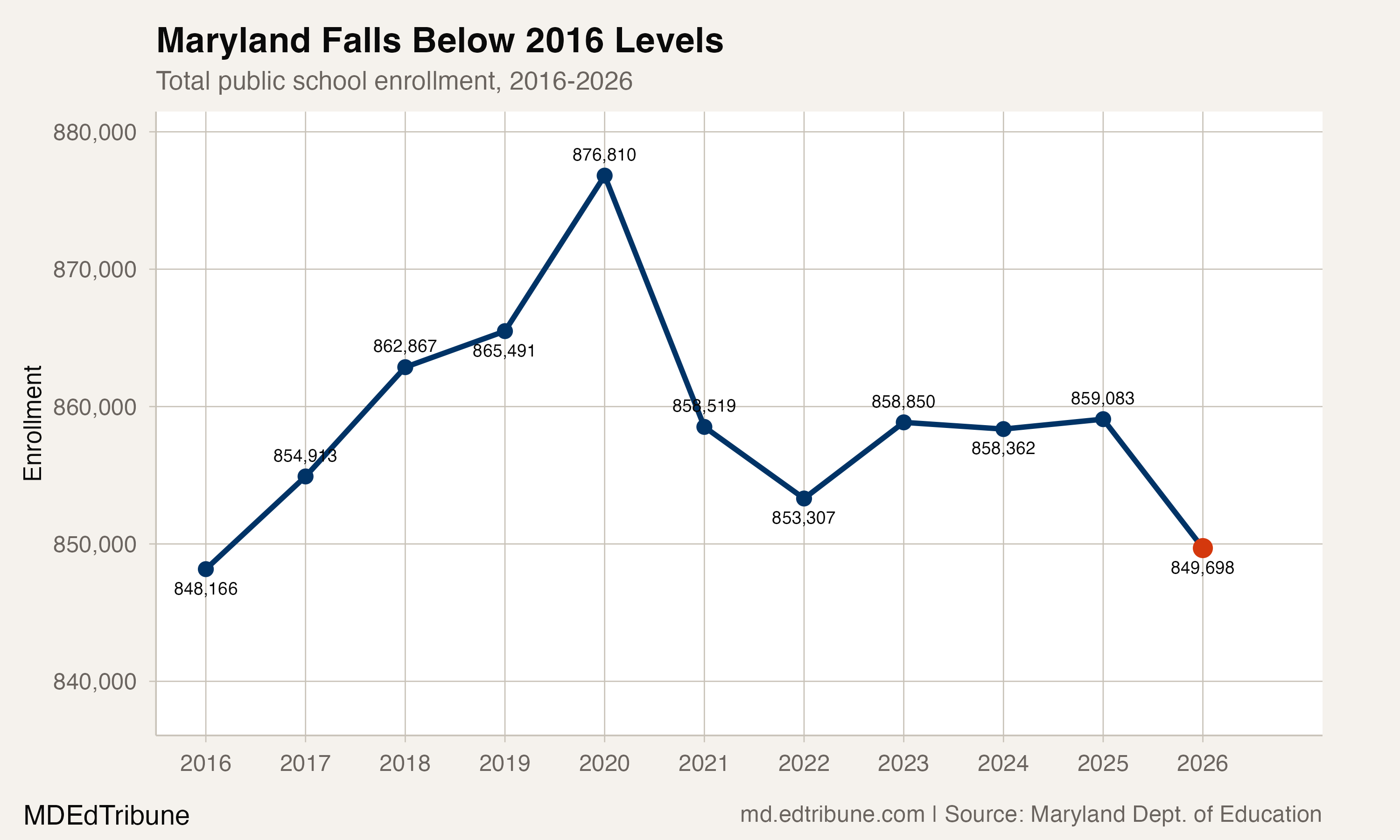
Maryland's public schools peaked at 876,810 students in 2020. The state had been growing steadily, adding nearly 29,000 students between 2016 and that pre-COVID high. The pandemic reversed the trend, dropping enrollment by 18,291 in a single year. But schools partially recovered. By 2025, enrollment had climbed back to 859,083, and the trajectory looked stable.
Then came 2025-26. The state lost 9,385 students, a 1.1% decline that wiped out three years of post-pandemic recovery and dropped total enrollment to 849,698. That figure sits barely 1,500 above where Maryland started in 2016. A decade of growth, functionally erased.
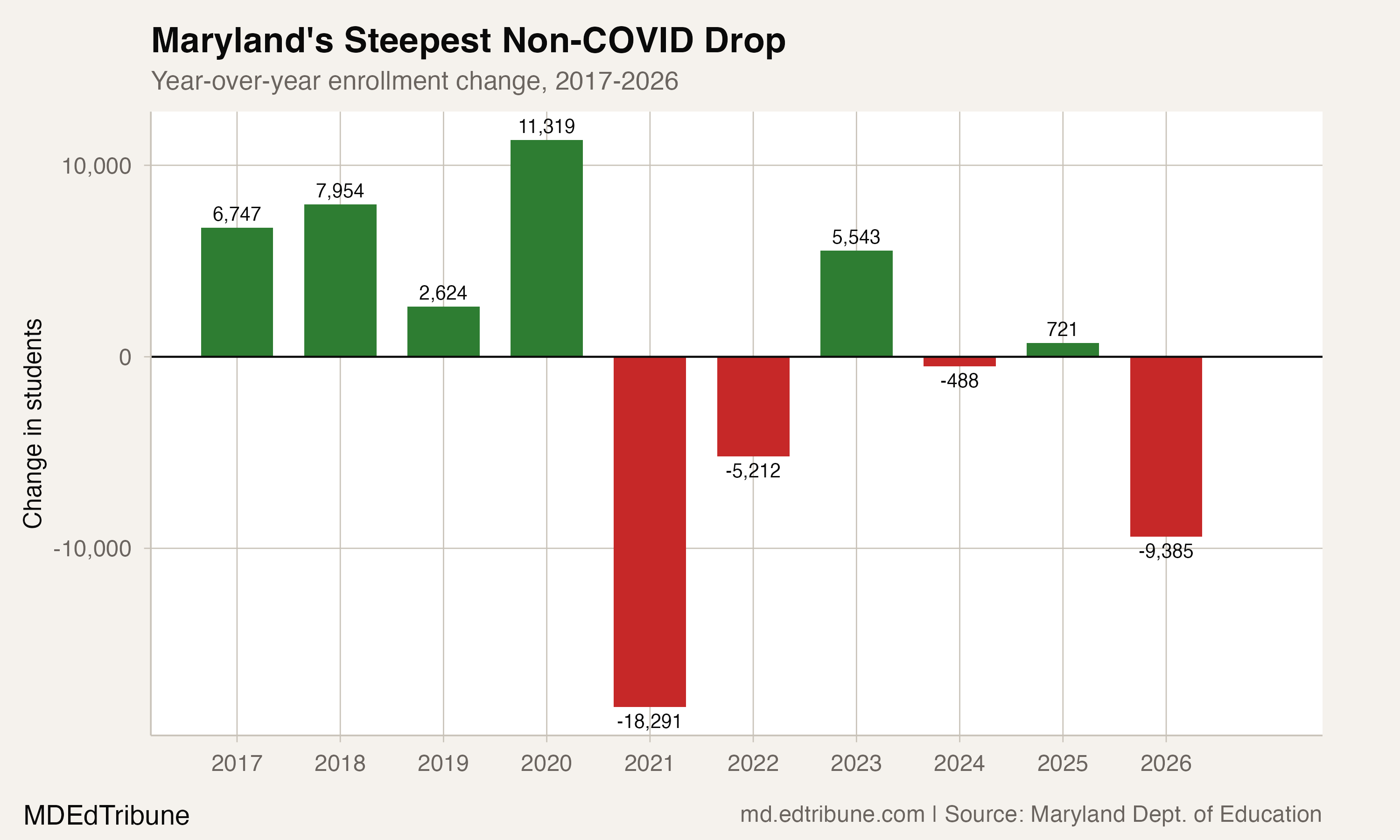
The loss is the steepest non-COVID drop in the available data, nearly double the 5,212-student decline in 2022 and an order of magnitude larger than the modest losses of 2024 (-488) and the slight gain of 2025 (+721). Twenty-three of 24 districts shrank. Only Kent County↗ET, the state's smallest district, grew.
The eleven
The 11 districts at all-time lows collectively enroll 360,793 students, 42.5% of the state total. Their losses account for 62.5% of the total decline among shrinking districts. The list spans every size category and every corner of the state:
I-95 corridor: Montgomery (now 5.4% below its 2020 peak), Baltimore County↗ET (-1,913, 6.3% below peak), Harford↗ET (-415, 3.3% below peak)
Southern Maryland: St. Mary's↗ET (-314, 6.3% below its 2018 peak), Calvert↗ET (-166, 7.8% below its 2016 peak)
Eastern Shore: Cecil↗ET (-222, 8.3% below its 2016 peak), Caroline↗ET (-95, 5.0% below its 2019 peak), Dorchester↗ET (-91, 8.6% below its 2017 peak), Talbot↗ET (-30, 7.1% below its 2020 peak)
Western Maryland: Allegany↗ET (-32, 8.5% below its 2016 peak), Garrett↗ET (-51, 14.7% below its 2016 peak)
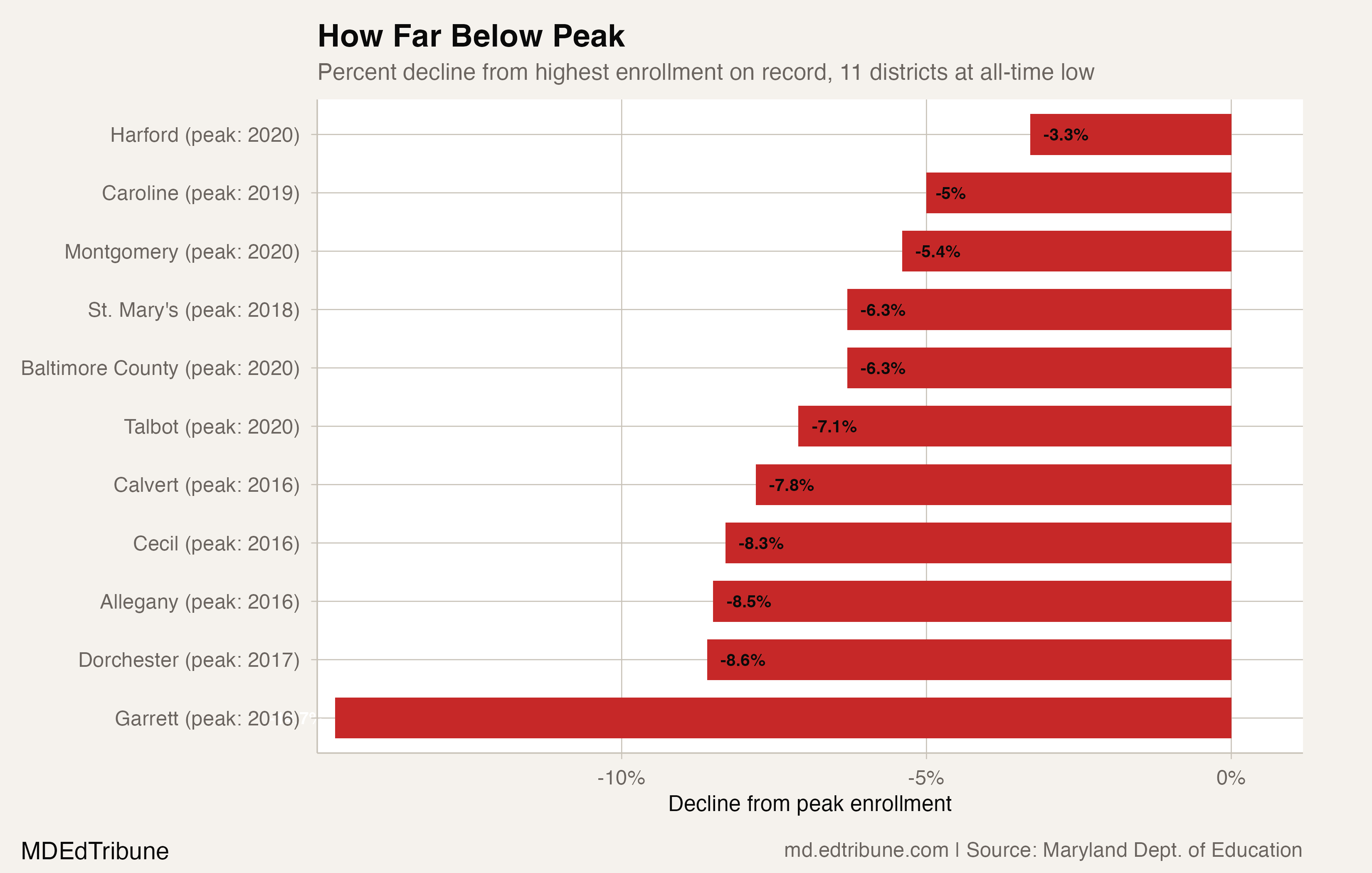
The range tells a story. Montgomery lost the most in absolute terms. Garrett lost 51. But in percentage terms, Garrett's situation is far more severe: at 3,142 students, it has shed nearly one in seven students since 2016. It has declined in seven consecutive years. Baltimore County has declined in six straight. Talbot has declined in six.
A COVID-level concentration
The last time this many districts sat at record lows simultaneously was 2021, the COVID year, when 13 hit bottom. Before that, the count had been falling steadily from 2016 onward as most districts grew. In 2019, just five districts were at their lowest point. In 2020, six.
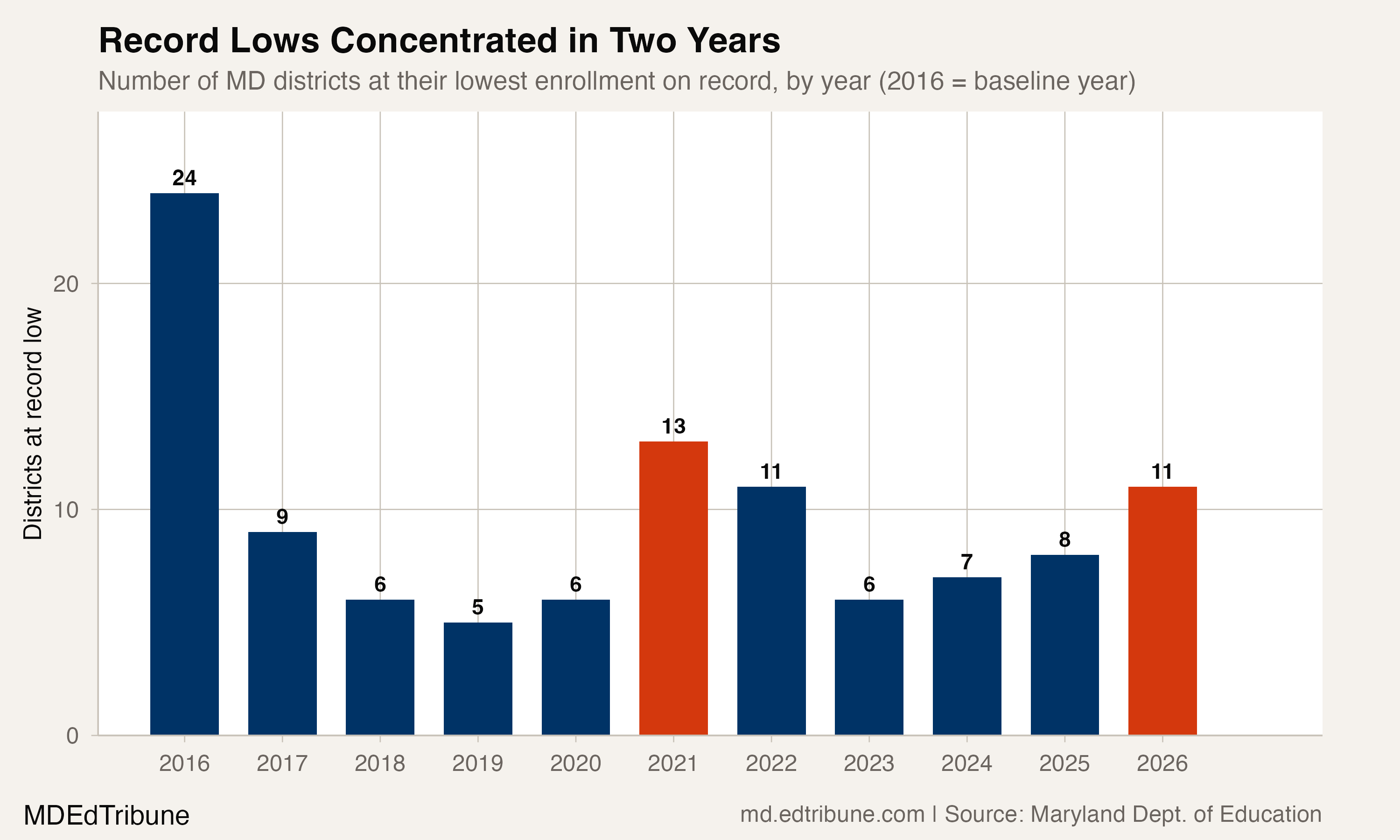
The 2026 figure of 11 is significant because it arrived without a pandemic. In 2021, the cause was obvious: schools closed, families left, the count collapsed. In 2026, schools are open, the economy is functioning, and enrollment fell anyway. The 2021 spike was a shock. The 2026 spike looks structural.
Zero districts set a record high in 2026. In 2025, five did. In 2020, 11 did. The asymmetry is total.
Three forces converging
The most likely driver of the statewide drop is a birth rate decline that is now working its way through the kindergarten pipeline. Maryland births fell from roughly 77,000 per year in 2007-2008 to about 70,000 by 2019-2020, according to Baltimore Banner reporting. In Montgomery County specifically, births dropped from over 13,000 in 2014 to under 11,000 by 2023, according to WJLA. Those smaller cohorts are now entering elementary school while larger cohorts graduate out.
A second factor: homeschooling. Maryland's homeschool enrollment jumped from roughly 28,000 before the pandemic to over 42,000 by the latest reported count, a 51% increase that had not reversed. Alfred Sundara, the state's Assistant Secretary for Data and Analysis, put it directly:
"The missing children in the public school system are in the homeschooling environment and they have not come back." -- Conduit Street / MACo, Sept. 2025
A third, more recent factor is immigration enforcement. Montgomery County, which lost the most students of any district in raw terms, saw its newcomer enrollment drop sharply. Between July and December, the district enrolled roughly 1,540 newcomer students, about half the number from the same period in 2023. School board members in Montgomery County have attributed the decline partly to immigration enforcement, saying some students simply disappeared from the rolls without explanation.
These three forces explain different pieces of the picture. Birth rate decline is structural and affects every district. Homeschooling is a post-pandemic shift that appears sticky. Immigration enforcement is more concentrated in districts with large immigrant populations, particularly Montgomery County. No single cause accounts for a statewide loss of this magnitude.
Where it hits hardest
The percentage declines reveal a different hierarchy than the raw numbers. Dorchester lost 91 students, but that 2.1% drop is the steepest rate among the 11 record-low districts. St. Mary's fell 1.9%. Montgomery, Baltimore County, and Caroline all declined by 1.8%.
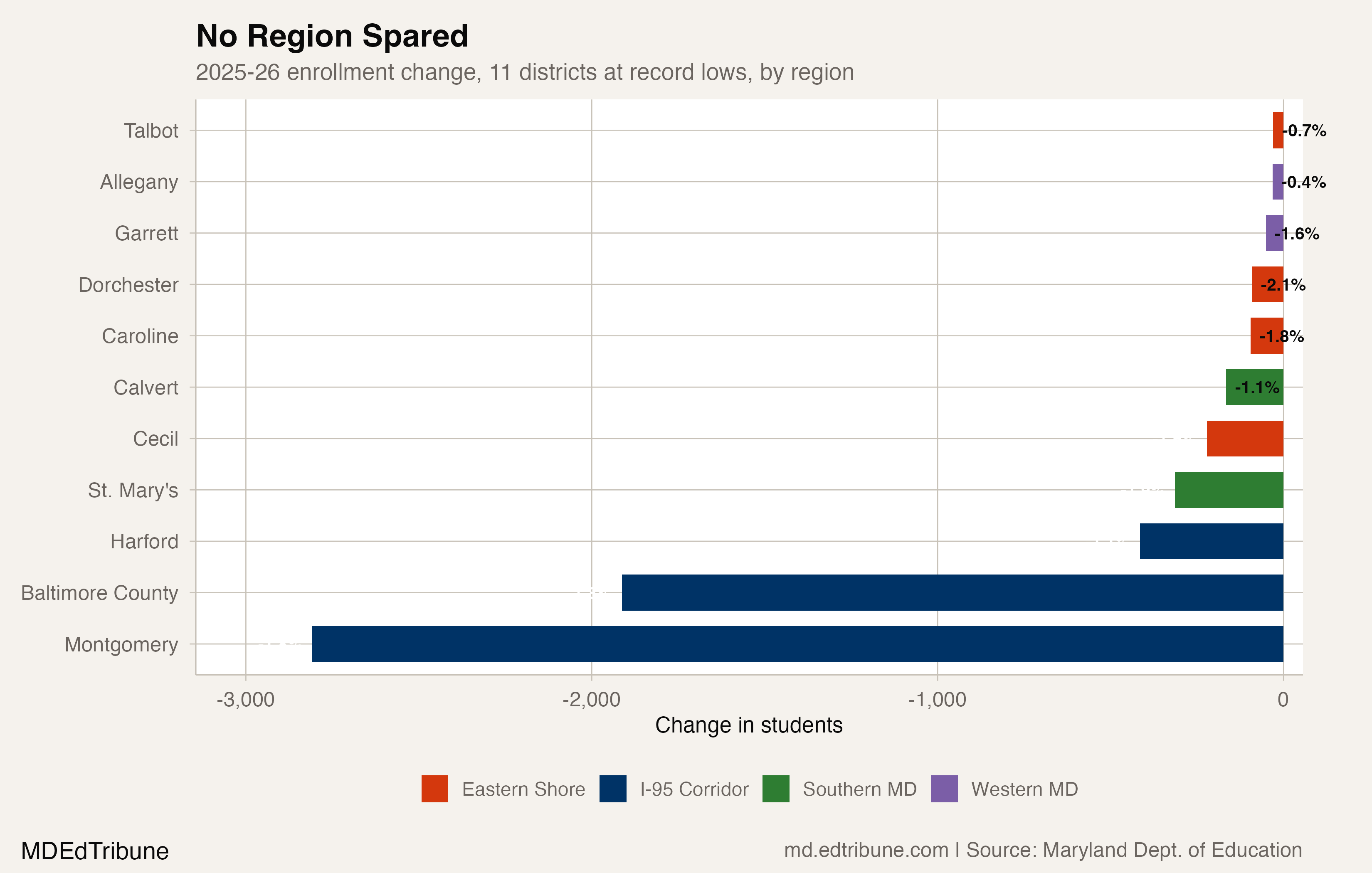
For the rural and small-county districts, the arithmetic is punishing. Garrett County's 3,142 students must sustain the same basic infrastructure that any school system requires: a central office, transportation, special education services, athletic programs. Cecil, at 13,843 students and 8.3% below its 2016 peak, faces the same fixed-cost squeeze. These districts cannot close a wing of a building or merge two schools the way a large suburban system can redistribute students across campuses.
For the large suburban districts, the scale of the losses translates directly into budget pressure. Montgomery's steep single-year decline, combined with Maryland's enrollment-based funding formulas, reduces the resources available to a system that is simultaneously managing rising costs. MCPS Capital Budget Manager Donald Connelly has projected a loss of over 6,000 additional students in the next six years based on birth trends.
The Blueprint gap
Maryland's enrollment decline has a specific policy consequence. The Blueprint for Maryland's Future, the state's landmark $3.8 billion education reform law, funds schools based on enrollment counts. The law was built on pre-COVID growth projections that assumed enrollment would continue rising. Instead, the state is now roughly 32,300 students short of the initial Blueprint estimates for 2025-26. That gap means less funding flowing through the formula than lawmakers anticipated when they designed the program.
IAC Executive Director Alex Donahue suggested the state should focus on "enhancing and maintaining existing schools where possible rather than significantly expanding the number of facilities," a tacit acknowledgment that the growth the law anticipated is not coming.
What remains uncertain
The data cannot distinguish how much of each district's loss comes from which cause. Birth rate decline is well-documented at the state level but varies by county. Homeschooling data is not broken down by district in a way that maps cleanly onto enrollment losses. The immigration enforcement effect is likely concentrated in a few districts, but Maryland does not track enrollment by immigration status.
It is also unclear whether the 2026 drop represents a new equilibrium or an acceleration. The state had been roughly flat from 2023 to 2025, hovering around 858,000-859,000 students. The sudden drop to 849,698 could be a one-time correction, perhaps driven by the immigration enforcement shock, or the beginning of a steeper structural decline as smaller birth cohorts continue to enter the system.
Geoff Sanderson, Maryland's accountability chief, told the Baltimore Banner that the fall was "a bit of a surprise to us." The state's own projections had anticipated around 861,580 students for 2025-26. The actual figure of 849,698 undershot even those reduced projections by nearly 12,000.
The one exception
Kent County's 18-student gain stands out precisely because it is so small and so alone. Kent is Maryland's smallest district by enrollment at 1,609 students. It has been declining for years, losing 300 students since 2016. The 2026 uptick, a 1.1% increase, does not reverse that trend. But in a year when every other district shrank, it is the only data point running the other direction.
The question for Maryland is whether 2026 marks the moment when post-pandemic enrollment stagnation tipped into sustained decline. The birth pipeline suggests it does. The National Center for Education Statistics projects Maryland will lose about 8% of its students by 2031. If that trajectory holds, school systems that were at record lows in 2025-26 will need to make decisions about which buildings to keep open and which programs to fund, decisions that will define Maryland public education for a generation.
Detailed code that reproduces the analysis and figures in this article is available exclusively to EdTribune subscribers.
Discussion
Sign in to join the discussion.
Loading comments...