Clarification, September 24, 2026: This article originally gave Garrett County's enrollment total without saying what the figure counted. It covers kindergarten through grade 12 and excludes prekindergarten. No number has changed.
This is part of The MDEdTribune's series on Maryland's 2025-26 enrollment data.
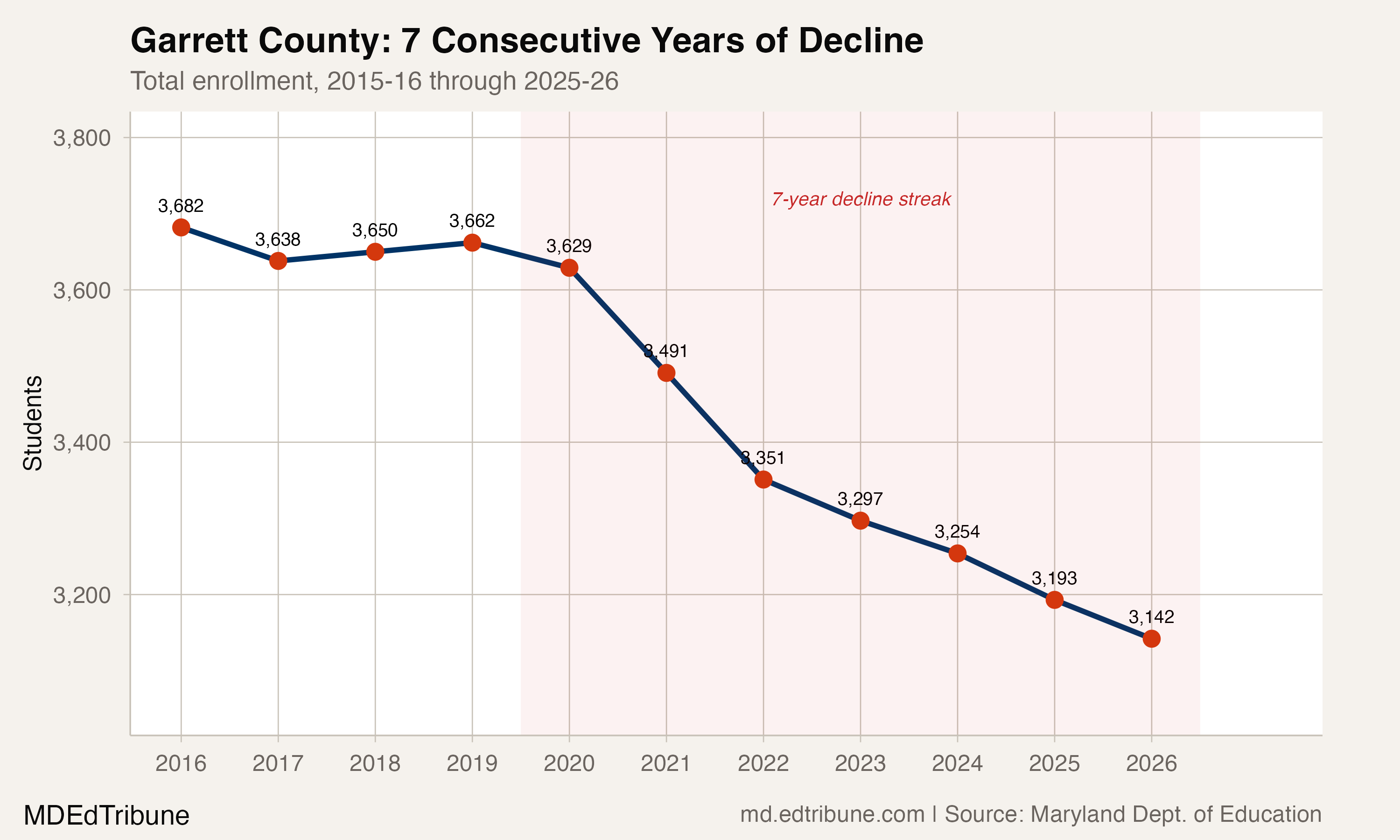
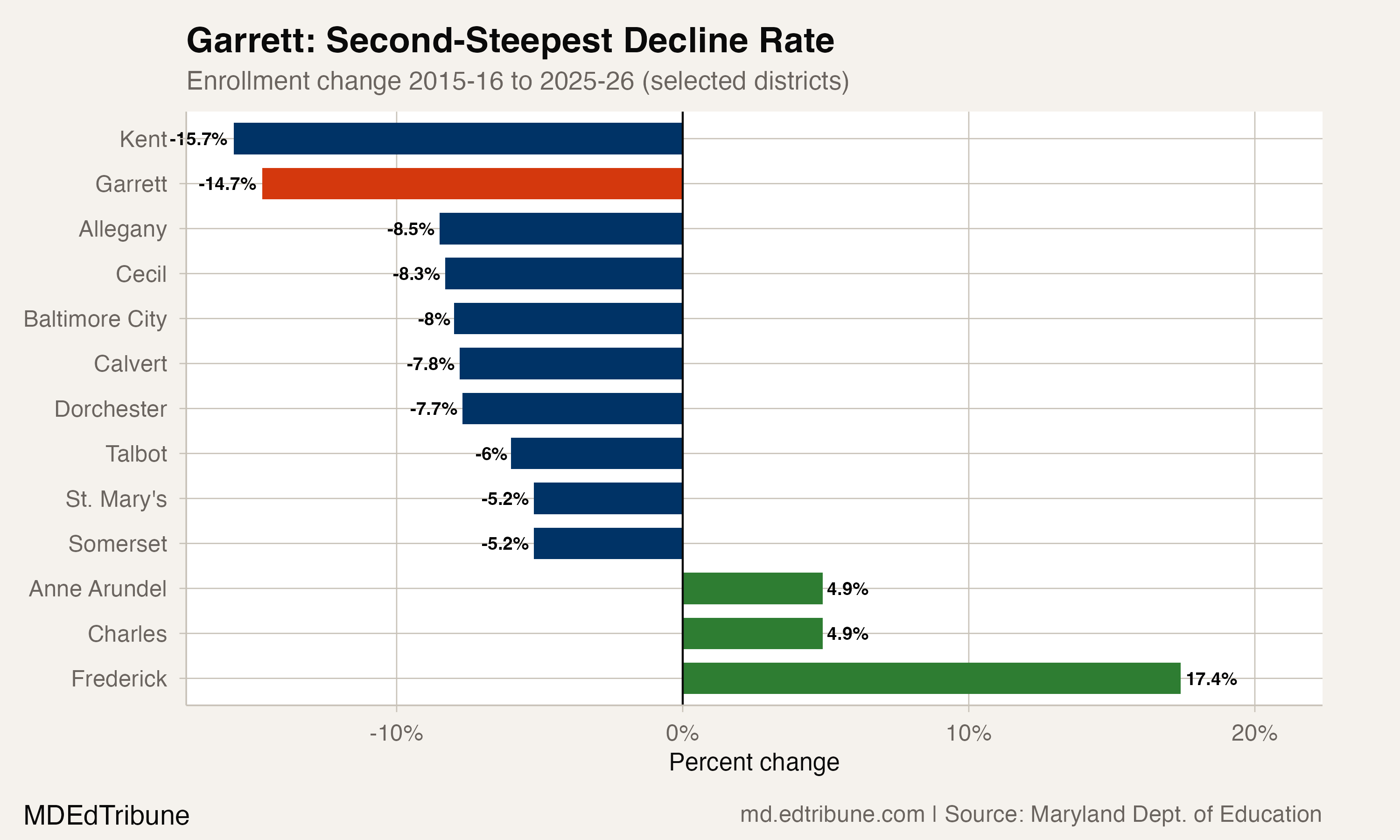
No district in Maryland has declined as persistently as Garrett County↗ET. The state's westernmost school system has lost students every year since 2019-20, a seven-year streak unmatched by any of Maryland's other 23 districts. In 2025-26, Garrett enrolled 3,142 students in kindergarten through 12th grade, down 540 from its 2016 peak of 3,682, a 14.7% loss.
In a county of roughly 28,000 residents with a median age approaching 50, those 540 students represent something more than a budgeting inconvenience. They represent the difference between a school system that can sustain 12 buildings and one that may not be able to.
Seven years, no reprieve
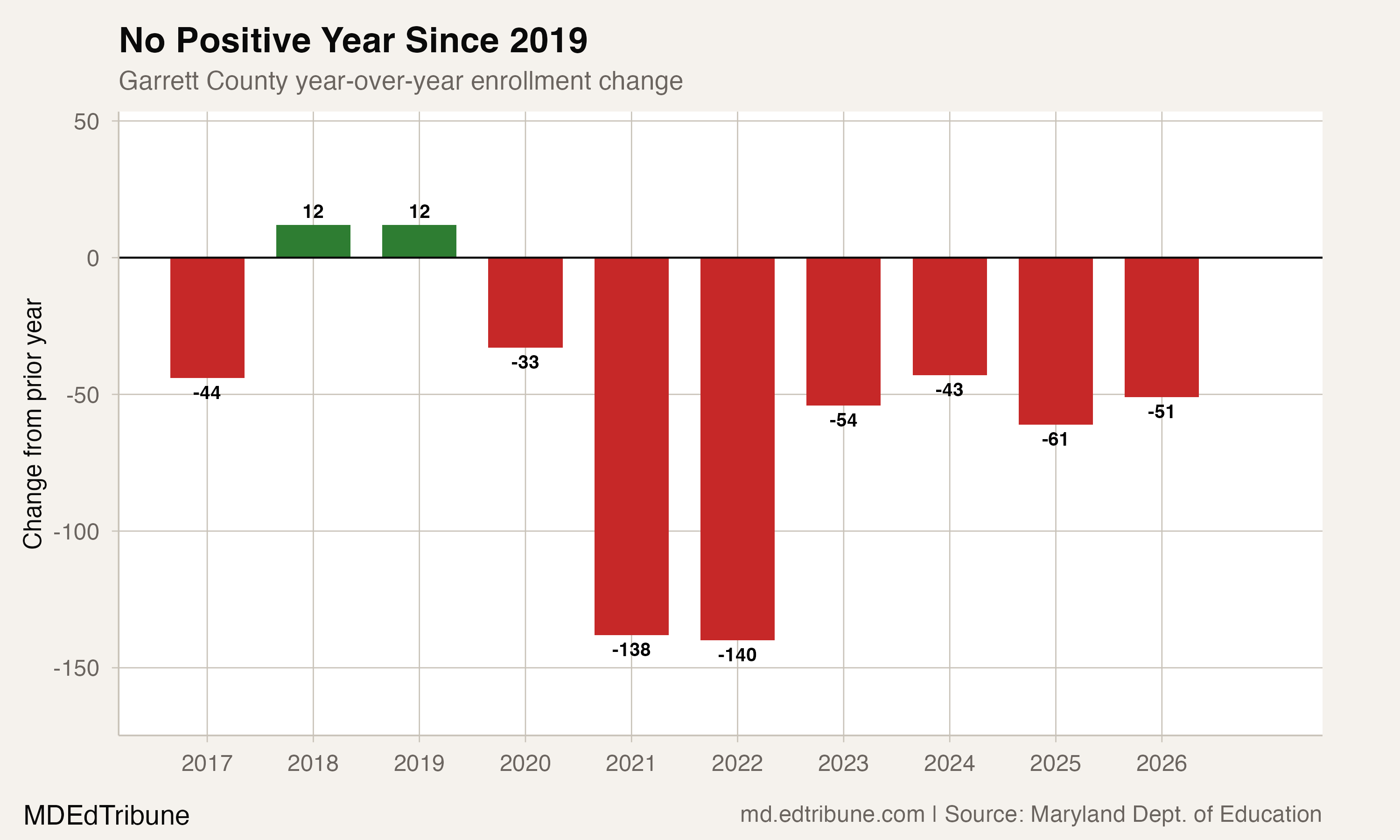
Garrett's last year of growth was 2018-19, when enrollment ticked up by 12 students to 3,662. Every year since has been negative. The COVID years of 2020-21 and 2021-22 hit hardest, with losses of 138 and 140 students respectively. Those two years alone erased 278 students, roughly 7.7% of the pre-COVID total.
The losses have not stopped. Post-pandemic, Garrett has continued to shed 43 to 61 students per year. The 2025-26 loss of 51 students, or 1.6%, shows no sign that the decline is decelerating.
The next-longest active decline streak in Maryland belongs to Baltimore County and Talbot County, each at six years. But Baltimore County's six-year loss of 7,043 students represents 6.3% of its base, while Garrett's seven-year loss of 520 students represents 14.2% of its much smaller starting point. Percentage-wise, Garrett's erosion is more than twice as severe.
A 15-point gap with the state
Indexed to 2015-16, Garrett's enrollment stands at 85.3, meaning the district retains just 85 cents of every enrollment dollar it had a decade ago. Maryland statewide sits at 100.2 over the same period, essentially flat. The 14.9-point gap between Garrett and the state has widened every year since 2020.
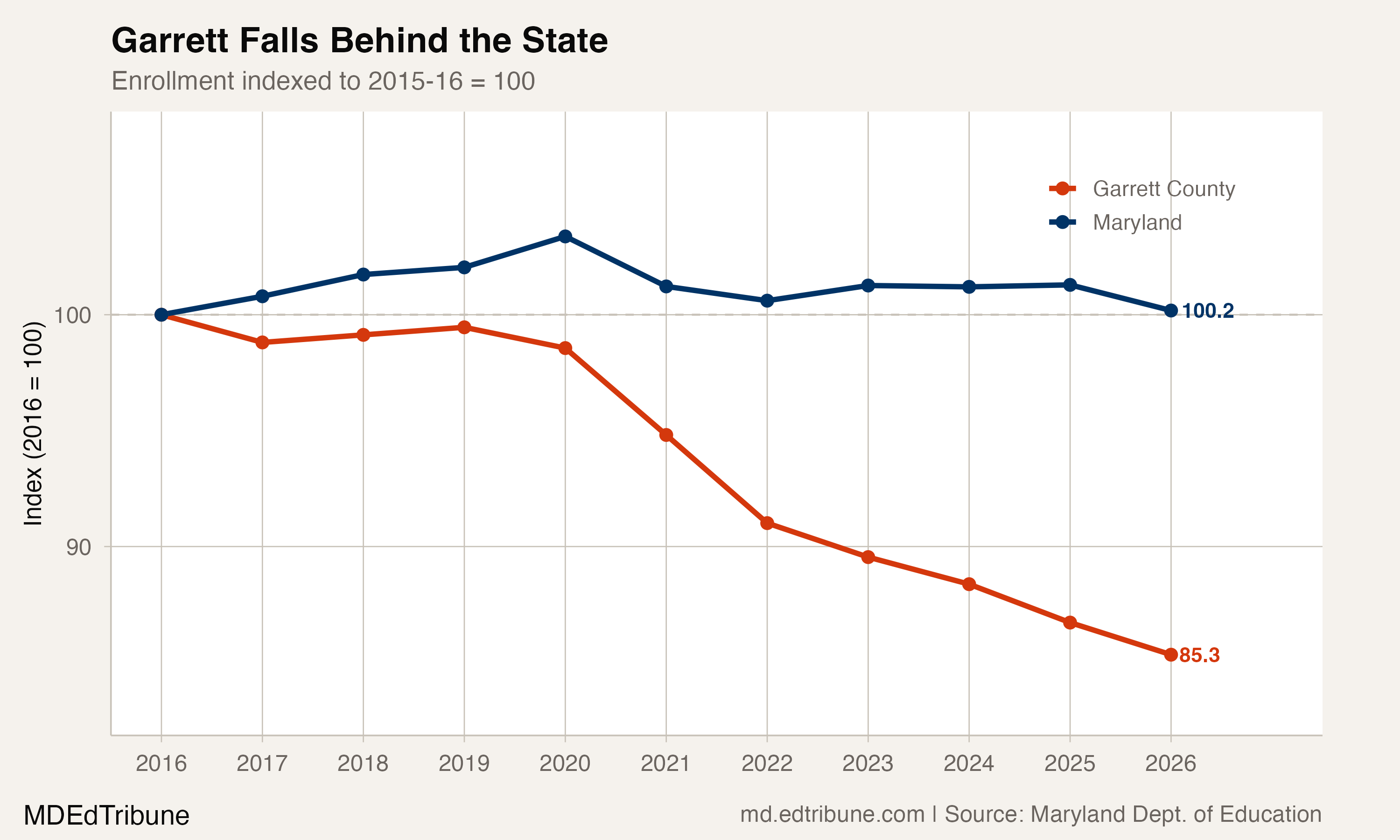
That divergence is not just a Western Maryland story. Garrett's neighbor Allegany County has declined 8.5% over the same period, and Washington County, the largest Western Maryland district, has been roughly flat at -0.8%. Garrett's trajectory is steeper than both.
3,142 students spread across 12 schools. That is an average of 242 students per grade level, or roughly 262 per building. In any other context, those are small-school numbers. In Garrett County, they are the entire public school system.
The pipeline offers no relief
What stands out about Garrett's decline is its uniformity. Between 2019-20 and 2025-26, every single grade level lost students. Seventh grade lost 65 students (-21.4%), the steepest drop. Ninth grade lost 57 (-18.9%). Even 12th grade, where students who entered years ago are aging out, fell by 21 (-7.8%).
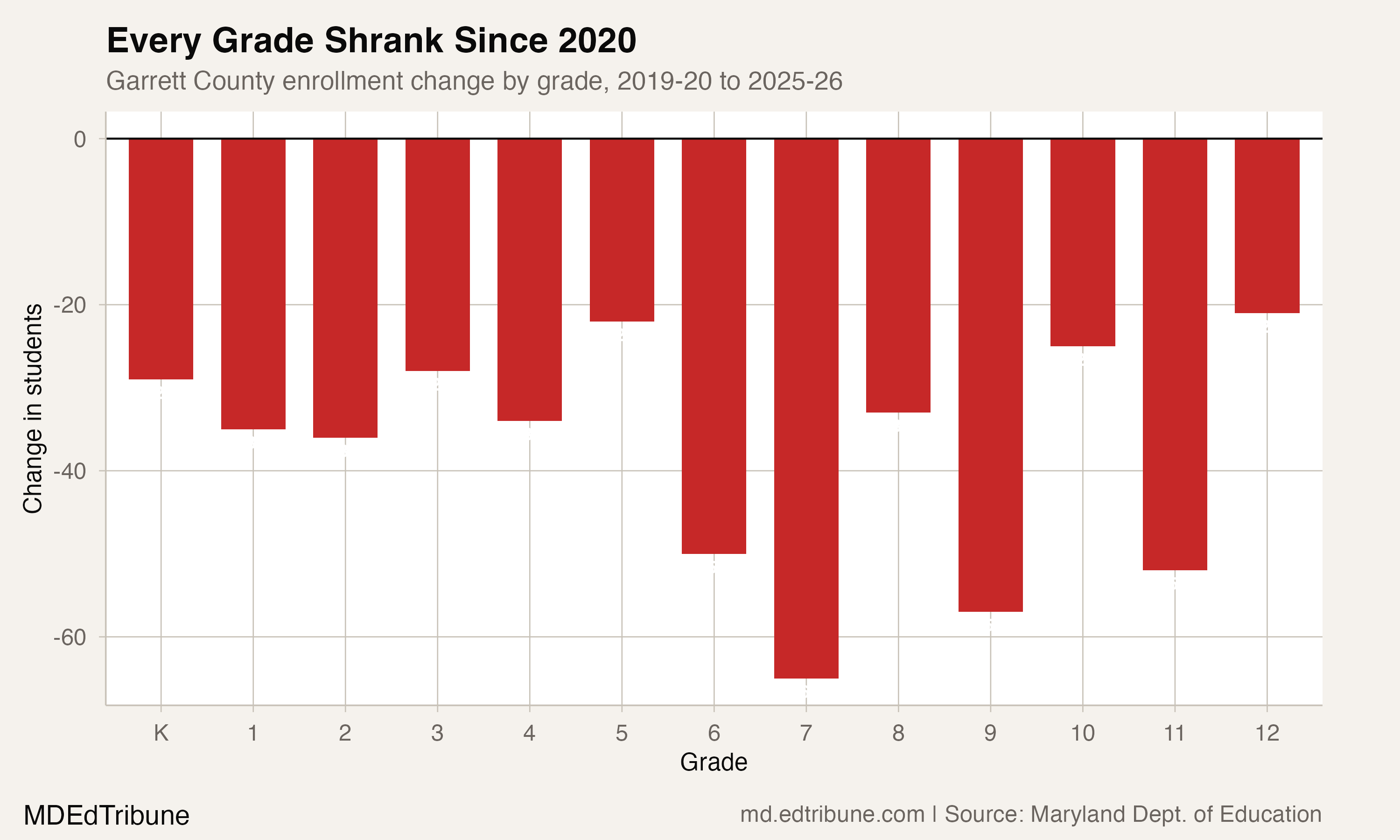
Kindergarten enrollment, which signals the incoming pipeline, has been volatile but directionally down. Garrett enrolled 288 kindergartners in 2015-16 and 239 in 2025-26, a 17.0% decline. The K-8 segment has contracted from 2,561 students in 2016 to 2,155 in 2026, a loss of 406 students or 15.9%. High school grades (9-12) have fallen from 1,121 to 987, a 12.0% decline.
The K-8 losses foreshadow what the high school will look like in four to five years, as those smaller elementary cohorts move upward through the system.
Where the students are going
Garrett County's enrollment decline tracks closely with its population decline. The county's estimated population has fallen from 30,144 in 2010 to roughly 28,175 in 2026, a 6.5% loss. The median age has climbed to 48.3 years, nearly a decade older than Maryland's statewide median of 39.8, reflecting a county where young families are leaving faster than they are arriving.
The most likely driver is demographic: fewer births and sustained outmigration of working-age adults. Garrett is 95% white with no significant immigration pipeline to offset natural population decline. Unlike suburban Maryland districts that can attract families from neighboring jurisdictions or benefit from international migration, Garrett draws from a fixed and shrinking pool. Notably, the county's population has declined roughly 6.5% since 2010 while school enrollment has fallen 14.7% since 2016, suggesting that enrollment is dropping faster than the population itself, likely reflecting the county's aging demographic profile.
A secondary factor may be economic. A 2023 commentary in the Baltimore Sun described the county as caught between "wealthy second homeowners" at Deep Creek Lake and "residents seeking social services," with a disappearing middle class. The author argued that Garrett's county commissioners provide only the legally required minimum funding for schools, despite a robust property tax base inflated by resort properties. Sub-par wages and a high cost of living driven by the vacation economy compound the difficulty of retaining families.
Whether school quality itself is contributing to outmigration is harder to establish. Garrett County Public Schools earned an average star rating of 3.45 on the 2024-25 MSDE report card, slightly above the state average of 3.35. Five of its 12 schools earned four stars. Academic performance, at least by state metrics, does not appear to be the problem.
Funding in a shrinking district
Maryland's Blueprint for Maryland's Future allocates state education funding through a per-pupil foundation formula weighted for student characteristics. A key provision for declining-enrollment districts: the formula uses the greater of prior-year enrollment or a three-year moving average, providing a buffer against sudden drops.
That buffer helps with one-year shocks. It does less for a district in its seventh consecutive year of decline, where the three-year average is itself declining. Each year Garrett loses 50 students, the moving average catches up to reality, and the funding floor drops with it.
The Maryland Department of Planning projects that Garrett will lose an additional 374 students, or 11.5%, between 2024 and 2033. If that projection holds, the district would fall below 2,900 students within the decade.
The homeschool unknown
Enrollment data alone cannot distinguish between families leaving Garrett County entirely and families switching to homeschooling or private alternatives within the county. Maryland does not publish homeschool enrollment at the county level in a way that allows year-over-year comparison. In a county where 84% of residents live in rural areas, homeschooling may be a more viable option than in dense suburban districts.
The data also cannot capture the operational consequences of losing 242 students per grade level in a 12-school system. At what point does a building become too small to staff efficiently? At what point does a school close? Those are decisions that enrollment trends can inform but not make.
Watching the kindergarten line
The question facing Garrett County is whether the decline flattens or accelerates. The county's population is aging, and each year's kindergarten class reflects birth cohorts from five years earlier, when the county was already shrinking. The 2025-26 kindergarten class of 239 is 17% smaller than the 2015-16 class of 288.
If Garrett's kindergarten enrollment continues at roughly 230 to 240 per year, the district is on a path toward 3,000 students by 2028 or 2029. At 12 schools, that is 250 students per building. The question is not whether the district is shrinking. It is whether 12 buildings can serve a district of that size, and what happens to the communities around them when they cannot.
Detailed code that reproduces the analysis and figures in this article is available exclusively to EdTribune subscribers.
Discussion
Sign in to join the discussion.
Loading comments...