Clarification, September 24, 2026: This article originally gave Montgomery County's enrollment total without saying what the figure counted. It covers kindergarten through grade 12 and excludes prekindergarten. No number has changed.
This is part of The MDEdTribune's series on Maryland's 2025-26 enrollment data.
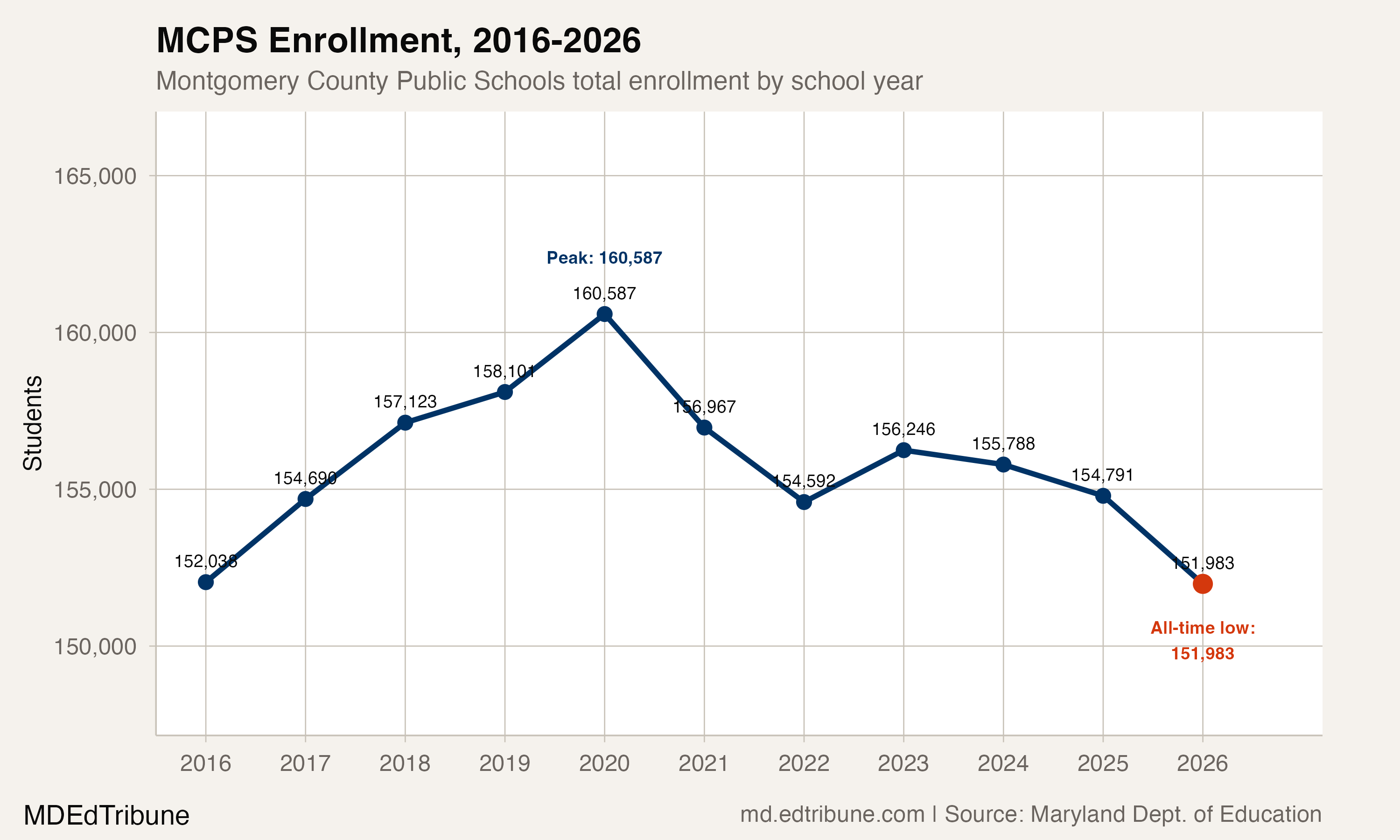
Montgomery County↗ET Public Schools enrolled 151,983 students in kindergarten through 12th grade in fall 2025 — fewer than any year on record, including 2016, when the dataset begins. The 2,808-student loss is the district's worst outside of the pandemic year itself, and it dropped MCPS below even the 152,038 baseline that predates a decade of construction and hiring.
Between 2016 and 2020, the district had added 8,549 students, peaking at 160,587. That growth justified new schools, expanded programs, a capital plan built around more kids arriving. The trajectory reversed, and MCPS has now given back every student it gained plus 55 more.
The acceleration no one budgeted for
The year-over-year numbers tell a story of compounding losses. After COVID drove a 3,620-student drop in 2020-21, the district partially recovered in 2022-23, adding 1,654 students. That recovery has evaporated. Losses of 458 in 2023-24 became 997 in 2024-25, then nearly tripled to 2,808 in 2025-26.
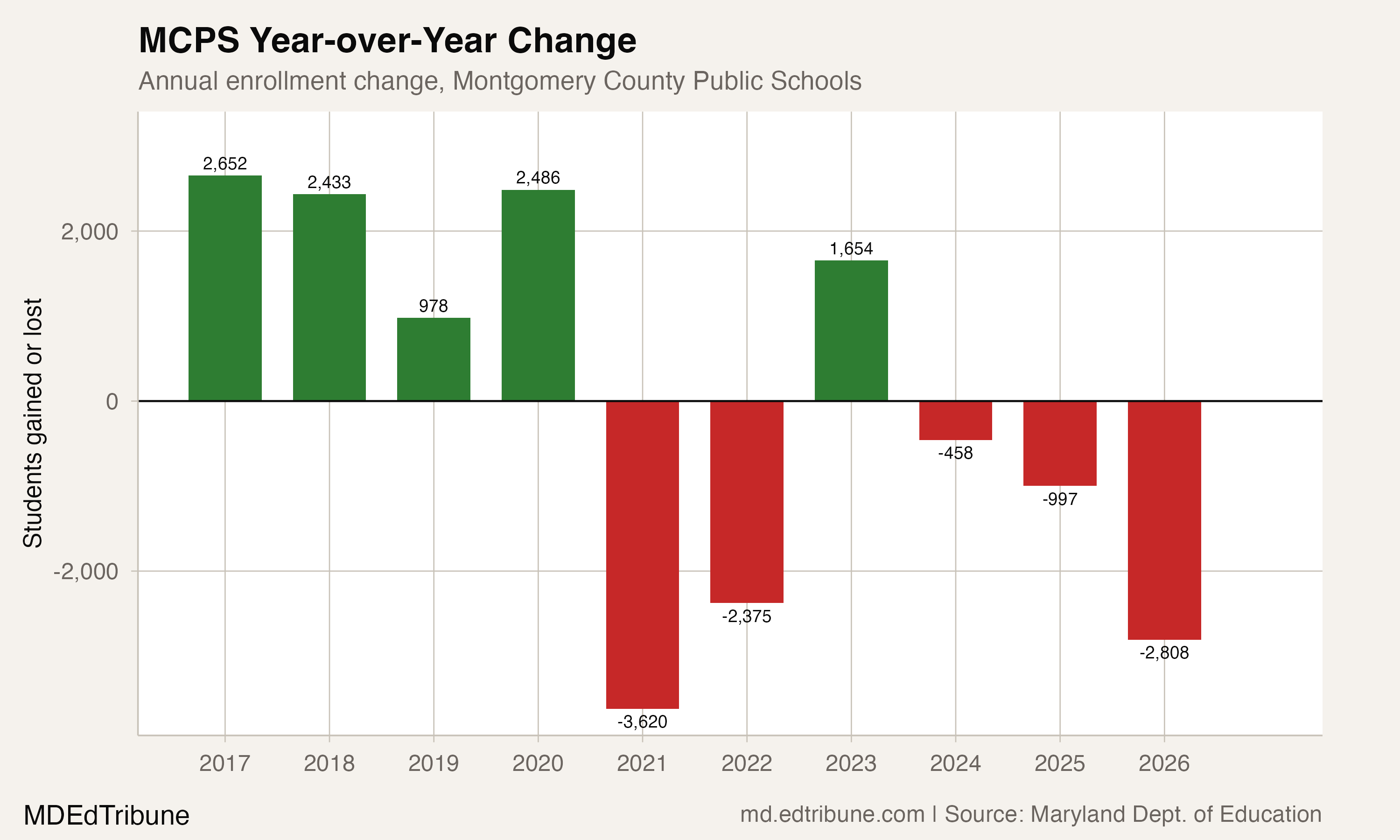
The 2,808-student decline is the largest outside of the pandemic year. It accounts for nearly a third of Maryland's statewide loss, despite Montgomery representing 17.9% of total state enrollment. The district is losing students faster than its share of the state would predict.
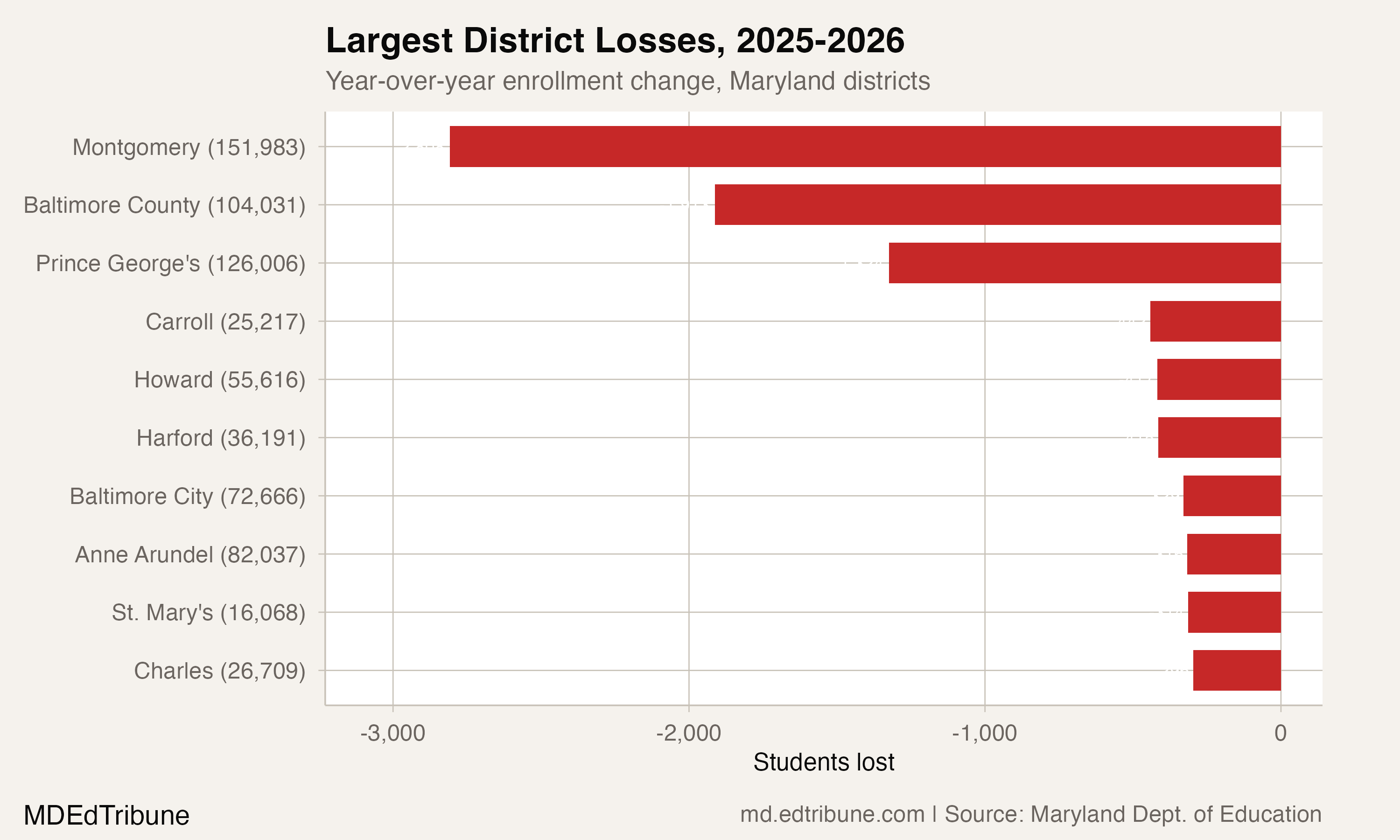
Montgomery is not alone. Twenty-three of Maryland's 24 districts lost students in 2025-26. Only Kent County, the state's smallest district, grew. But no district matched Montgomery's raw loss. Baltimore County (-1,913) and Prince George's (-1,324) were the next largest decliners. Together, the three districts account for 61.7% of the statewide drop.
Fewer babies, fewer kindergartners
The most straightforward explanation is demographic. Montgomery County births fell from roughly 13,200 per year in 2014 to about 10,900 by 2023, a pattern that flows directly into kindergarten classrooms five years later.
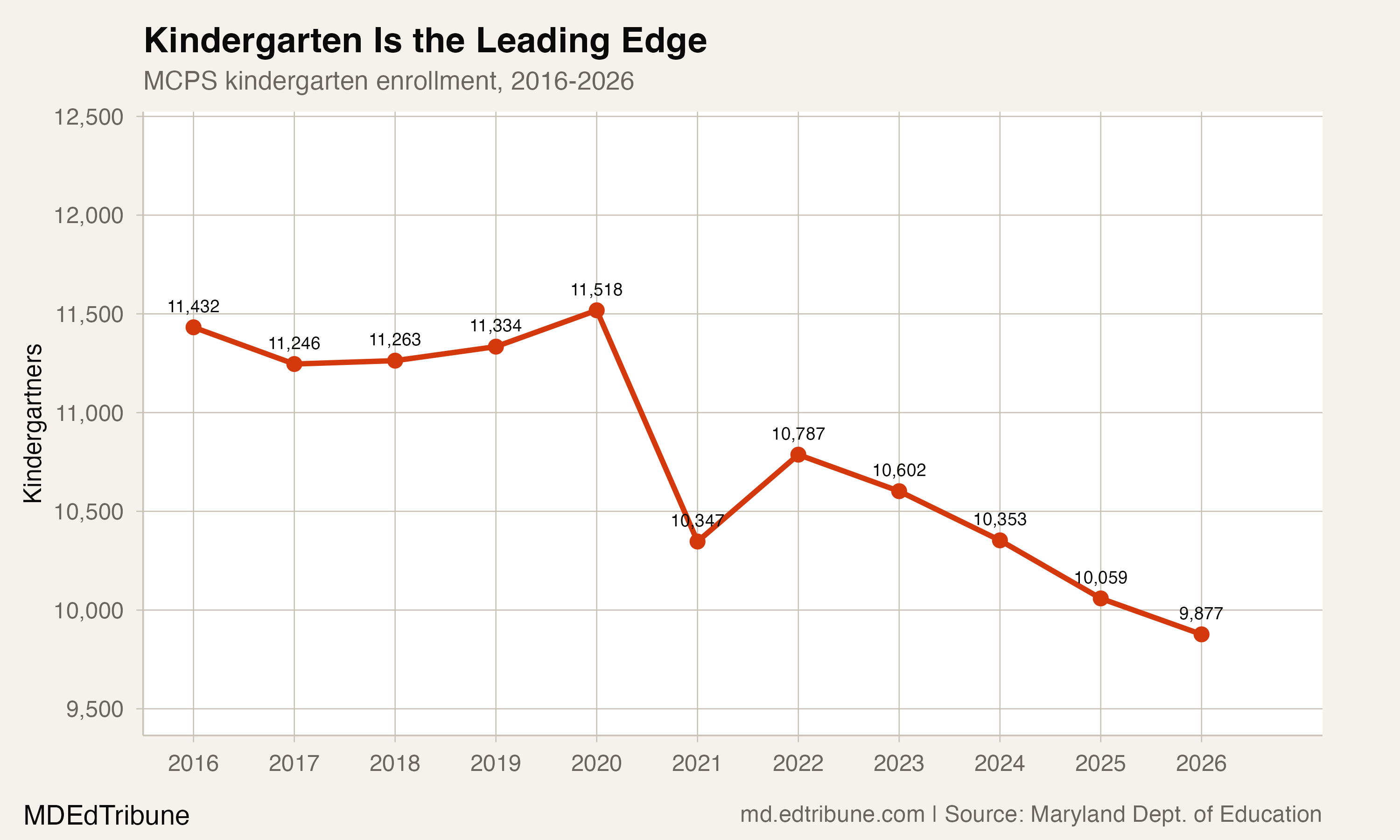
MCPS kindergarten enrollment has dropped from 11,518 in 2019-20 to 9,877 in 2025-26, a decline of 1,641, or 14.2%. The kindergarten class is now the smallest in the dataset.
Donald Connelly, MCPS capital budget manager, described the link directly: "What that does is that translates five years later, six years later to kindergarteners."
The birth-rate effect is not limited to kindergarten. It cascades upward. Elementary grades (K-5) have shed 6,458 students since the 2020 peak, a 9.0% decline. Middle school (6-8) lost 2,369 students, or 6.3%. High school (9-12), still graduating the larger cohorts born before 2010, is essentially flat, up 223 students, or 0.4%.
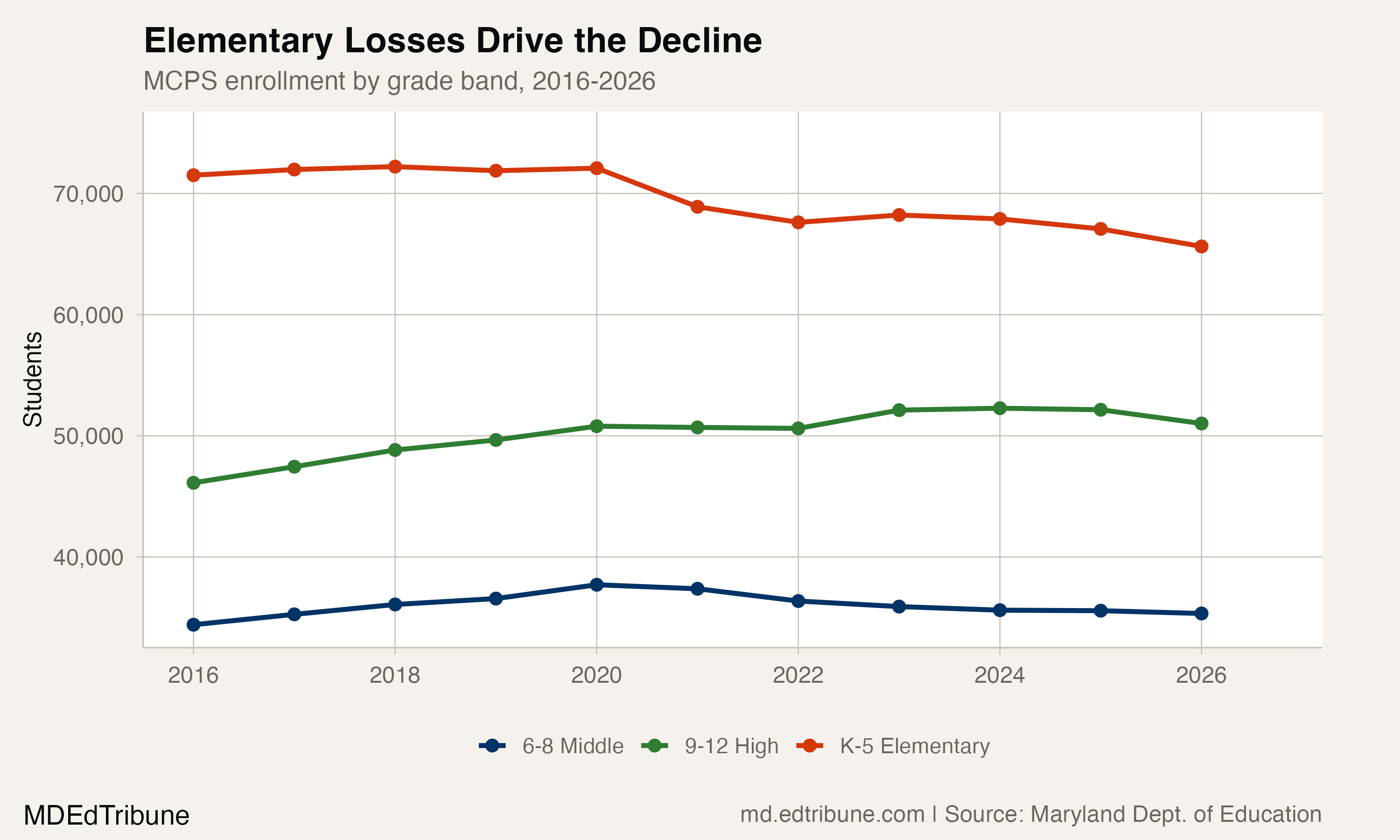
That high school stability is temporary. The smaller elementary cohorts will reach ninth grade within three to four years, and the district knows it. MCPS projects enrollment falling to roughly 149,700 by 2031-32, a 9% decline from its 2019 peak, according to the Baltimore Banner.
The newcomer collapse
Declining births alone would produce a gradual, predictable slide. What made 2025-26 different was a second, sharper force: a collapse in international student enrollment.
MCPS enrolled 1,544 international students from July to December 2025, down from 2,787 during the same period in 2024, and 3,082 in 2023. That is a 50% decline in two years. Monthly newcomer enrollment, which had been running above 400, fell to 111 by October 2025.
Superintendent Thomas Taylor acknowledged the drop but was cautious about attribution. He told the Baltimore Banner: "It may be causation, but it's definitely correlation."
Others were more direct. Brenda Wolff, vice president of Montgomery County's school board, told the Baltimore Banner:
"With what's going on with ICE, some of our students, we just don't know where they went. People are afraid."
Oscar Alvarenga, MCPS newcomer transition coordinator, described the operational reality:
"The volatility of the current immigration climate has significantly increased the demand of crisis intervention."
The connection between federal immigration enforcement and school enrollment is difficult to quantify precisely. MCPS does not collect immigration status data, and families who leave do not always explain why. What the enrollment data can show is that the timing of the newcomer decline aligns with the escalation of enforcement activity in 2025. Whether the effect is driven by departures, deterred arrivals, or families enrolling children elsewhere, the net impact on MCPS headcount is measurable.
A third pressure point: federal jobs
Montgomery County has one of the highest concentrations of federal workers in the country. Nearly 25,000 federal positions in Maryland were cut in 2025, with Montgomery and Prince George's counties absorbing a disproportionate share.
The Baltimore Banner reported that the loss of up to 15,000 jobs could have contributed to families relocating for other employment. Whether federal layoffs have already moved the enrollment needle in 2025-26 is uncertain. The effect may appear more clearly in next year's counts, as families exhaust severance and make longer-term decisions about where to live.
What the funding formula sees
Superintendent Taylor framed the situation as unfamiliar territory:
"This is an uncomfortable conversation for Montgomery County, because this has not been our experience for much of the past few decades. We've added a lot of housing, and we've added a lot of people, and we've grown very fast, but something else has changed. The percentage of households that have children has dramatically reduced."
Maryland funds schools on an enrollment basis. Under the Blueprint for Maryland's Future, the state's $30 billion, 10-year education reform plan, enrollment-driven formulas mean fewer students translate directly to less revenue. The state is already bracing for a $1.4 billion budget shortfall. Districts cannot reduce fixed costs, such as building maintenance, transportation routes, and administrative staff, at the same rate they lose per-pupil dollars.
MCPS is attempting to turn the decline into an advantage. The superintendent proposed using declining headcount to reduce class sizes by at least one student per class at the elementary level, maintaining current staffing while enrollment drops. That FY27 budget proposal totals $3.775 billion, a 5% increase over the prior year.
The district is also reconsidering its capital plan. Crown High School in Gaithersburg, originally scheduled to open in 2027 as a new comprehensive high school, may instead serve as a temporary holding site while aging buildings undergo renovation, though a February 2026 proposal would relocate Wootton High School there permanently.
Blind spots
The enrollment data shows what happened but not why each family left. The birth-rate explanation is strong for elementary grades, where smaller cohorts are working their way through the pipeline year by year. The newcomer collapse is corroborated by MCPS's own intake data. Federal job losses are plausible but harder to trace directly to school enrollment.
What remains unknown is the role of housing costs. Montgomery County median home prices have risen sharply, and young families may be choosing to live elsewhere in the metro area. The homeschool population in Maryland grew from about 28,000 in 2020 to more than 42,000 in 2025, though how much of that growth comes specifically from Montgomery County is not broken out in state data.
The question for 2027
Montgomery County's 2026 kindergarten class, 9,877 students, was born around 2020, when county births were still above 11,000. The children entering kindergarten in 2028 and 2029 were born during years when births dipped closer to 10,900. Unless newcomer enrollment recovers or families with young children begin moving into the county at rates that offset the birth decline, the pipeline suggests the current trajectory will persist.
The district's own projection of 149,700 students by 2031-32 assumes a steady glide. If the newcomer collapse deepens, or if federal job losses accelerate outmigration, the actual number could be lower. The 2026-27 count, due in fall 2026, will be the first test of whether the forces that produced this all-time low are stabilizing or still gathering speed.
Detailed code that reproduces the analysis and figures in this article is available exclusively to EdTribune subscribers.
Discussion
Sign in to join the discussion.
Loading comments...