This is part of The MDEdTribune's series on Maryland's 2025-26 enrollment data.
The wave nobody staffed for
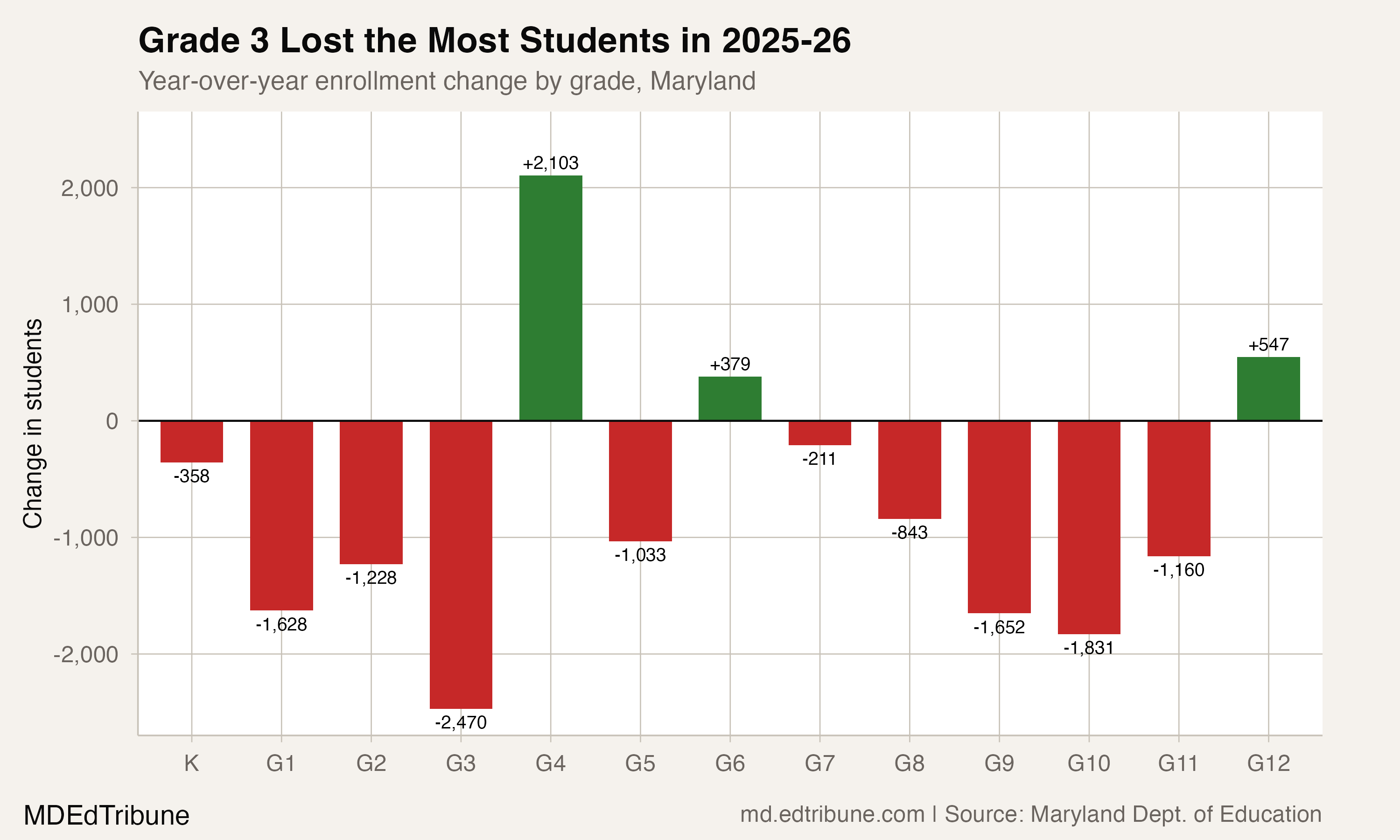
Every grade in Maryland lost students in 2025-26 except three. Grade 4 gained 2,103 students, Grade 12 added 547, and Grade 6 picked up 379. Grade 3 lost 2,470. Grades 3 and 4 sit side by side in elementary school hallways, and the contrast between them is not a coincidence. It is the same event, viewed from two angles.
The class that entered kindergarten in fall 2021, during the deepest trough of pandemic enrollment, is now in fifth grade. But the disruption it left behind did not end when families came back. The pandemic created an uneven sequence of kindergarten classes, some larger, some smaller, and that sequence is still moving through Maryland's grade structure like a pressure wave. Third grade absorbed the sharpest hit in 2025-26: a 3.7% decline, the largest at any grade level, as a relatively large cohort aged out and a smaller one took its place.
How cohort arithmetic works
The mechanics are straightforward, once you trace each class to its kindergarten origin.
The students in third grade last year (2024-25) were the kindergarten class of 2021-22: 61,671 children who entered school during the first big bounce-back from the pandemic trough. That was the largest K class since COVID hit, and as it moved through the grades, it inflated each one in turn. Third grade in 2024-25 reached 66,787.
In 2025-26, that bounce-back cohort moved to fourth grade, which is why fourth grade gained 2,103 students. The cohort replacing them in third grade entered kindergarten in 2022-23: just 60,986 students, about 700 fewer. The swap produced the largest single-grade decline in the state.
The pattern is predictable. Next year, when the K-2022 bounce-back class moves to fifth grade, that grade will likely see a gain. Third grade will receive the even smaller K-2023-24 class (60,514 kindergartners) and could shrink again. Each year, each grade experiences the pandemic's enrollment distortion on a slight delay.
A pipeline running dry
The COVID trough is only part of the story. Behind it, the kindergarten pipeline itself is contracting.
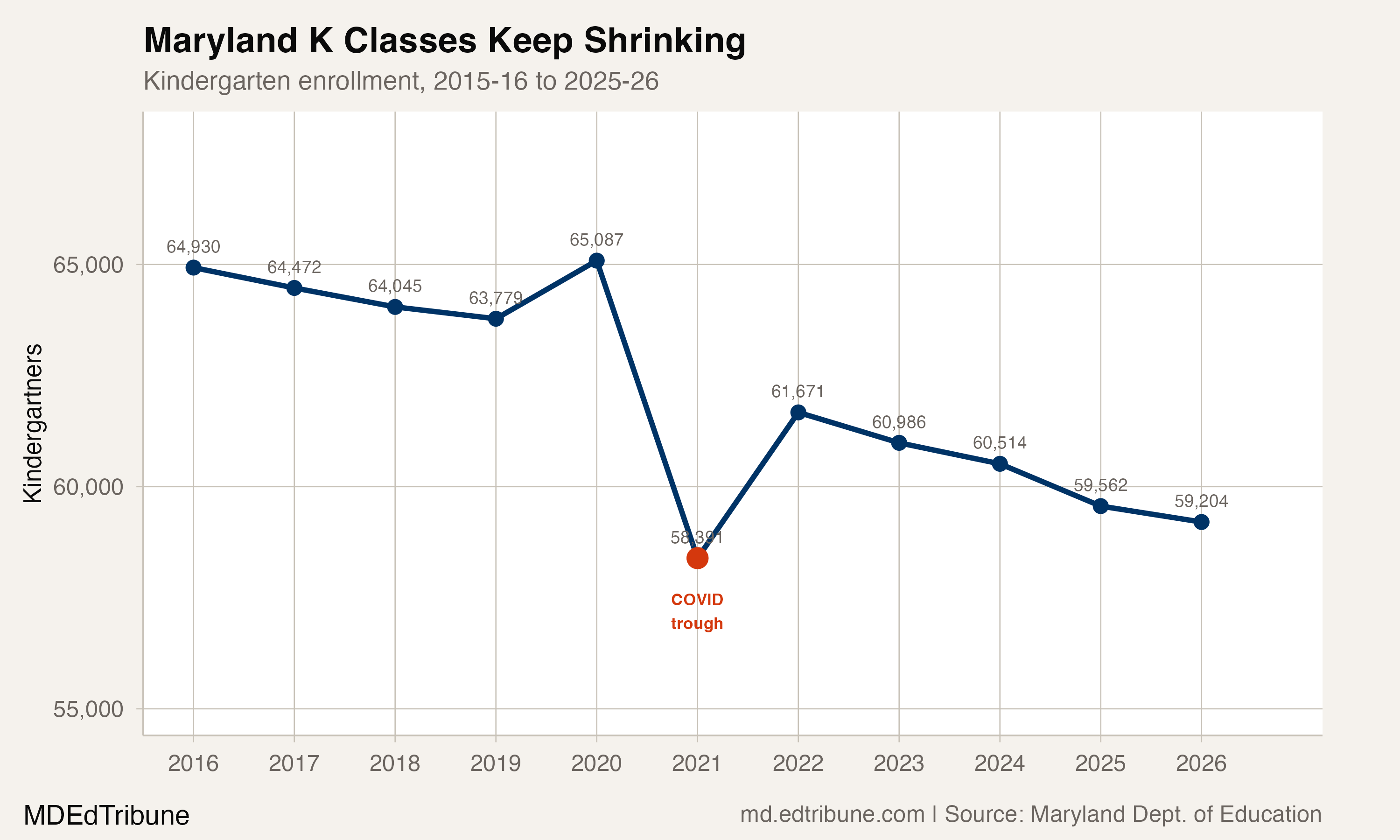
Maryland enrolled 65,087 kindergartners in 2019-20, an unusually large class and the highest in the dataset. By 2025-26, that number had fallen to 59,204, a decline of 9.0%. Even measured against the more typical 2018-19 class of 63,779, the current K class is 7.2% smaller. No post-COVID K class has come within 3,400 students of the pre-pandemic average. The average pre-COVID K class (2016 to 2020) was 64,463 students. The average post-COVID K class (2021 to 2026) is 60,055, a gap of roughly 4,400 students per year.
The immediate cause is demographic. Maryland's birth rate has been declining since the 2007-09 recession, and Montgomery County alone saw births fall from over 13,000 in 2014 to under 11,000 by 2023. "We are continuing to see an enrollment decline because of those live births and you can see where we are headed in the next six years," MCPS Capital Budget and Projects Manager Donald Connelly told the Montgomery County school board in October 2025.
But birth rates alone did not produce the jagged grade-by-grade pattern. The pandemic layered a one-time disruption on top of a long-term trend. The K-2021 class (58,391) was an anomaly, roughly 6,700 students smaller than the 2020 class (65,087). Many families delayed entry or chose homeschooling. When those families returned the following year, they created the K-2022 bounce-back. Now both the trough and the bounce are moving through the system simultaneously, producing adjacent grades that swing in opposite directions.
Where the losses landed
Montgomery↗ET lost more third-graders than any other district: 543 students, a 4.6% decline. Prince George's↗ET lost 403 (-4.0%), and Howard↗ET lost 201 (-4.7%). All three are large suburban systems where even modest percentage drops translate to hundreds of empty seats.
But the sharpest percentage declines hit smaller jurisdictions. Dorchester↗ET County lost 80 of its 361 third-graders, a 22.2% drop. Worcester↗ET lost 85 out of 491 (-17.3%). Carroll↗ET County fell 7.2%, and Frederick↗ET 5.2%. Only three of Maryland's 24 districts gained third-graders: Calvert (+31), Talbot (+24), and Allegany (+8).
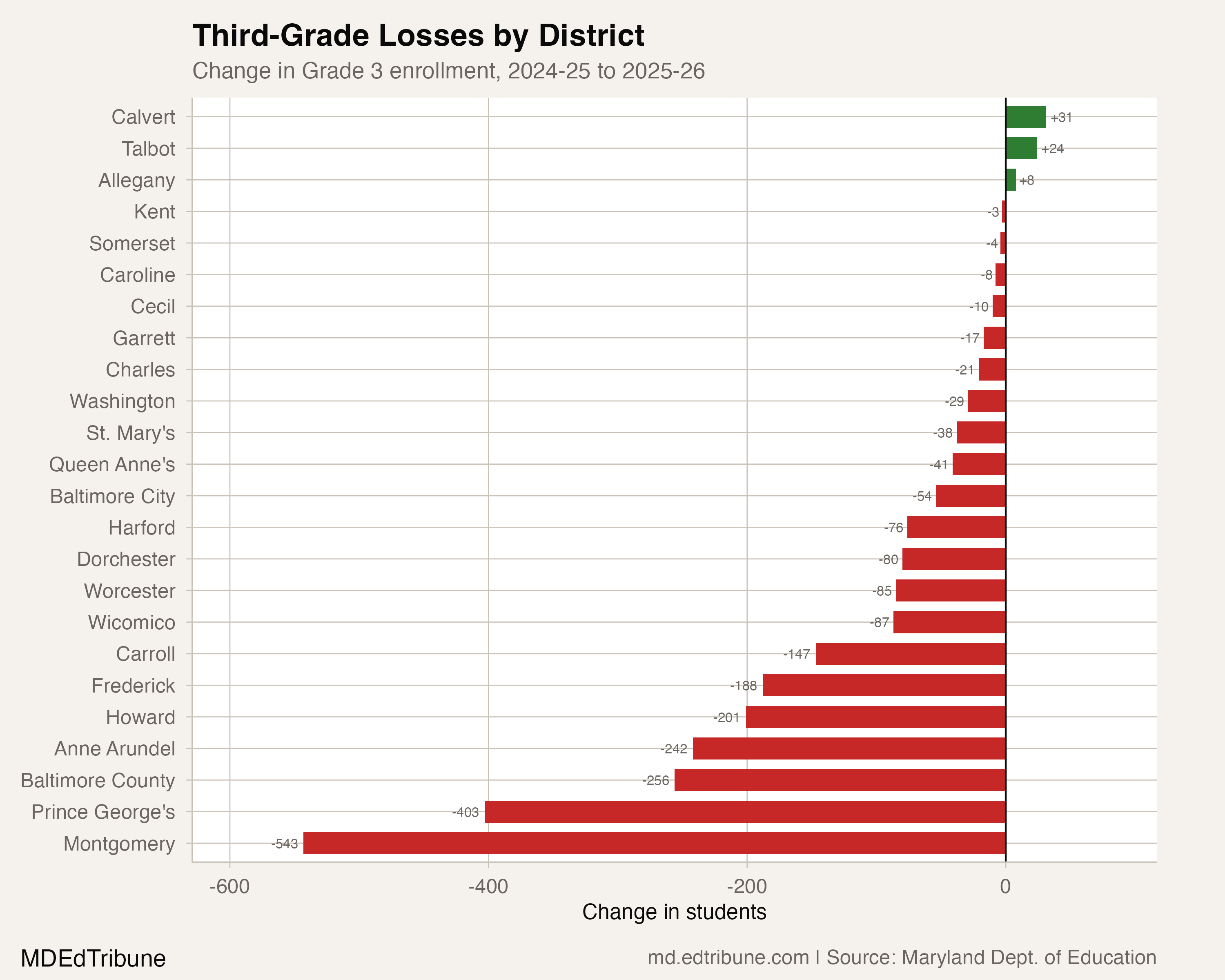
The near-universality of the decline matters. When 21 of 24 districts lose students in the same grade in the same year, the explanation is structural. This is a cohort-size effect, not a policy failure in any single county.
Five cohorts, five trajectories
Tracking individual K classes as they age through the system reveals how differently each cohort moves.
The K-2019 class (63,779 kindergartners) followed a conventional trajectory, gaining students as it aged through elementary school. The K-2020 class (65,087) entered kindergarten just before the pandemic disrupted everything, and its progression was relatively normal. The K-2021 class (58,391) started far below the others, but has gained students at every grade since, absorbing children who delayed school entry. By Grade 5 in 2025-26, it had grown to 65,076, nearly closing the gap with older cohorts. The K-2022 bounce-back class (61,671) has been the largest post-COVID cohort at every grade it has passed through. And the K-2023 class (60,986) is tracking below its predecessor, continuing the downward pressure.
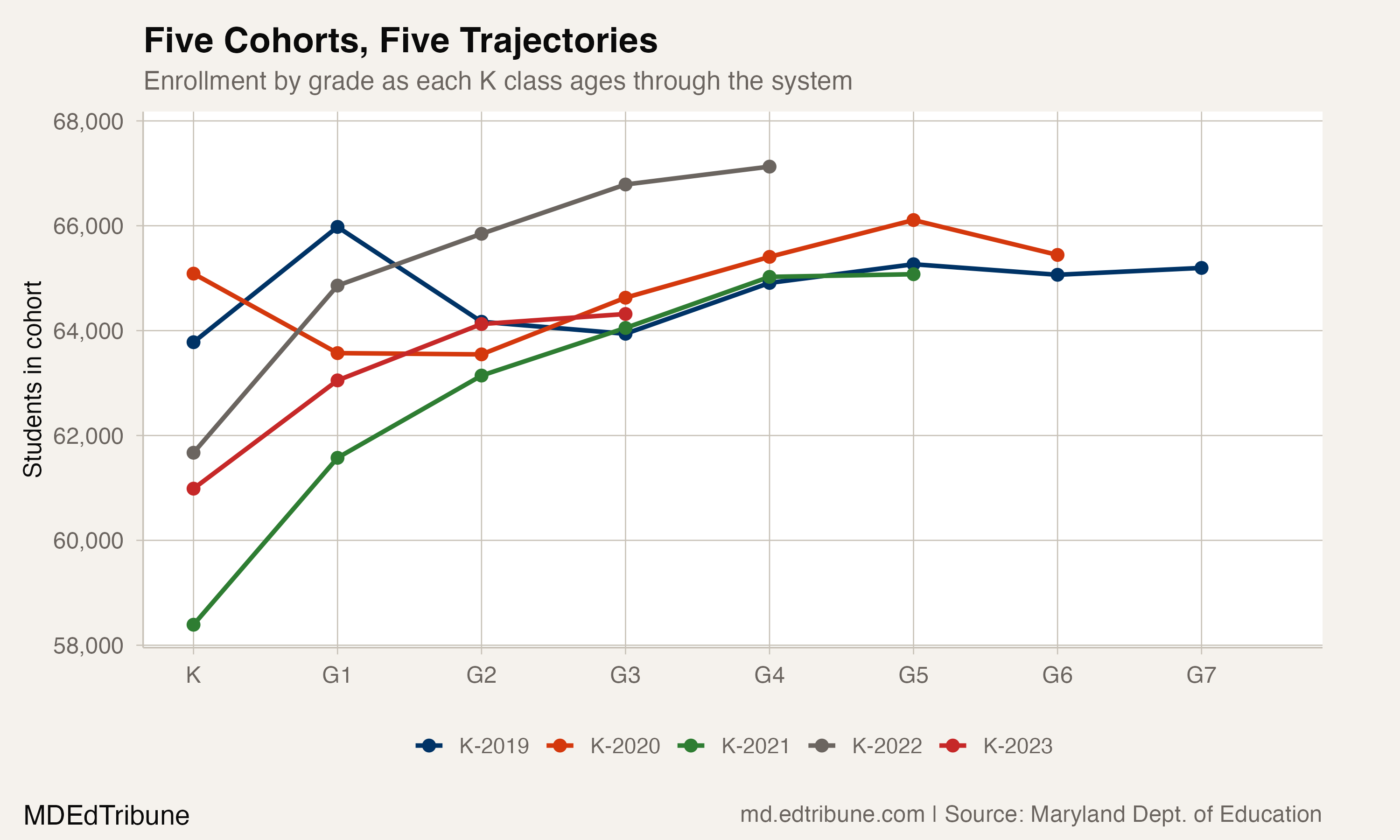
The K-2021 trough cohort's ability to grow as it ages is notable. It started at 58,391 and reached 65,076 by fifth grade, an increase of more than 6,600 students. Some of that growth reflects late school entry by students whose families held them out during the pandemic. Some reflects transfers into the public system. The data does not distinguish between the two.
The funding question
Maryland's Blueprint for Maryland's Future distributes funding on a weighted per-pupil basis. When a grade shrinks, the funding tied to those students shrinks with it. A 2,470-student decline in a single grade, at a statewide average above $17,000 per pupil, represents tens of millions in reduced per-pupil funding. Districts do not lose that money all at once, and some costs (building maintenance, administration) do not scale down with enrollment. The result is a structural mismatch between revenue that follows students and costs that follow buildings.
"One of the choices could be combining classes to make classes that are overly large or having classes that are smaller than we would normally prefer." — Montgomery County Executive Marc Elrich, WJLA, October 2025
Maryland superintendents have asked the governor to "hold harmless" school funding for 2026-27, recognizing that the enrollment decline is accelerating. The state's 1.1% enrollment decline in 2025-26 was the largest since the pandemic's initial shock.
What comes next
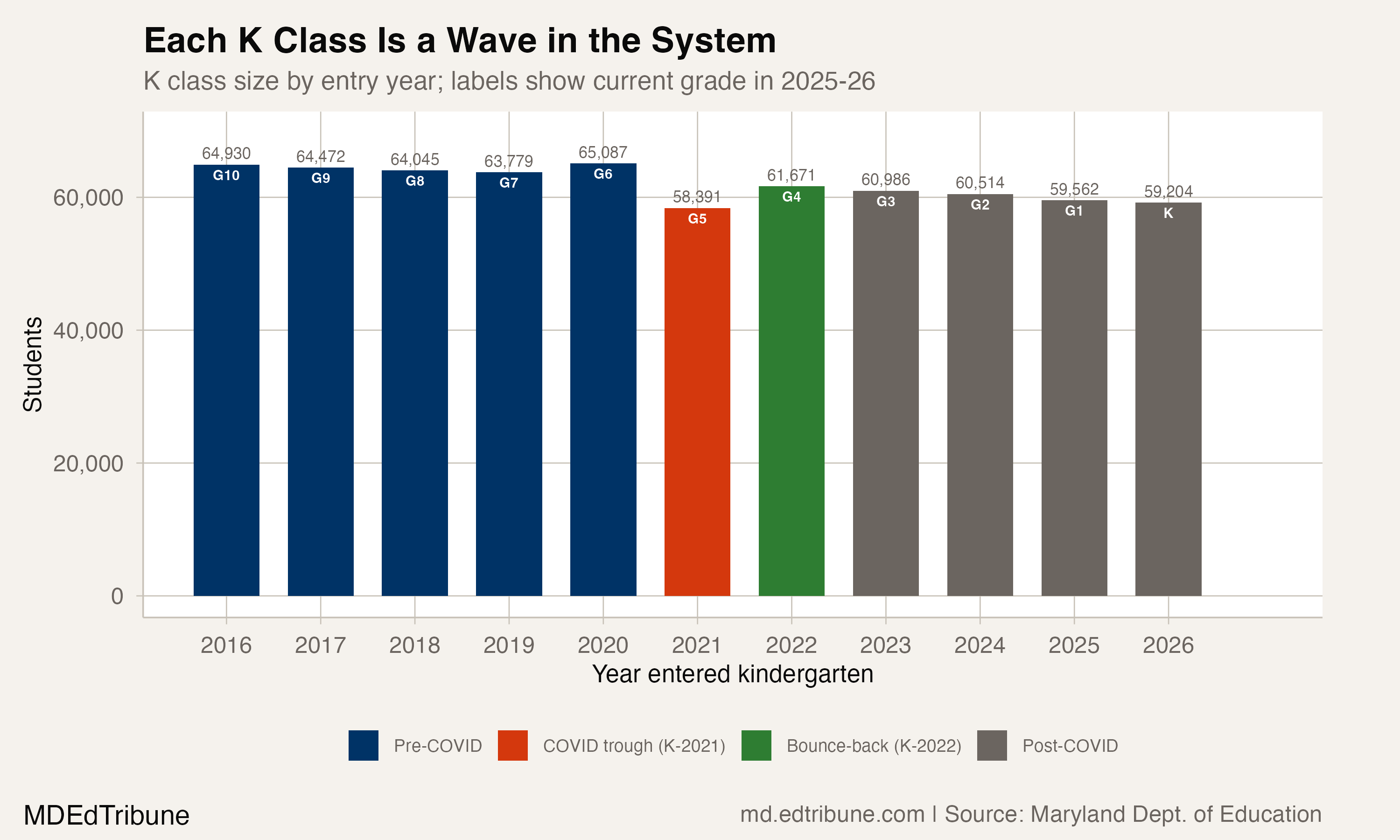
The COVID trough cohort (K-2021, now in fifth grade) will enter middle school in 2027-28. When it does, sixth grade will absorb a noticeably smaller class. But the bounce-back class (K-2022) will follow one year later, partly cushioning the blow. The problem is that every K class since the bounce-back has been smaller than the one before it: 60,986 in 2023, 60,514 in 2024, 59,562 in 2025, 59,204 in 2026.
Maryland is not experiencing a single disruption that will wash through the system and leave normalcy behind. The pandemic created a sharp one-year dip, but it landed on top of a decade-long decline in births. Even after the COVID trough passes through high school and graduates, the classes entering behind it will be smaller than anything the pre-pandemic system was built to serve.
The question for Maryland's 24 school districts is not when the wave passes. It is whether they can right-size operations for a system that, kindergarten class by kindergarten class, is becoming permanently smaller.
Detailed code that reproduces the analysis and figures in this article is available exclusively to EdTribune subscribers.
Discussion
Sign in to join the discussion.
Loading comments...