In this series: Maryland 2025-26 Enrollment.
This is part of The MDEdTribune's series on Maryland's 2025-26 enrollment data.
High school was supposed to be the good news. While elementary and middle schools hemorrhaged students after the pandemic, the secondary grades kept climbing, absorbing larger cohorts that had entered kindergarten before the state's birth rate fell. That buffer is gone.
Maryland's high school enrollment dropped by 4,096 students in 2025-26, landing at 273,893 and ending nine consecutive years of growth — the longest sustained streak in the dataset. It is the first time since at least 2016 that both K-8 and high school enrollment declined simultaneously. Together, the two levels produced Maryland's steepest non-pandemic enrollment decline.
Nine years of growth, erased in the math
Maryland's high schools added 25,094 students between 2016 and 2025, a 9.9% increase driven by large cohorts born in the late 2000s working their way through the grade pipeline. Even during the pandemic year of 2020-21, when K-8 enrollment cratered by nearly 20,000 students, high school enrollment still rose by 1,644.
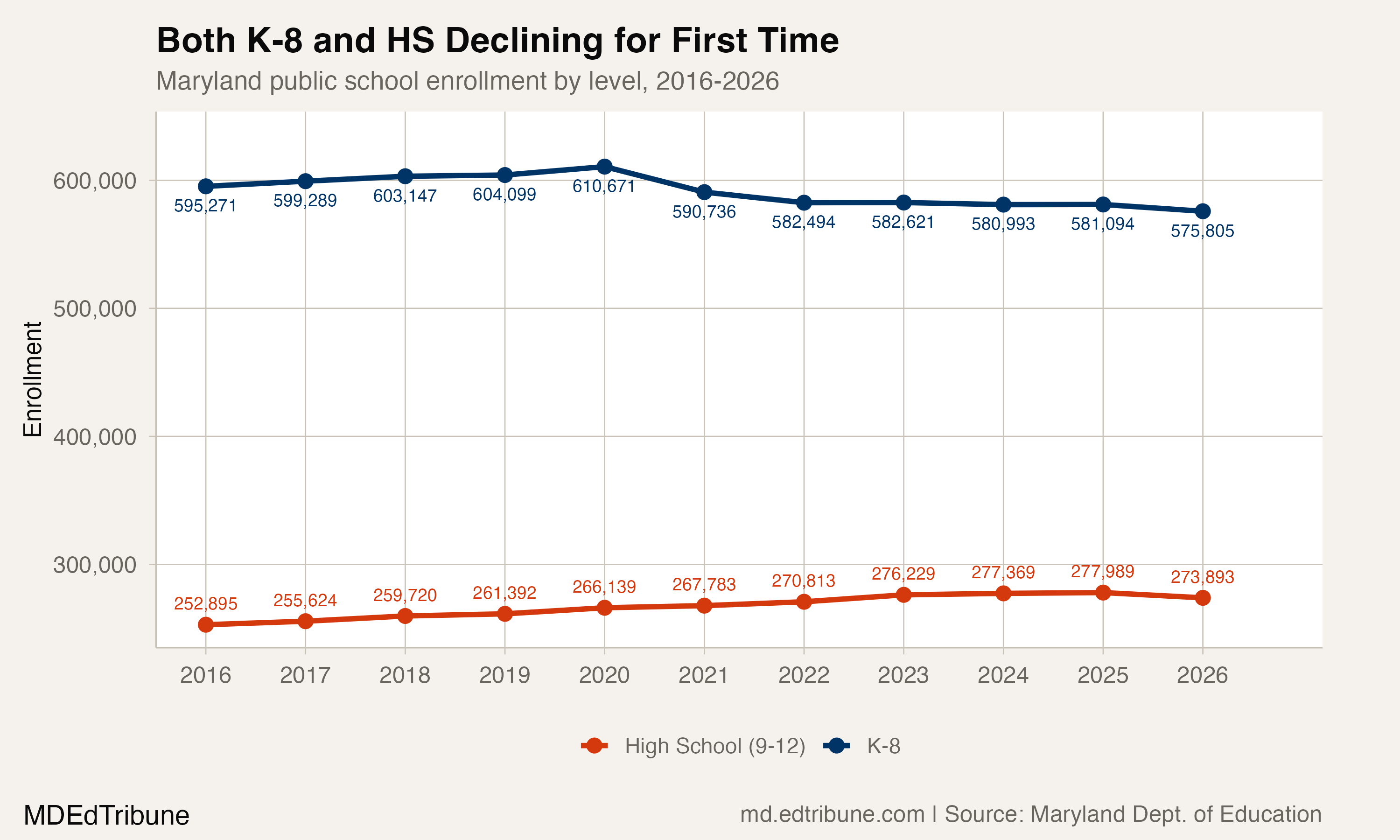
That pattern made high schools the system's shock absorber. From 2021 through 2025, K-8 enrollment was essentially flat or falling while high school enrollment climbed by 10,206. The high school share of total K-12 enrollment rose from 29.8% in 2016 to a peak of 32.4% in 2025.
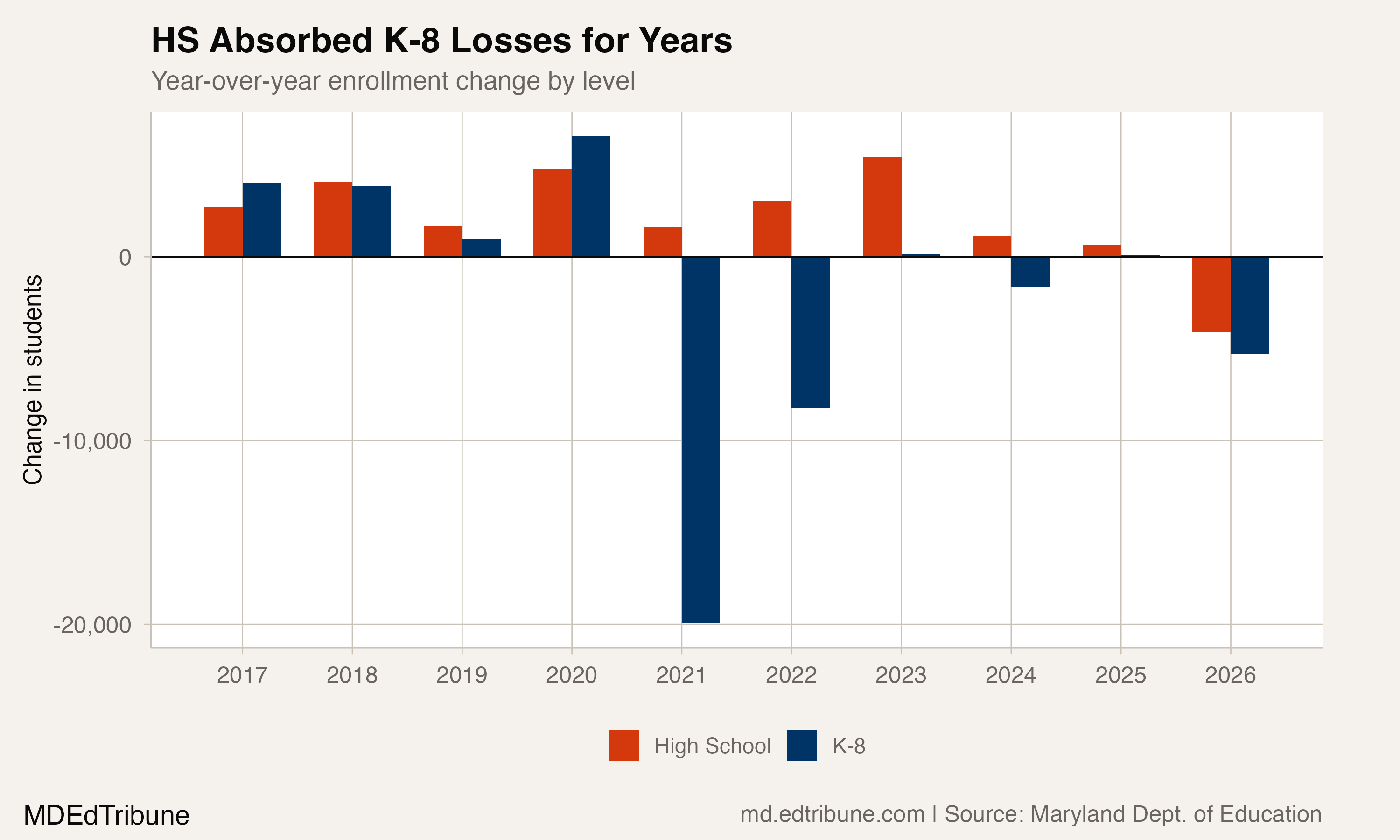
In 2026, both bars turned negative for the first time. K-8 lost 5,289 students. High school lost 4,096. The combined loss of 9,385 is the largest single-year decline outside the pandemic year itself.
The 9th-grade bulge is gone
The mechanics are visible in a single grade. Ninth-grade enrollment peaked at 83,081 in 2021-22, when the large pre-recession birth cohorts of 2007-08 reached high school. Since then, each entering freshman class has been smaller: 82,145 in 2023, 79,658 in 2024, 77,465 in 2025, and 75,813 in 2026.
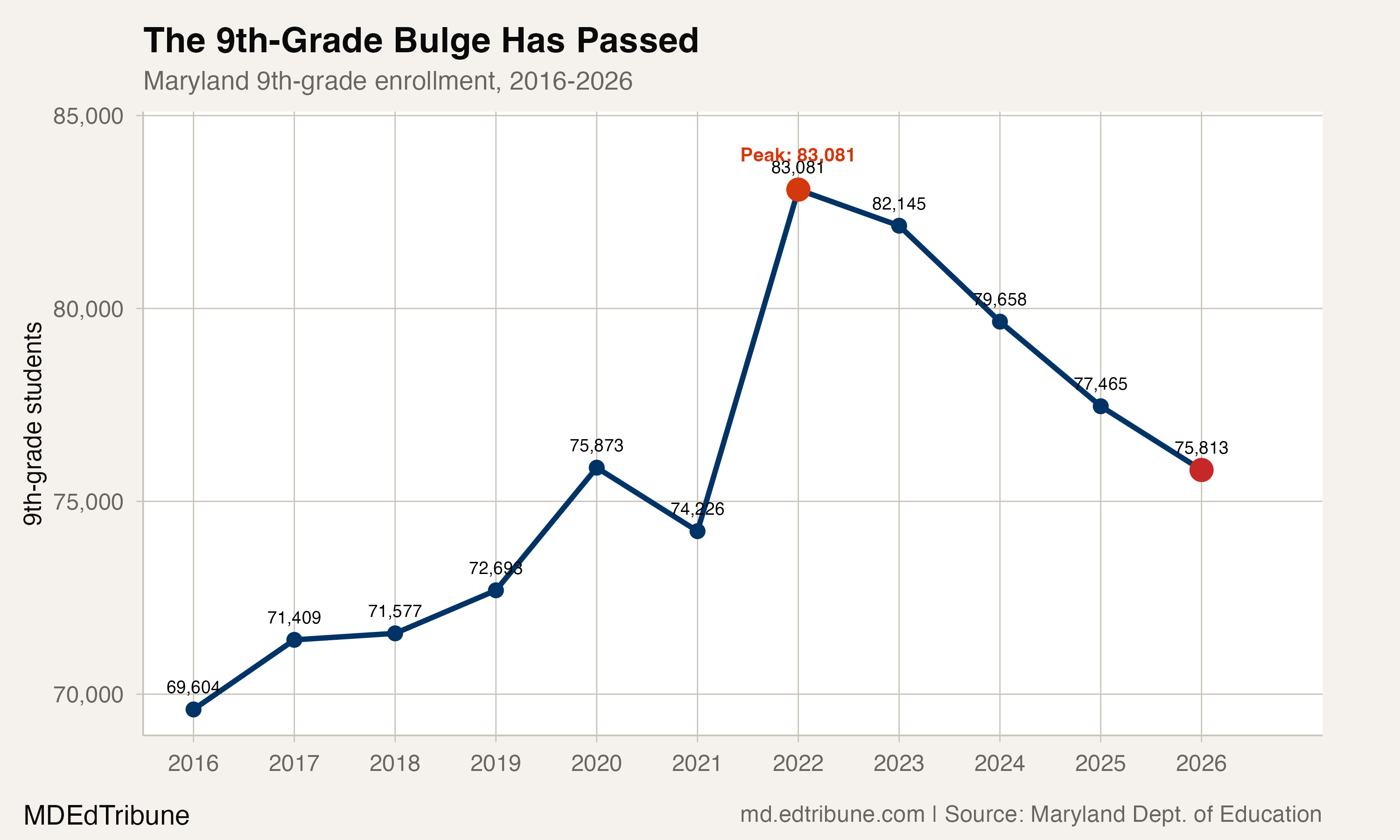
The decline from peak to present is 7,268 students, an 8.7% drop in four years. The 2026 freshman class is now smaller than the 2020 class that entered during the pandemic. This is not a COVID anomaly. It is the pipeline catching up: the kindergarten class of 2017 (64,472 students) was smaller than the kindergarten class of 2016 (64,930), which was smaller still than the pre-2016 cohorts that fed the 9th-grade surge.
Grades 10 and 11 also declined, by 1,831 (-2.6%) and 1,160 (-1.8%) respectively. Only grade 12 grew, adding 547 students (0.9%), as the last of the large cohorts graduated.
Nobody was spared
Twenty of Maryland's 24 school districts lost high school students in 2025-26. Montgomery County↗ET Public Schools led the losses at 1,133 students (-2.2%), followed by Baltimore County↗ET Public Schools at 999 (-2.9%) and Prince George's County↗ET Public Schools at 622 (-1.5%).
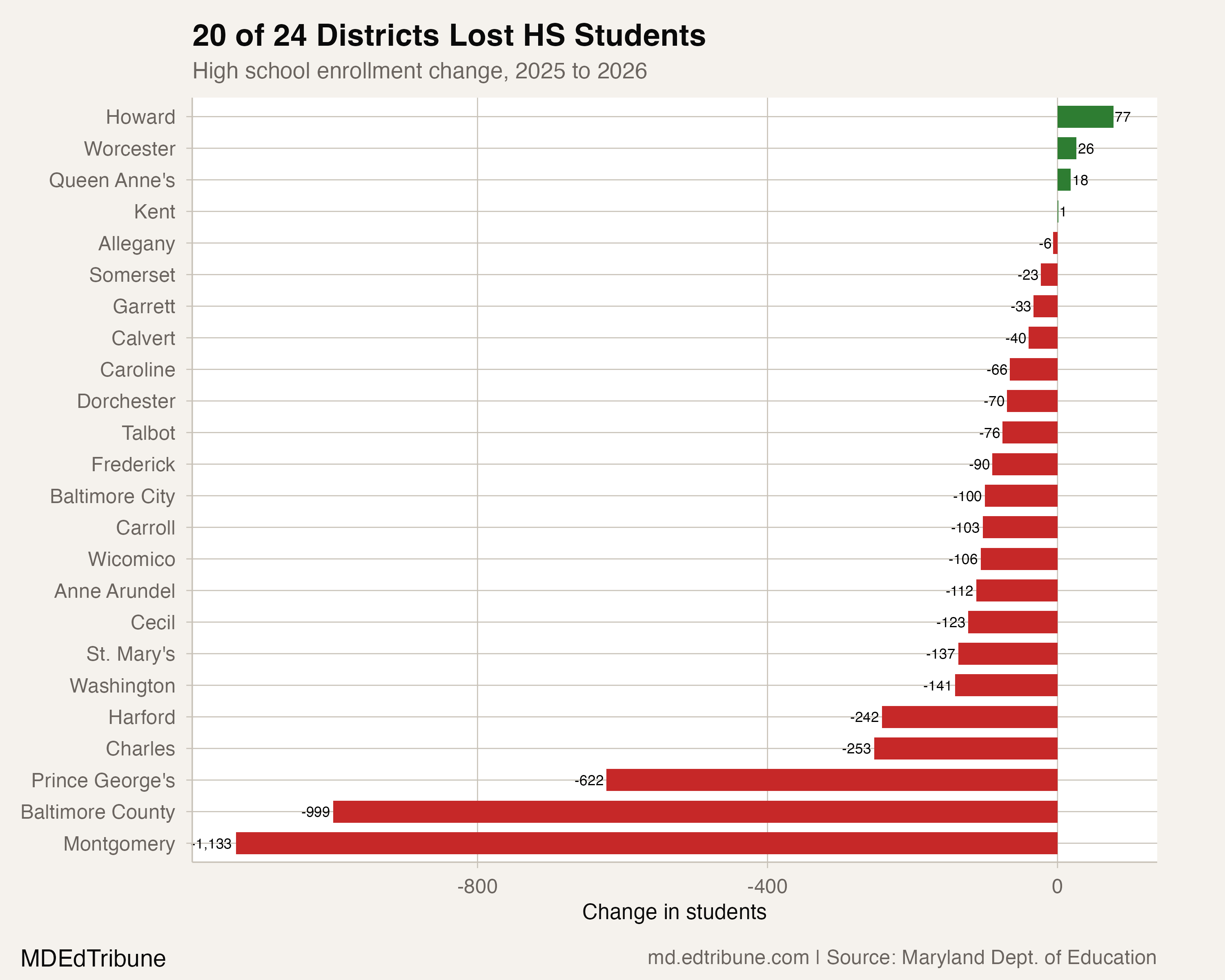
Only four districts gained high school students, all modestly: Howard County↗ET added 77, Worcester 26, Queen Anne's 18, and Kent 1. The breadth of the decline, spanning suburban, urban, and rural systems alike, points to a demographic cause rather than a district-specific one.
Birth rates and the pipeline that could not last
The most direct explanation is straightforward arithmetic. Maryland births peaked above 77,000 per year in the late 2000s and have since declined to roughly 70,000, according to Baltimore Banner reporting. Those larger birth cohorts sustained high school growth for years as they moved through the pipeline. By 2025-26, the pipeline has emptied: the students now entering 9th grade were born around 2011-12, when births were already falling.
Montgomery County Superintendent Thomas Taylor attributed his district's losses in part to "a sustained reduction in resident births in the county, which translates directly to smaller incoming kindergarten classes," according to the Baltimore Banner. That kindergarten effect is now, years later, a high school effect.
A second factor compounds the decline. Federal immigration enforcement has slowed the flow of newcomer students into Maryland schools. Montgomery County enrolled just 111 students new to the country by October 2025, compared to over 400 in the same period a year earlier. While the immigration effect is most visible in elementary schools, it removes students who would eventually have reached high school. The state does not track enrollment by immigration status, making the exact contribution impossible to isolate.
Funding in a system without a floor
The timing collides with Maryland's Blueprint for Maryland's Future, the landmark education reform law that distributes funding on a per-pupil basis. Every lost student reduces the revenue flowing to a district. When only elementary schools were shrinking, high school growth partially offset the fiscal damage. That offset no longer exists.
The state is already bracing for a $1.4 billion budget shortfall. Districts that planned staffing and facility usage around continued high school growth now face a structural mismatch: high schools sized for 278,000 students serving 274,000, with the gap likely to widen.
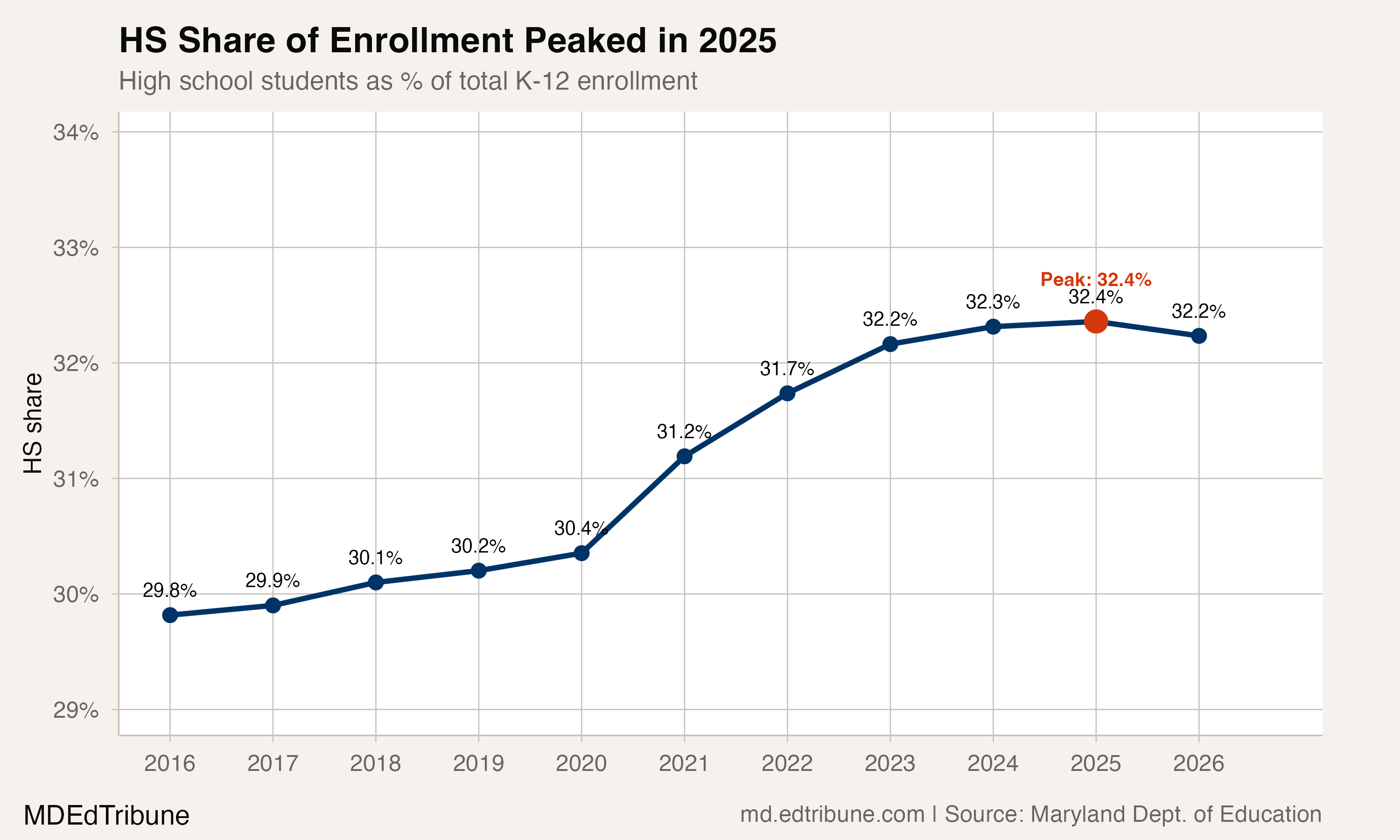
The share chart tells the story differently. High school's portion of total enrollment rose steadily from 29.8% in 2016 to 32.4% in 2025 as K-8 shrank and HS grew. In 2026, that share ticked down to 32.2%. The reversal is small but it signals the end of the compositional shift that districts used to justify high school investments.
The Maryland Department of Planning had anticipated high school declines beginning in 2026-27. The actual decline arrived a year early, which caught state forecasters off guard.
The question ahead
The kindergarten classes entering Maryland schools in 2025-26 average around 59,000 students, compared to the 65,000-student classes that fed the high school boom. Those smaller cohorts will take nine years to fully work through the system. High school enrollment has not bottomed out. It has only just begun to decline.
The question for Maryland's school systems is whether the remaining large cohorts, currently in middle school, will provide one more year of relative stability before the pipeline narrows further, or whether the immigration slowdown and continued homeschooling growth will accelerate the decline beyond what demographics alone would predict. The COVID-era kindergarten class of 2021, just 58,391 students, will reach 9th grade in 2030. That cohort will set the floor.
Detailed code that reproduces the analysis and figures in this article is available exclusively to EdTribune subscribers.
Discussion
Sign in to join the discussion.
Loading comments...