This is part of The MDEdTribune's series on Maryland's chronic absenteeism data.
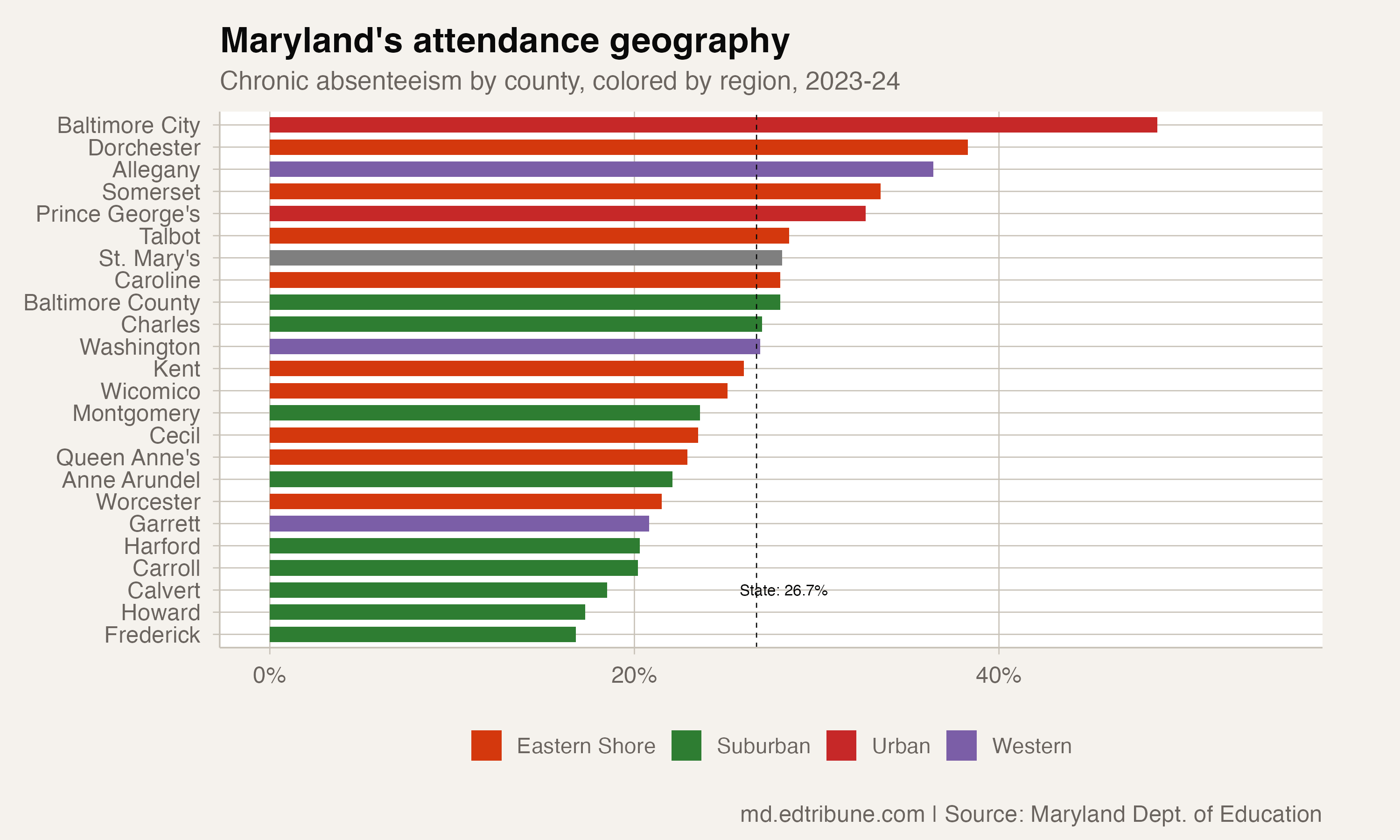
Drive west from Baltimore on Interstate 70 for about an hour and you reach Frederick↗ET County, where 16.8% of students are chronically absent. Turn around and drive an hour east past Baltimore to Dorchester County on the Eastern Shore, where the rate is 38.3%. Stay in Baltimore itself and the rate is 48.7%.
Maryland is a small state, 250 miles tip to tip, and yet its chronic absenteeism rates range across 31.9 percentage points. That span, from Frederick's 16.8% to Baltimore City↗ET's 48.7%, is wider than many states' entire distribution of rates.
Four Marylands
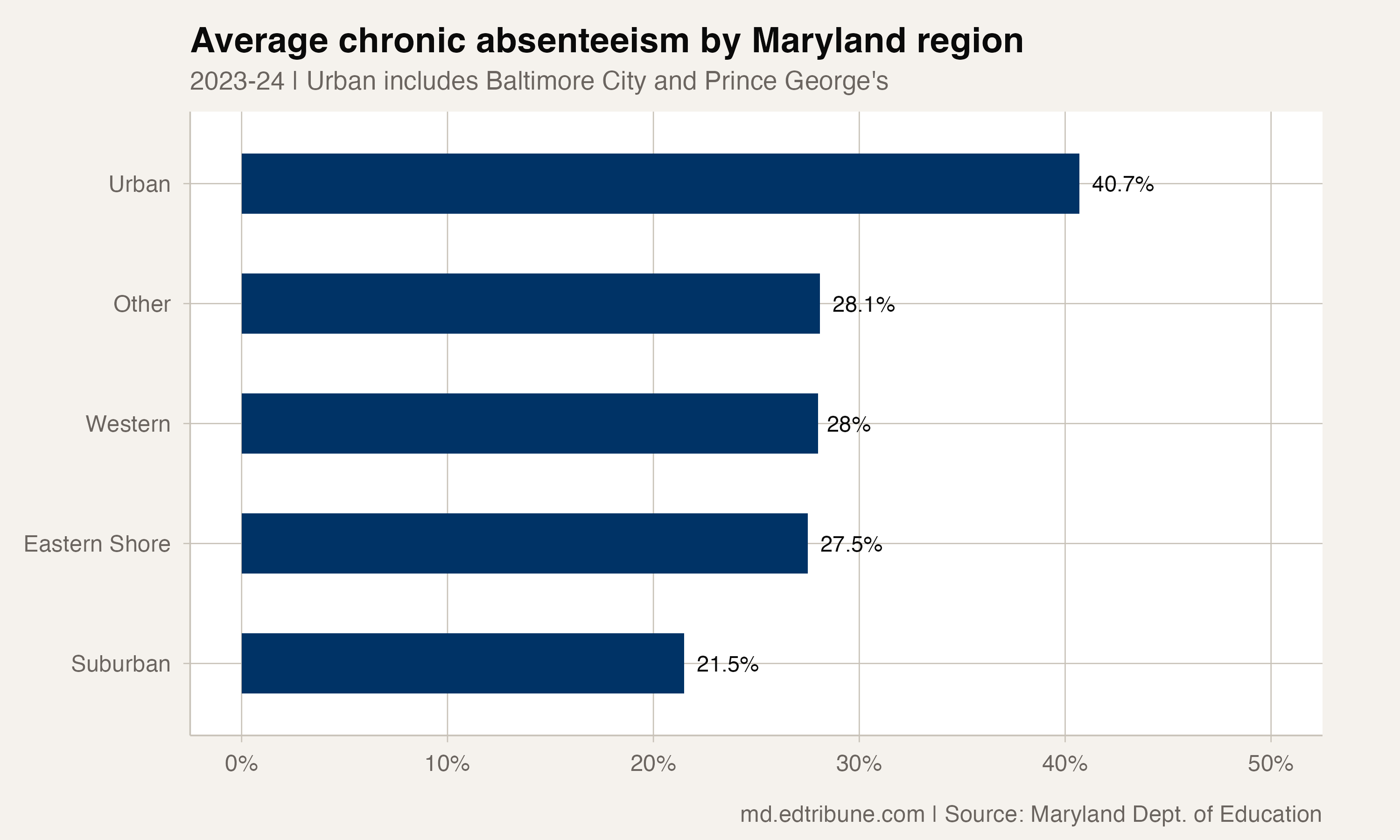
The 24 counties sort themselves into recognizable clusters. The nine suburban counties that ring Baltimore and Washington average 21.5%. The nine Eastern Shore counties average 27.5%. The three Western Maryland counties average 28.0%. The two urban systems, Baltimore City and Prince George's↗ET, average 40.7%.
The suburban band is wide: nine counties spread from 16.8% (Frederick↗ET) to 28.0% (Baltimore County↗ET). The Eastern Shore is wider still. Its counties range from 21.5% (Worcester↗ET) to 38.3% (Dorchester↗ET), a 16.8-point spread within a single region. St. Mary's County, in Southern Maryland, sits at 28.1%, above the state average despite its small-town character.
The state average of 26.7% is a number that describes almost nowhere. Only eight counties are within three points of it in either direction. Maryland does not have a single statewide chronic absenteeism rate so much as it has several regional rates that happen to average to 26.7%.
The five above 30%
Five Maryland counties have chronic absenteeism rates above 30%. They look nothing alike on a map, and the common thread runs through their economics rather than their geography.
Baltimore City (48.7%) is the state's only large urban school system. Dorchester County (38.3%) is a rural Eastern Shore community of roughly 4,400 students. Allegany↗ET County (36.4%) is in the mountains of Western Maryland, 180 miles from Baltimore. Somerset↗ET County (33.5%) sits on the lower Eastern Shore in one of the state's lowest-income regions. Prince George's County (32.7%) is the state's second-largest district, a suburban system whose attendance numbers track with the urban ones.
What connects these five is not geography or size. Four of them have among the highest child poverty rates in Maryland, and all five include census tracts that the federal government classifies as persistent poverty areas. Dorchester, Allegany, and Somerset are among only seven Maryland counties carrying that designation. The pattern points at the conditions families navigate (transportation, health appointments, stable housing) far more than at anything happening inside the classrooms.
The three below 20%
At the other end: Frederick (16.8%), Howard↗ET (17.3%), and Calvert↗ET (18.5%). Frederick and Howard are affluent I-270 corridor suburbs with median household incomes above $100,000. Both invest heavily in school-based mental health services. Howard has the highest percentage of five-star-rated schools in the Baltimore region.
Calvert is less expected. A semi-rural Southern Maryland county, it is geographically closer to the high-absence Eastern Shore than to the Washington suburbs. Its 18.5% rate suggests that low chronic absenteeism is not exclusively a function of wealth or proximity to a major employment center, though Calvert's median income is itself well above the state median.
Even Maryland's three leaders have room to climb. The state target is 15%. Frederick, the best performer in the state, is still 1.8 percentage points above it. No Maryland county has yet reached the goal the state set for itself.
What geography cannot explain
The regional averages tell a tidy story: wealthier suburbs post lower rates, lower-income rural and urban systems post higher ones. The outliers complicate it. Garrett County, in the far western panhandle, holds its rate to 20.8% even though it is one of the state's most rural and least affluent counties. Worcester County on the Eastern Shore comes in at 21.5%. Prince George's County, a suburban system with a substantial commercial tax base and proximity to Washington's federal workforce, exceeds 32%.
Those exceptions matter. They show that while poverty and geography are powerful predictors, they are not destiny. Some lower-income counties are reaching students that the averages would not predict, and at least one well-resourced suburb is posting higher rates than its neighbors. The drivers of chronic absenteeism (transportation, health care access, housing stability, the day-to-day climate of a school) play out differently in each community. A statewide rate of 26.7% smooths over those local dynamics. A 31.9-point range makes them impossible to ignore, and it points other districts toward the places already finding answers.
Detailed code that reproduces the analysis and figures in this article is available exclusively to EdTribune subscribers.
Discussion
Sign in to join the discussion.
Loading comments...