This is part of The MDEdTribune's series on Maryland's chronic absenteeism data.
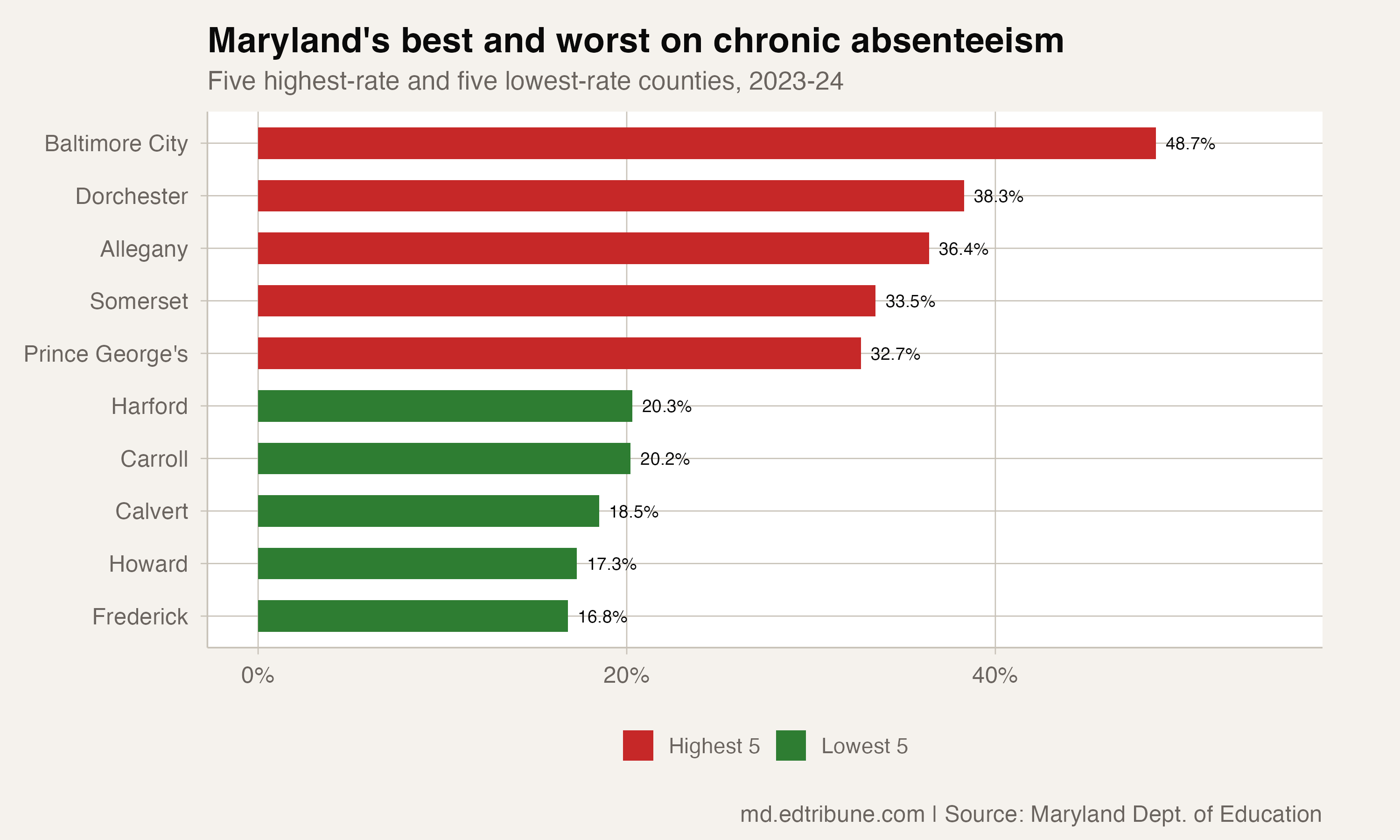
Frederick↗ET County's chronic absenteeism rate is 16.8%. Howard↗ET County's is 17.3%. These are the two lowest rates among Maryland's 24 school systems, and in a state where the average sits at 26.7% and Baltimore City approaches 50%, they look like success stories. Both counties are 9 to 10 percentage points below the state average. Both are affluent I-270 corridor communities with strong school systems and household incomes well above the state median.
They have also both failed to reach Maryland's stated target of 15%.
The ceiling that no one has hit
Maryland committed to reducing chronic absenteeism to 15% by 2025-26, part of a multi-state pledge to halve chronic absence within five years. Frederick County, the state's best performer, is 1.8 percentage points above that goal. Howard is 2.3 points above. Calvert↗ET, the third-lowest at 18.5%, is 3.5 points above.
No Maryland county has achieved 15%. The statewide target asks every community in the state to do something that none of them -- not even the wealthiest, best-resourced suburbs -- have managed on their own. This is either an appropriately ambitious goal or an unrealistic one. The distinction matters when the target date arrives and every single district has missed it.
What the leaders share
Frederick and Howard have the most obvious thing in common: money. Both are among Maryland's wealthiest counties. Frederick's median household income exceeds $100,000. Howard County consistently ranks among the highest-income counties in the nation.
But income alone does not explain a 16.8% rate. Montgomery County, the state's wealthiest large jurisdiction, has a rate of 23.6% -- nearly 7 points higher than Frederick. Baltimore County, another affluent suburban system, sits at 28.0%.
Frederick County received state youth mental health grants in 2025, part of a broader investment in school-based behavioral health services. Howard County has the highest percentage of five-star-rated schools in the Baltimore region, a designation tied to overall school quality metrics that include attendance.
What likely separates the leaders from their suburban peers is not a single program but a constellation of advantages: relatively compact geography, lower rates of deep poverty, strong community infrastructure, and school cultures that prioritize attendance without the compounding challenges of large-scale homelessness, limited transportation, or persistent poverty.
Calvert's quieter case
Calvert County's 18.5% rate deserves separate attention. Unlike Frederick and Howard, Calvert is not a Washington corridor suburb. It is a semi-rural Southern Maryland county of roughly 15,000 students, geographically closer to the high-absence Eastern Shore than to the affluent I-270 corridor. Its median income is above the state median but well below Frederick and Howard.
Calvert's rate is 8.2 percentage points below the state average. It ranks third among Maryland's 24 counties despite a geographic and economic profile that would predict a higher rate. Whatever Calvert is doing on attendance, it is working despite headwinds that its wealthier peers do not face.
The gap below
The distance between Frederick's 16.8% and Baltimore City's 48.7% -- a 31.9-point span across 60 miles of highway -- frames the challenge. Even if every county achieved what Frederick has achieved, Maryland's rate would be roughly 17%, still above the target. The state's chronic absenteeism problem is not simply that some counties are doing poorly. It is that the baseline, even in the best-performing communities, reflects a level of student absence that most educators consider too high.
One in six Frederick County students is chronically absent, missing at least 18 days of a 180-day school year. In Howard, it is one in 5.8. These are communities where schools function well, where most families have resources, where the infrastructure to get students to school exists. The fact that 17% of students in these communities still miss significant amounts of school suggests that chronic absenteeism has structural roots that extend beyond poverty and into the way American families and schools interact with each other.
Maryland's attendance leaders are doing better than almost everyone else in the state. By any reasonable standard, 16.8% and 17.3% are noteworthy achievements in the post-COVID landscape. The state's 15% target, which looked ambitious when it was set, now looks like it may have been set at a level that no one has figured out how to reach.
Detailed code that reproduces the analysis and figures in this article is available exclusively to EdTribune subscribers.
Discussion
Sign in to join the discussion.
Loading comments...