
Dr. Nicole Miller took over Garrett County Public Schools↗ET on July 1 after years inside the system she now runs. She had been the district's chief academic officer, and before that she led its elementary education office and served as principal of Southern Garrett High School and Grantsville Elementary School. The Garrett County Board of Education voted unanimously in February to give her a four-year contract, according to the district's announcement, and Maryland State Superintendent Dr. Carey Wright approved the appointment later that month. She succeeds Dr. Brenda McCartney, who announced plans to retire at the end of the 2025-26 school year.
Miller answered The MDEdTribune's questions in writing, through Mark Greene, the district's manager of communications and public relations. The answers refer to her in the third person, and they are quoted here as written.
Asked what work best prepared her for the job, she pointed first to the chief academic officer role. "Dr. Miller's previous role as Chief Academic Officer provided experience with system-wide academic planning, curriculum and instruction, student achievement, implementation of the Blueprint for Maryland's Future, and collaboration with school administrators, educators, families, and community partners," Miller said in written answers to The MDEdTribune. The earlier jobs, she added, gave her something a newcomer would have to build: "This experience also provided a broad understanding of the district's schools, programs, staffing needs, and student supports."
Her career did not start in Garrett County. The district's announcement of her appointment as chief academic officer, republished by the Deep Creek Times, says she began as a band and chorus teacher in Orange County Public Schools in Virginia and was an assistant principal at Buckingham County High School, also in Virginia, before her principalships in Garrett County. She holds a Bachelor of Music Education from Mansfield University, a master's degree in educational leadership from George Mason University, and an education specialist certification and a doctorate in educational leadership from Liberty University, according to the same announcement.
"Her familiarity with GCPS and the Garrett County community provides continuity as she has moved into the superintendent role," Miller said.
Listening first
Her first months have been built around hearing from people. "Since becoming Superintendent on July 1, Dr. Miller has made listening and engagement a priority, seeking input through school events, community gatherings, and conversations with students, families, staff, and community partners," Miller said. "These interactions are helping shape her early priorities, with a focus on student achievement, strong relationships, and ensuring GCPS remains responsive to the needs of students and families."
The same feedback, Miller said, will also help guide efforts to "retain and attract students." That goal connects directly to the district's enrollment record.
A smaller system, one year at a time
Garrett County enrolled 3,142 students in kindergarten through 12th grade in 2025-26, the most recent school year in the state's published data. That is 540 fewer than in 2015-16, a decline of 14.7 percent. Across the same 11 published years Maryland's enrollment grew 0.2 percent, and among the state's 24 school systems only Kent County↗ET lost a larger share of its students. Garrett's figures do not include the district's prekindergarten classes.
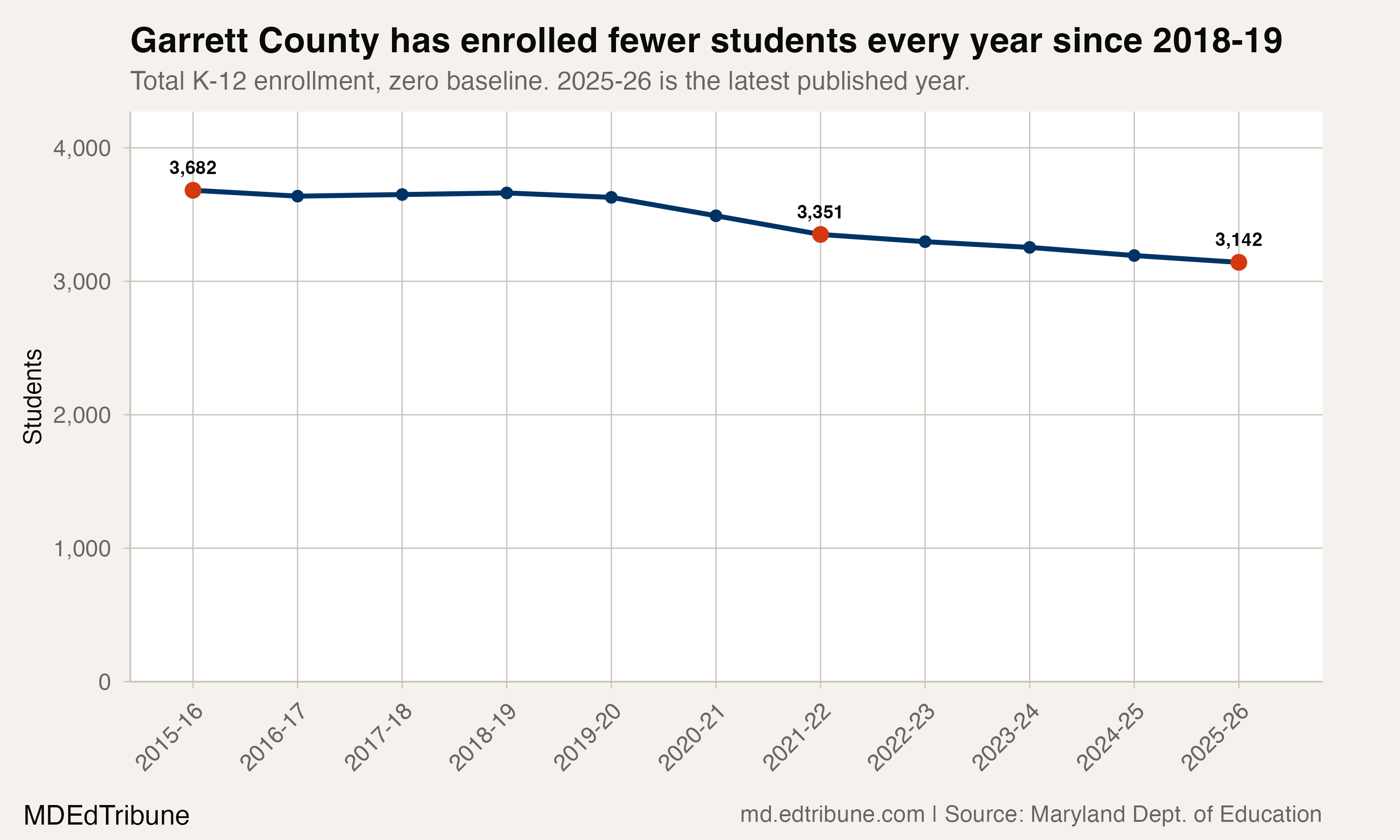
The district has now enrolled fewer students than the year before in seven consecutive years, the longest active streak in the state. No other Maryland system's current streak is longer than six. The pace has eased since the pandemic years. The two largest annual losses were 138 students in 2020-21 and 140 in 2021-22, and in each year since, the district has lost between 43 and 61 students. The 2025-26 loss was 51 students, or 1.6 percent, while Maryland as a whole lost 1.1 percent. Counts for the current 2026-27 school year will differ once the state publishes them.
The MDEdTribune looked at that run in MarchET, before Miller's appointment took effect.
Miller described the district looking at those numbers in finer detail than the total. "Declining enrollment is an important consideration in GCPS's long-term planning," Miller said. "Enrollment trends are reviewed by school and grade level to inform decisions related to staffing, programming, transportation, facilities, and student supports."
Where the losses show up
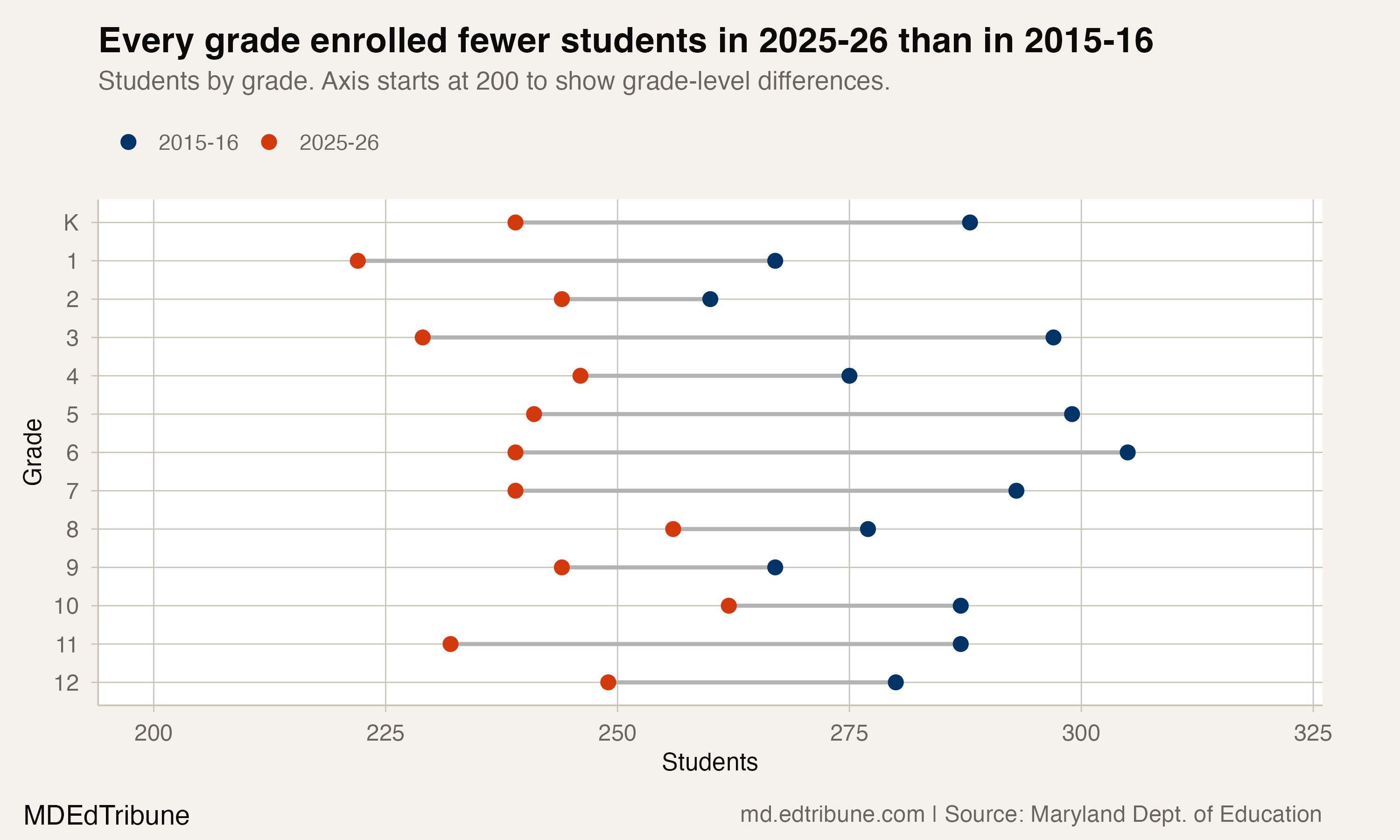
The state's grade-level counts show every grade is smaller than it was a decade ago. All 13 grades, kindergarten through 12th, enrolled fewer students in 2025-26 than in 2015-16.
The grade counts also allow each year's change to be split into two parts. One is the difference between the kindergarten class that arrives and the senior class that leaves. The other is how much the classes already enrolled grow or shrink as they move up a grade. That second part is a net figure. It combines students moving in and out of the county, families choosing private schools or home instruction, and students repeating a grade or leaving high school, and the state's counts cannot separate those.
From 2021-22, when the district enrolled 3,351 students, to 2025-26, enrollment fell by 209. Of that, 145 came from enrolled classes getting smaller as they moved up. The other 64 came from kindergarten classes smaller than the senior classes they replaced. In 2025-26 alone, the 239 kindergartners were only seven fewer than the 246 seniors who had finished the year before, while the classes moving up shrank by 44 students.
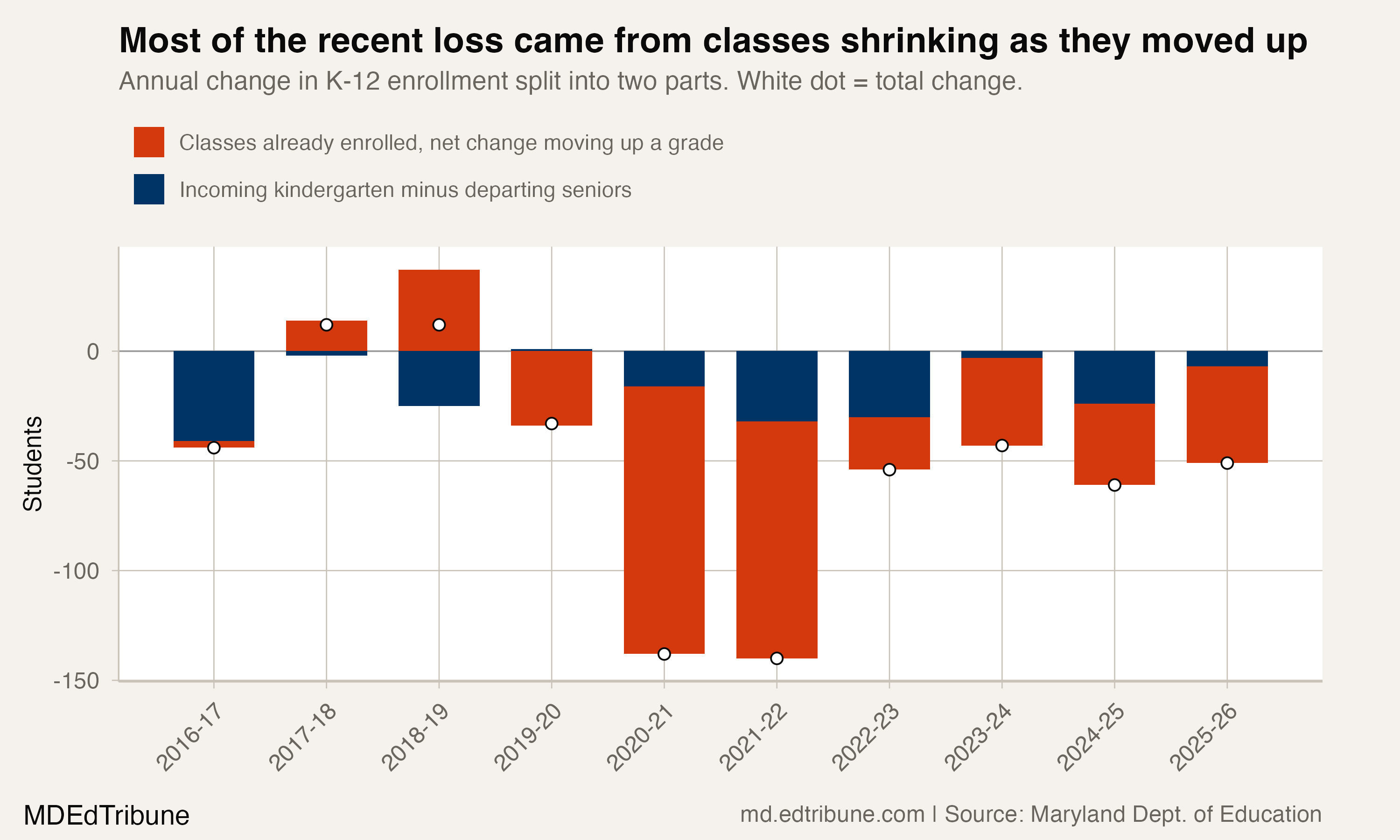
That split lines up with the priority Miller set out for the years ahead. "Moving forward, Dr. Miller and the school system will also place a strong focus on retaining current students and attracting new families to GCPS," Miller said. The size of a kindergarten class depends heavily on births and on which families move to the county. The change among enrolled classes is shaped by forces outside the district too, but it is where keeping students would show up. The first year of Miller's tenure is 2026-27, and when the state publishes those counts, the change among classes moving up a grade will be one of the first places to look.
Enrollment counts come from the Maryland Department of Planning's published enrollment files and the Maryland State Department of Education's Staff and Student Publications, including its 2025-26 enrollment publication, covering 2015-16 through 2025-26. Quotations are from Dr. Nicole Miller's written answers to The MDEdTribune, provided by Garrett County Public Schools. The district supplied the headshot used with this profile.
Detailed code that reproduces the analysis and figures in this article is available exclusively to EdTribune subscribers.
Discussion
Sign in to join the discussion.
Loading comments...