Clarification, September 24, 2026: This profile originally gave 104,031 students as Baltimore County's 2025-26 enrollment total without saying what the figure counted. It covers kindergarten through grade 12. The Maryland State Department of Education's headline count for the district, 107,983 students, also includes 3,952 prekindergarten students. The article now states the definition and gives both figures. No K-12 number has changed.

William Heiser returned to Baltimore County Public Schools↗ET on July 1 with a question for every decision: “What is best for students?” He posed it in his first written message as superintendent, setting a student-centered test for a district whose operating landscape has shifted.
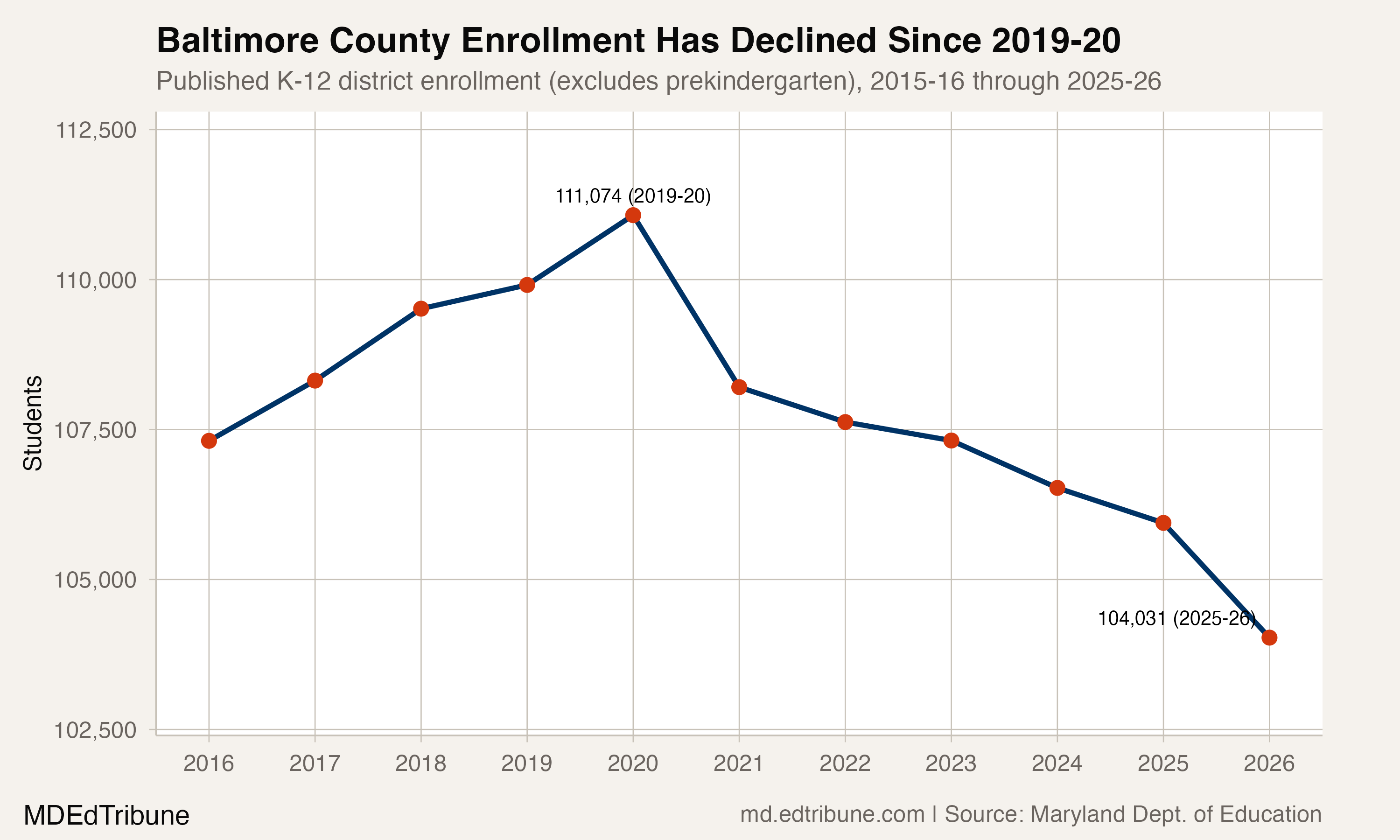
Baltimore County enrolled 104,031 students in kindergarten through high school (K-12) in 2025-26, the prior school year and the most recent in the state's published data, not a current 2026-27 count. Adding 3,952 prekindergarten students brings the district to 107,983, the all-grades figure the Maryland State Department of Education reports on the Maryland Report Card. This profile follows the K-12 count because it is available on the same basis for every year back to 2015-16. On that basis, 2025-26 is the lowest total in the records available for this analysis, and enrollment fell in six consecutive annual transitions from a 2019-20 peak of 111,074, a decline of 7,043 students, or 6.3%.
The Board of Education appointed Heiser to succeed Myriam Rogers. The district’s communications office confirmed the appointment and supplied official source material and the photograph used with this profile. Heiser arrived from Anne Arundel County Public Schools, where he was chief operating officer, but the move is also a return. He previously led Catonsville High School in Baltimore County.
A return with an operating brief
Heiser’s official biography traces a career through the schoolhouse and central office. He led North County High School in Anne Arundel County and Cristo Rey Jesuit High School in Baltimore City. Earlier roles included assistant principal, school counselor and higher education administrator.
That path puts academic leadership and system operations in the same frame. In his opening message, Heiser named academic excellence, operational readiness and financial sustainability, talent, and community engagement as priorities. An official district summary of his first media availability described school visits, a review of operational and financial systems, attention to staffing capacity, and a listening-and-learning tour.
The K-12 enrollment record gives that agenda a concrete baseline. The latest one-year change was a loss of 1,913 students, or 1.8%, the district’s largest annual decrease since 2020-21. Among Maryland’s 24 county and city school systems, Baltimore County had the sixth-steepest percentage decline from 2019-20 to 2025-26 and the second-largest decline by student count.
The comparison matters because percentage and scale tell different stories. Several smaller systems lost a greater share of their enrollment, while Baltimore County’s size made its absolute change one of the state’s largest. The data establish the scope of the planning context. They do not establish why enrollment changed.
Six different annual steps
The district’s decline did not arrive as one isolated drop. Enrollment fell in every annual transition after the 2019-20 peak. The initial decrease was the largest of the sequence, followed by smaller losses before the latest decline widened again.
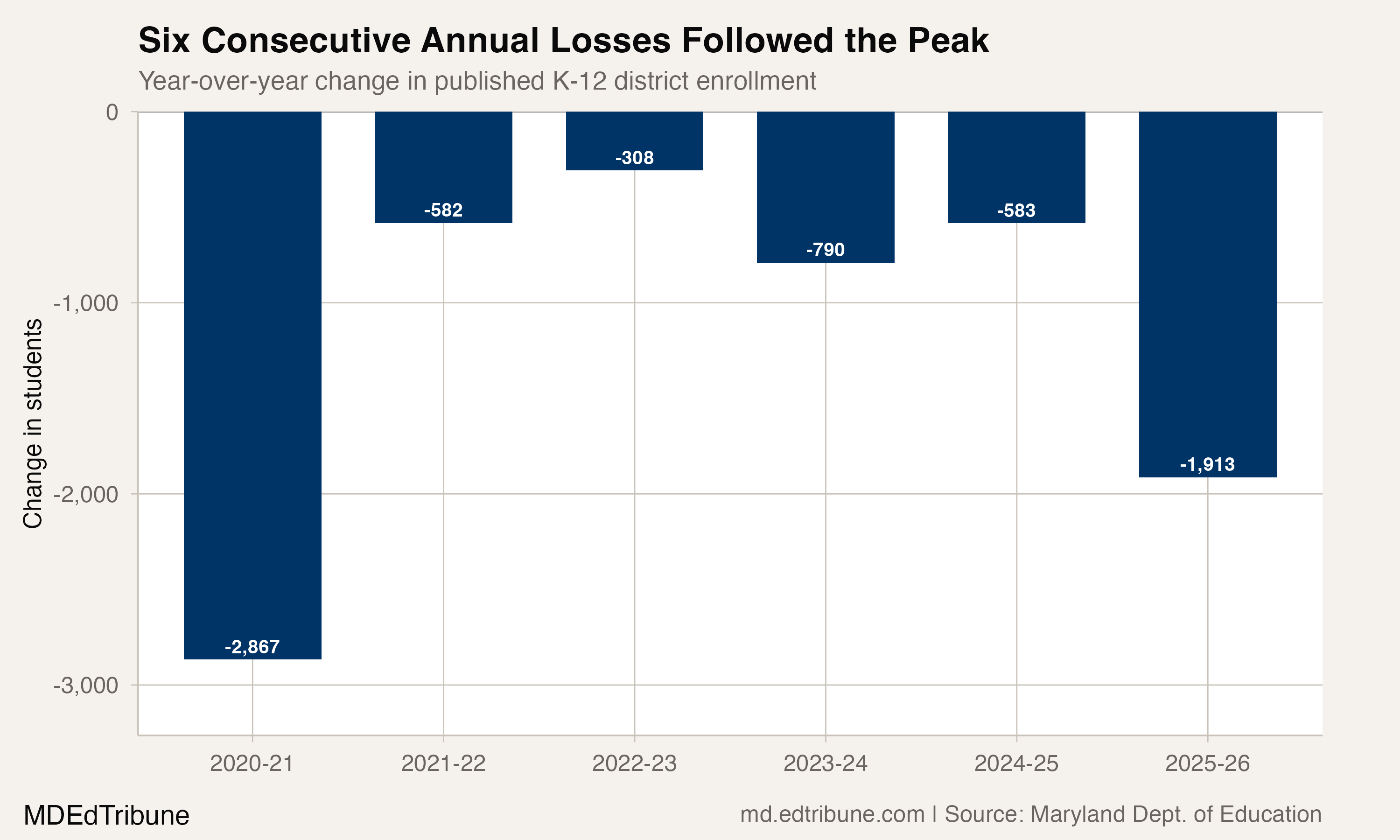
That pattern makes timing important. A single-year response would miss the persistence of the change, while a straight line would hide the different size of each annual move. Heiser’s emphasis on reviewing systems and setting performance measures arrives as the district has both a long-running direction and a sharper latest-year result to examine.
The enrollment series does not show whether births, migration, nonpublic-school choices, program changes or another factor produced the decline. Those are competing explanations that require evidence beyond student counts. The fair conclusion is narrower: the system Heiser now leads is serving fewer students than it did at its recent peak, and the path has not been uniform across grades.
Different grades, different planning questions
Elementary and middle grades account for the decline from 2019-20 to 2025-26. Enrollment in kindergarten through grade five fell from 52,183 to 47,498, a loss of 4,685 students, or 9.0%. Grades six through eight fell from 25,885 to 23,222, a loss of 2,663 students, or 10.3%.
High school moved differently. Enrollment increased from 33,006 to 33,311 over the same span, a gain of 305 students, or 0.9%.
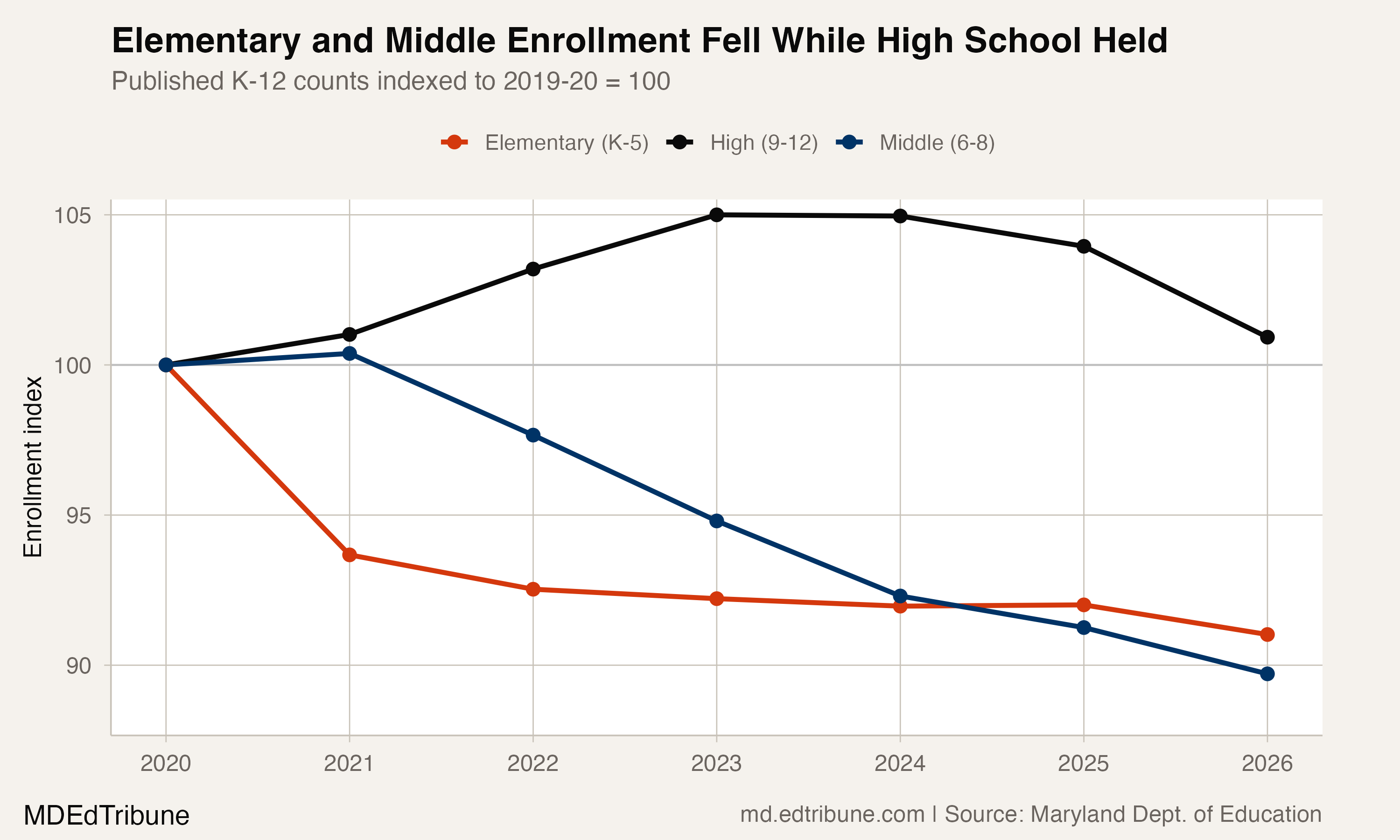
The divergence is a planning signal, not a forecast. It gives the new administration different questions to test across grade bands rather than one districtwide assumption. School-level staffing, space and student-support choices require more local evidence than this countywide series provides.
Listening before choosing
Heiser has publicly paired his operating review with community engagement. His opening materials call for listening to staff, students and families, then using what the district learns to shape its direction. That sequence fits the evidence: the enrollment data identify where the landscape has changed, while communities and school-level records can help explain what the countywide totals cannot.
The assignment ahead is therefore specific. Baltimore County enters Heiser’s tenure at an available-record K-12 enrollment low, with six consecutive annual declines and grade bands moving on different paths. His first decisions will show how a leader with experience in both schools and operations turns that evidence, and the community’s account of it, into priorities for the system.
Enrollment counts are K-12 counts and come from the Maryland Department of Planning’s public school enrollment tables and the Maryland State Department of Education’s 2025-26 enrollment publication, which also reports the prekindergarten count. The Maryland Report Card headline enrollment includes prekindergarten.
Detailed code that reproduces the analysis and figures in this article is available exclusively to EdTribune subscribers.
Discussion
Sign in to join the discussion.
Loading comments...